
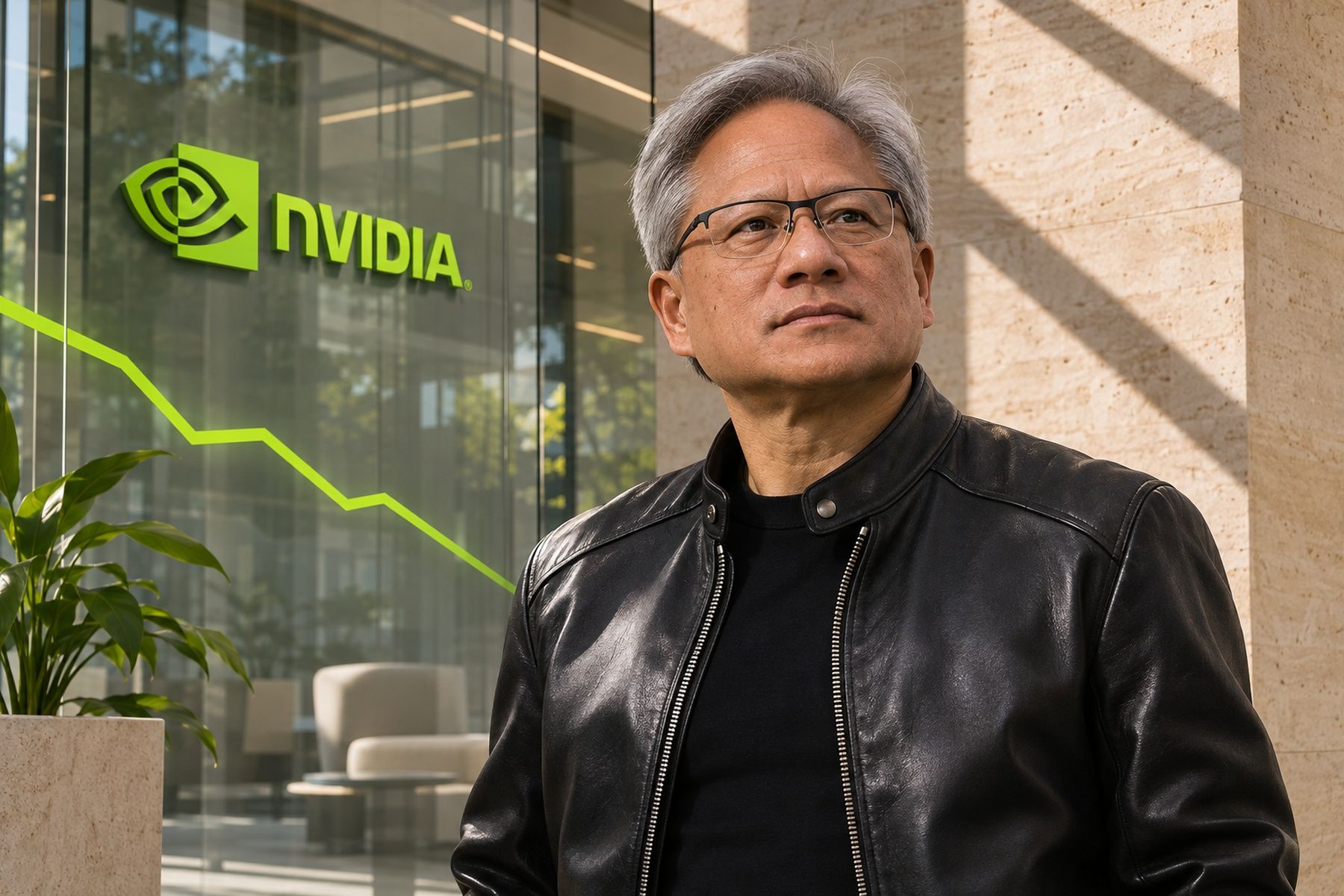
Nvidia shed approximately $430 billion in market value across two trading sessions as Jensen Huang’s admission of an extramarital affair collided with allegations that he had been targeted by Chinese intelligence.
The company’s shares closed Tuesday at $168.89, down roughly 9.5% from Friday’s close. Nvidia’s board has opened an independent investigation, turning questions about its founder’s personal conduct into questions about leadership, security and corporate oversight.
For investors, the concern extends beyond embarrassment. Huang runs a company whose chips are central to the global AI buildout—and whose access to China is already a sensitive political issue.
How much value disappeared?
| Trading session | Closing share price | Daily decline | Estimated market value lost |
|---|---|---|---|
| November 9 | $178.67 | 4.27% | $192 billion |
| November 10 | $168.89 | 5.47% | $236 billion |
| Combined | — | 9.51% | $428 billion |
Blockster estimates use closing prices and Nvidia’s reported 24.1 billion shares outstanding as of August 21. The combined loss rounds to approximately $430 billion; subsequent changes in share count affect the exact figure.
The larger decline is even more striking: approximately $1.7 trillion since Nvidia’s October 6 closing high. But that covers a longer selloff, including declines before Huang’s admission. Attributing the entire amount to the affair would misrepresent what happened. Shares were also trading higher in Wednesday’s premarket session; the figures above measure losses through Tuesday’s close.
Post from @ReutersView the original post on X↗
Why this looks so bad for Huang
His credibility is now part of the investment question. Before acknowledging infidelity, Huang had characterized his interactions with the businesswoman at the center of the reporting as ordinary business dealings. The shift raises questions about what Nvidia’s board knew and whether earlier explanations gave investors an accurate picture. The New York Times reported that the woman, former Megaspeed executive Alice Huang, had been identified by U.S. intelligence officials as working for Beijing.
The alleged relationship also intersects with company business. Reuters, citing The Information, reported that Alice Huang’s connections helped facilitate at least $7.5 billion in Nvidia chip shipments to Chinese firms. Reuters said it could not independently verify the reports. That remains an allegation, but it explains why the scrutiny reaches beyond Huang’s private life.
The central governance question is whether personal access affected commercial decisions, exposed sensitive information or created a vulnerability to pressure. An affair alone does not prove any of those things. It does, however, give directors and shareholders a reason to demand clear answers.
What the alleged Chinese operation would mean
The New York Times reported that a classified U.S. intelligence memo described Alice Huang as having been recruited by China’s Ministry of State Security to target Nvidia’s CEO. If substantiated, that would describe deliberate targeting through a business relationship, with access to one of America’s most strategically important executives at its center.
The potential advantage is straightforward: access to a chief executive can offer insight into business plans and opportunities to influence decisions. For a company operating at the intersection of advanced chips, export restrictions and national security, that possibility warrants serious investigation.
But there is a crucial distinction between an alleged intelligence operation targeting Huang and a proven plan to damage Nvidia’s share price. The reporting reviewed does not establish that Beijing arranged the public revelations or intended the resulting selloff.
China’s foreign ministry has rejected the espionage allegations. Nvidia’s board says it has no reason to believe company secrets or U.S. national security were compromised. Those positions belong alongside the allegations.
Political pressure is nevertheless building. Republican Senator Kevin Cramer has called for Huang to resign, citing the potential for extortion. That is a senator’s demand, not a decision by Nvidia’s board.
Post from @ReutersView the original post on X↗
The board backs Huang. Investors still need answers.
Nvidia’s board has expressed confidence in Huang and his leadership team. On November 10, its independent directors retained former acting U.S. Attorney Joon H. Kim and Wachtell, Lipton, Rosen & Katz to conduct the investigation.
Huang’s own message to employees acknowledged that his conduct had damaged trust beyond his family.
“My responsibility is to serve you and be worthy of your trust. I have fallen short of that responsibility.”
— Jensen Huang, founder and CEO, Nvidia
He also committed to cooperating with the board’s investigation.
The next scheduled business checkpoint is November 17, when Nvidia reports quarterly results. Alongside demand and revenue, investors will be looking for clarity about oversight, leadership continuity and whether the investigation changes the company’s commercial outlook.
The exposure increasingly reaches crypto investors, too. As Blockster covered in NEAR.com’s expansion into tokenized Nvidia, Tesla and Apple, access to these companies now extends onto blockchain platforms. A different trading interface does not remove the underlying company’s governance risk.
For Nvidia shareholders, the question is whether Huang can rebuild confidence in his judgment while continuing to lead the business—and whether the investigation uncovers consequences beyond the reputational damage already visible.
Reporting by Lidia Yadlos