
Core research: October 3, 2026. Selected product terms, recent reporting, embeds and publication assets reviewed October 7, 2026.
Building an investment portfolio means deciding what you are investing for, how long you can leave the money invested and how to divide it among assets with different risks. Choose that mix before choosing the app or stock ticker.
A portfolio can contain individual shares, exchange-traded funds, bonds, cash and, where appropriate, crypto. The important part is how those holdings work together. Five investments tied to the same companies can leave you with one concentrated bet.
BlackRock’s portfolio education provides useful examples of diversification and building a core with funds. Ondo’s newer portfolio tokens show how some investment strategies are reaching blockchain users. Understanding both starts with the same questions: what do I own, why do I own it and how much can it lose?
The Portfolio-Building Process at a Glance
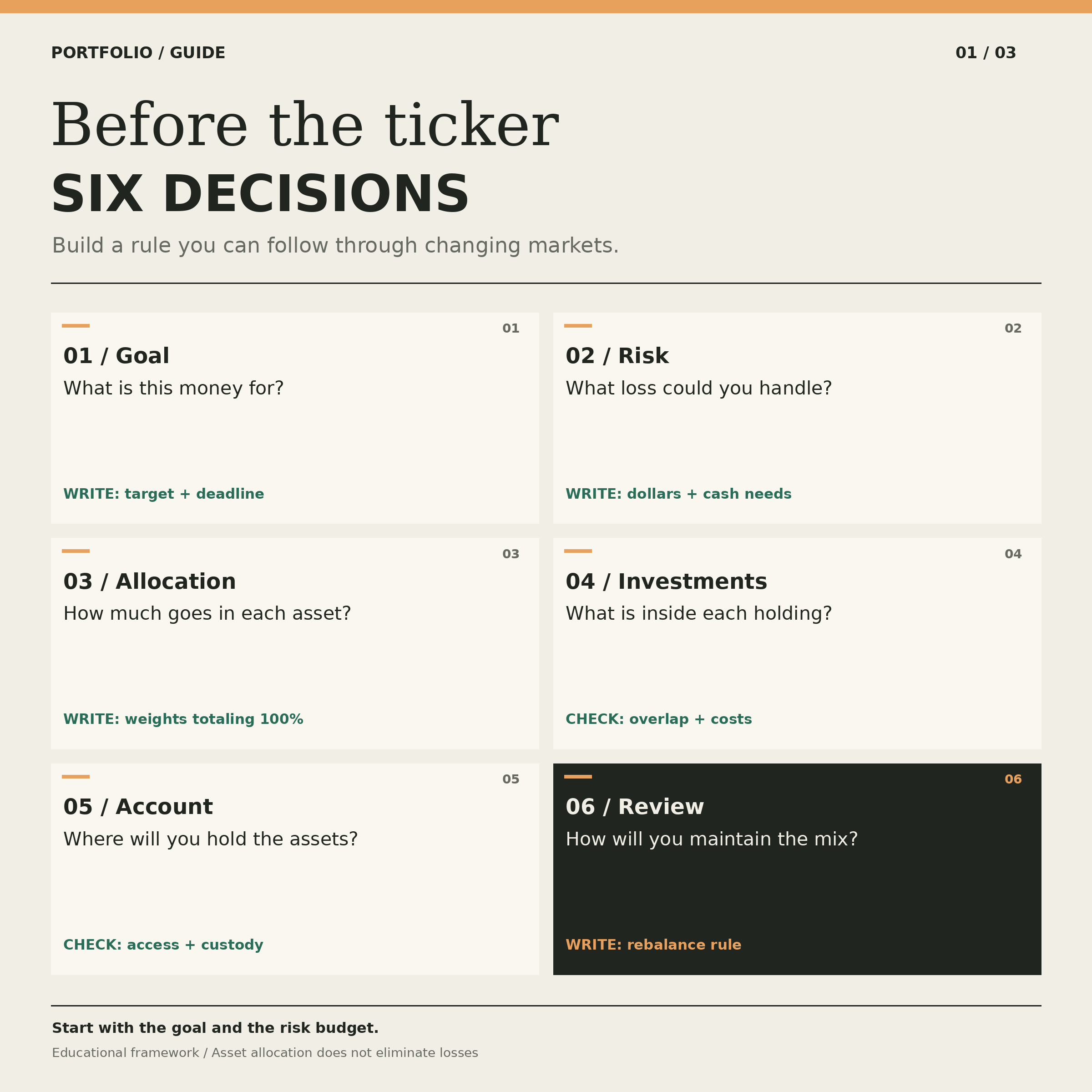
This is an educational framework, not a recommended allocation for every reader.
Start With the Goal, Not the Ticker
Money for a near-term bill and money intended for retirement have different jobs. A position that might recover over a decade is less helpful if you need to sell it next month.
The SEC’s investor education site explains asset allocation in terms of time horizon and risk tolerance. Those choices should shape the portfolio before a market forecast does.
Write a short investment brief. Include what the money is for, when you may need it and what amount must remain readily accessible. Also consider expensive debt and your emergency cash needs before treating every available dollar as long-term investment capital.
This separates the question “Could this investment rise?” from the more useful question “Does this investment belong in this pot of money?”
Understand the Main Building Blocks
| Asset | What it can contribute | Main limitation |
|---|---|---|
| Broad stock fund | Exposure to many companies and potential long-term growth | Can fall substantially with equity markets |
| Individual share | A focused investment in one company | Company-specific and concentration risk |
| Bond or bond fund | Income and exposure to debt markets | Interest-rate and credit risk; bond funds are not fixed-value cash |
| Cash or short-term instruments | Accessible funds and lower day-to-day volatility in some structures | Inflation, reinvestment risk and product-specific protections |
| Crypto | Exposure to digital-asset networks and markets | Large price swings, custody and market-structure risk |
| Tokenized investment | Blockchain-based ownership or exposure, depending on its terms | Additional issuer, technology and access dependencies |
FINRA’s bond guide explains why income-producing investments still face price and credit risks.
These categories overlap. An ETF can hold stocks, bonds or another asset. Tokenization describes a way to represent an investment, not a new source of guaranteed return.
What BlackRock’s Approach Can Teach a Beginner
BlackRock’s portfolio-construction education starts with investment needs, preferences and risk. Its iShares Core Builder illustrates how equity, bond and allocation ETFs can form a diversified portfolio.
The practical lesson is to give each holding a role. A broad equity fund might provide growth exposure. A bond allocation might serve an income or risk-management purpose. A narrower investment expresses a more specific view.
BlackRock also explains a core-and-satellite approach: a central set of holdings with smaller, more focused positions around it. The idea can help prevent a favorite theme from quietly becoming the entire portfolio.
These are examples from BlackRock’s educational materials. They are not a BlackRock-approved model for this article, an endorsement of Blockster or a reason every reader should own the same funds.
Diversification Means Checking What Is Inside
Buying several funds does not automatically create several different exposures. A U.S. large-cap fund, a technology fund and a single technology stock may all depend heavily on the same company.
Consider this hypothetical $10,000 portfolio:
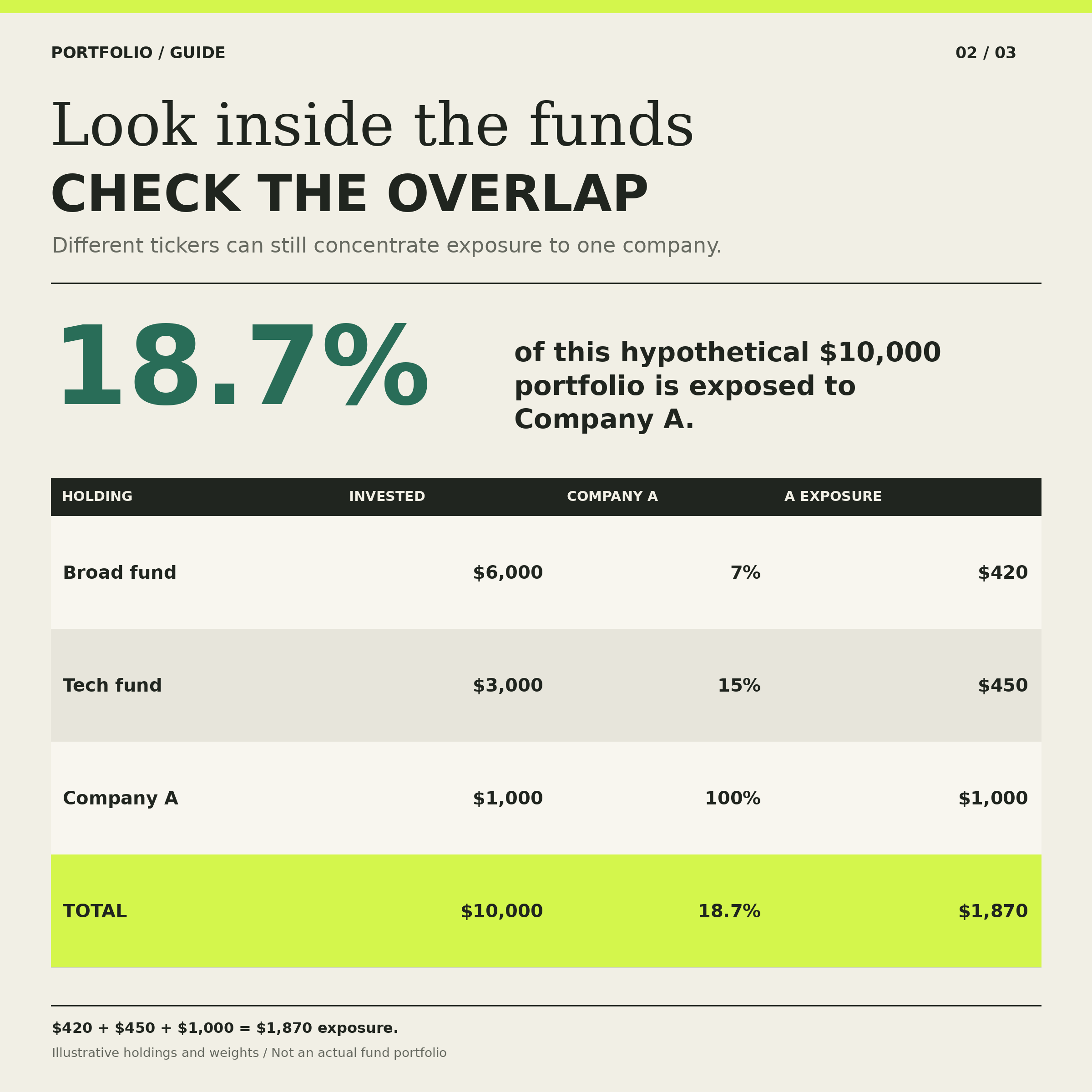
The direct shareholding looks like 10% of the portfolio. After including the funds, the exposure is 18.7%. These are invented weights for the calculation, not current holdings of any named fund.
Look through the wrapper to the underlying companies, sectors, countries and currencies. The same principle applies if one holding is a tokenized version of a fund you already own elsewhere.
How Much Crypto Belongs in a Portfolio?
There is no universal percentage. The amount depends on your circumstances, goals and capacity for loss; some investors will choose none.
A useful way to think about a possible allocation is to work backward from a stress scenario. If a hypothetical crypto position falls 70%, what would that mean for the whole portfolio?
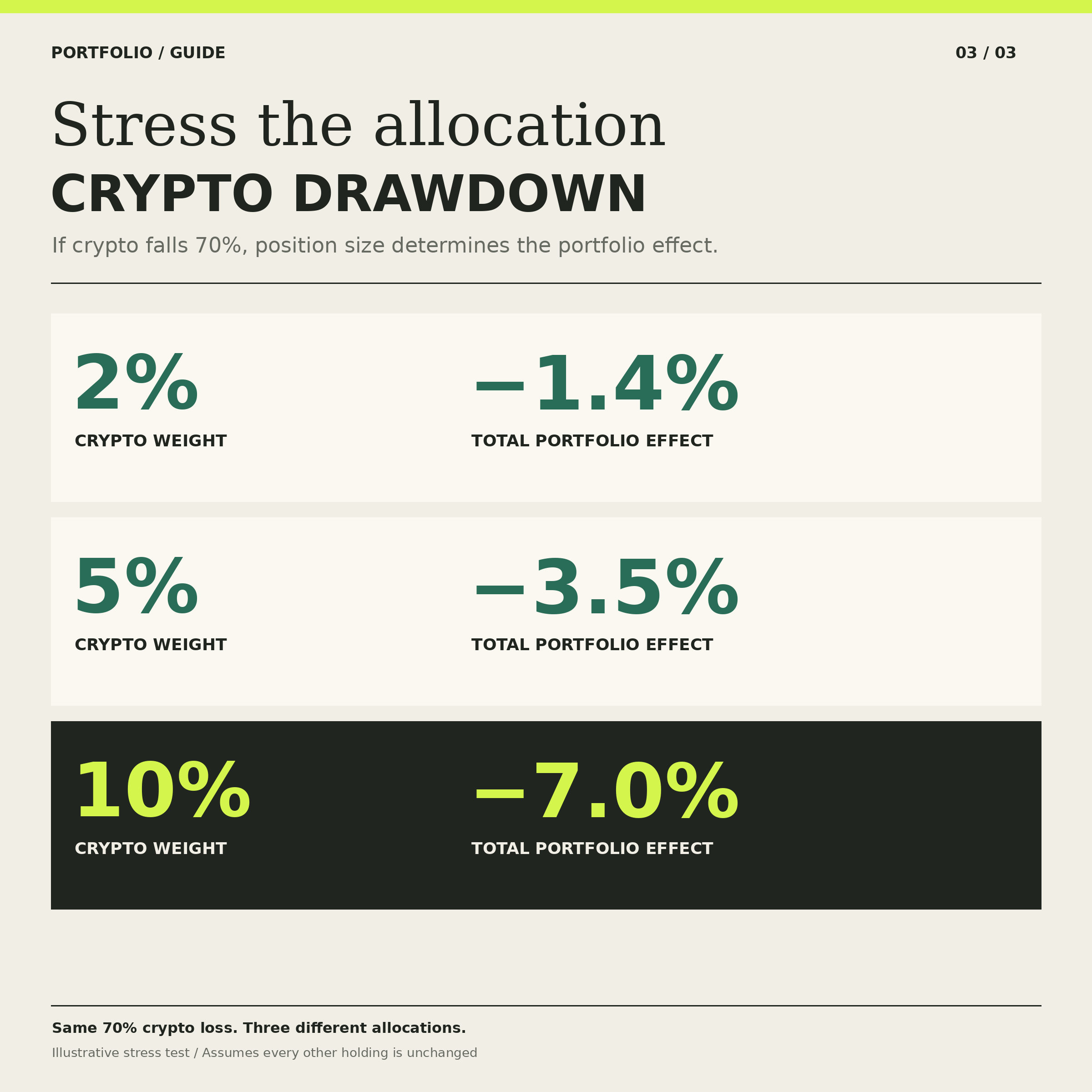
This is a sensitivity exercise, not a recommended allocation or a forecast. In a real selloff, other assets may fall too. The calculation helps put a percentage into context before enthusiasm or fear drives the decision.
Holding crypto through a fund, an exchange or a personal wallet also changes custody and operational responsibilities. Compare the investment and the holding arrangement separately.
For a closer look at legal rights, read our guide to tokenized stock ownership. When comparing cash-like products, our stablecoin yield guide explains how rewards and lending add different exposures.
ETFs, Model Portfolios and Portfolio Tokens Are Different
An ETF is a fund whose shares trade on an exchange. A model portfolio is an allocation approach that may be implemented through several investments. A portfolio token can provide contractual exposure to a basket through a blockchain instrument.
Similar holdings do not make these structures interchangeable.
| Structure | What the investor needs to understand |
|---|---|
| ETF | Fund strategy, holdings, fees, trading price and shareholder rights |
| Self-built portfolio | Position sizes, transactions, monitoring and rebalancing |
| Managed or model-based account | Who implements decisions, mandate, fees and account ownership |
| Portfolio token | Issuer, underlying exposures, token rights, fees, redemption and supported jurisdictions |
The structure can change how you exit, who owes you what and how taxes arise. Convenience at purchase is only one part of the comparison.
How Ondo’s BlackRock-Powered Portfolios Fit In
On September 24, 2026, Ondo introduced Intelligent Portfolios. The first three use strategies developed by BlackRock for Ondo:
| Portfolio | Token | Stated focus |
|---|---|---|
| Ondo High Income Powered by BlackRock | BLKHIon | Income |
| Ondo Diversified Growth Powered by BlackRock | BLKDIGon | Diversified growth |
| Ondo High Growth Powered by BlackRock | BLKGRWon | Higher-growth allocation |
Ondo implements the models using tokenized positions and scheduled rebalancing. BlackRock developed those strategies; Ondo manages, sponsors and administers the products. Buying a token does not mean opening a personal investment-management account with BlackRock.
The product FAQ limits access to eligible investors outside the United States. Direct minting and redemption require onboarding. Being able to hold a token in a wallet does not establish your eligibility to redeem it.
The Diversified Growth product disclosure explains that the token is not a fund share and does not provide shareholder rights in the underlying securities. Read the product’s costs, rights and exit process alongside its allocation.
Blockster’s original Intelligent Portfolios report covers the launch. For portfolio construction, the wider lesson is simple: automating the mix does not remove the need to decide whether that mix suits you.
New Investment Access Does Not Replace Allocation
The menu of onchain investments keeps expanding. Blockster’s October 6 report on Ondo Private Markets explains a new route to private-company exposure through tokenized notes. Those notes are different from a diversified ETF or an ordinary shareholding; transferable exposure does not guarantee liquidity.
Our October 7 coverage of stablecoin payments and tokenized bonds adds another distinction: a payments balance and a bond-linked investment serve different purposes. Classify each holding by its exposure, legal terms and exit conditions before assigning it a portfolio weight.
Post from @OndoView the original post on X↗
Keep Portfolio Tokens Separate From Tokenized Treasuries
Ondo’s OUSG is a different product. Its official page describes a fund offering short-term Treasury exposure, with eligibility restrictions for accredited investor qualified purchasers. It lists BlackRock’s BUIDL among its underlying assets.
That relationship is distinct from the BlackRock-developed strategies used by Intelligent Portfolios. Neither should be reduced to “BlackRock’s crypto investment.” The product, legal claim and eligibility determine what an investor is actually buying.
Compare Fees Before You Compare Returns
Look at fund expenses, platform charges, adviser fees, spreads, currency conversion and any token-specific costs. The SEC explains how recurring fees reduce portfolio value over time.
On an unchanged hypothetical $10,000 balance, an annual cost of 0.20% is $20; 1% is $100. That $80 difference is arithmetic, not a forecast. Over time, both charges and forgone compounding can affect results.
If a portfolio token references funds through other tokenized instruments, check costs at each layer. Do not assume the displayed platform fee covers everything.
For access options, Blockster’s crypto exchange comparison distinguishes brokerage shares, tokenized exposure and derivatives. Choosing the right account begins with choosing the right instrument.
Rebalance With a Rule You Can Follow
Rebalancing brings the portfolio back toward its intended mix after market moves or changes in your circumstances. Decide on a review process before a volatile day forces a decision.
For a simple example, a hypothetical $10,000 portfolio begins with $6,000 in stocks and $4,000 in bonds. Stocks rise to $7,200 while bonds remain at $4,000. Stocks now represent about 64.3% of the $11,200 total.
Returning to the original 60% stock weight would mean $6,720 in stocks and $4,480 in bonds. Ignoring costs and taxes, that requires moving $480 between them. New contributions may also help restore balance without selling as much.
The example explains the mechanism; it does not recommend a 60/40 portfolio. Consider transaction costs and tax consequences before making changes. Constantly chasing the latest outperformer is a different strategy from maintaining a planned allocation.
A Portfolio Plan You Can Write on One Page
Before opening another account, complete these six sentences:
I am investing this money for __, and may need it in __.
Money needed sooner will be held separately in __.
My intended asset mix is __.
Each holding belongs because __.
I will review costs, overlap and allocation every __.
I will change the plan when __, rather than in response to every headline.
You can discuss that plan with a qualified adviser if the choices involve complex finances, taxes or competing goals. A clear plan makes that conversation more productive.
Frequently Asked Questions
How much money do I need to start a portfolio?
Minimums depend on the account and investment. Fractional shares and some funds allow smaller purchases, but check fees and minimums against the amount you can contribute consistently.
Is an ETF already a diversified portfolio?
Some provide broad exposure; others concentrate on one sector, asset or strategy. Read the holdings and consider what you own elsewhere. The ETF label alone does not establish diversification.
Is 60/40 the best portfolio?
It is one familiar stock-and-bond mix, not a universal answer. Your time horizon, cash needs and capacity for loss matter more than following a standard percentage.
Does every portfolio need crypto?
No. Crypto is an optional exposure. Its potential role should be assessed against the portfolio’s purpose and the losses you could absorb.
Does BlackRock manage my Ondo portfolio token?
Ondo says BlackRock developed strategies for its initial three products, while Ondo implements and administers the products. That is different from a personal advisory relationship with BlackRock.
Can U.S. investors buy Ondo Intelligent Portfolios?
The product page currently excludes U.S. investors. Check the exact product’s eligibility; a different Ondo offering does not make this one available to you.
Does automatic rebalancing prevent losses?
No. It maintains a specified approach, which can still lose money. It also does not decide whether the strategy is suitable for a particular investor.
How This Guide Was Researched
This educational guide uses regulator education, BlackRock and iShares materials, Ondo disclosures and relevant Blockster reporting checked on October 3, 2026. All worked allocations and return scenarios are hypothetical. This is an independent explanation, not a personalized investment recommendation or a BlackRock-sponsored guide.
Reporting by Lidia Yadlos