

Buying Bitcoin is no longer the only reason to open an account with a crypto platform. Depending on the provider and your location, the same app may offer stocks, ETFs, AI trading agents, stablecoin rewards, borrowing and a payment card. (Last reviewed: September 30, 2026)
But similar-looking menus can conceal very different products. Buying Nvidia shares through a brokerage, holding a token linked to Nvidia and trading a leveraged Nvidia derivative do not give you the same investment.
This guide compares Robinhood, Binance, Coinbase, Kraken, Bybit and KuCoin across asset selection, AI trading, earning, borrowing and everyday benefits. It explains what the numbers mean, which features require a separate product or account, and how to narrow your choices.
The starting point: choose the investment structure and local availability you need before comparing headline rates, stock counts or rewards. A platform with more registered users does not necessarily have a better product for your purpose.
Crypto Exchanges and Investment Platforms at a Glance
The figures below are dated snapshots, not live totals. Stock counts include ETFs where indicated. Derivatives pairs, tokenized assets and conventional securities are identified separately.
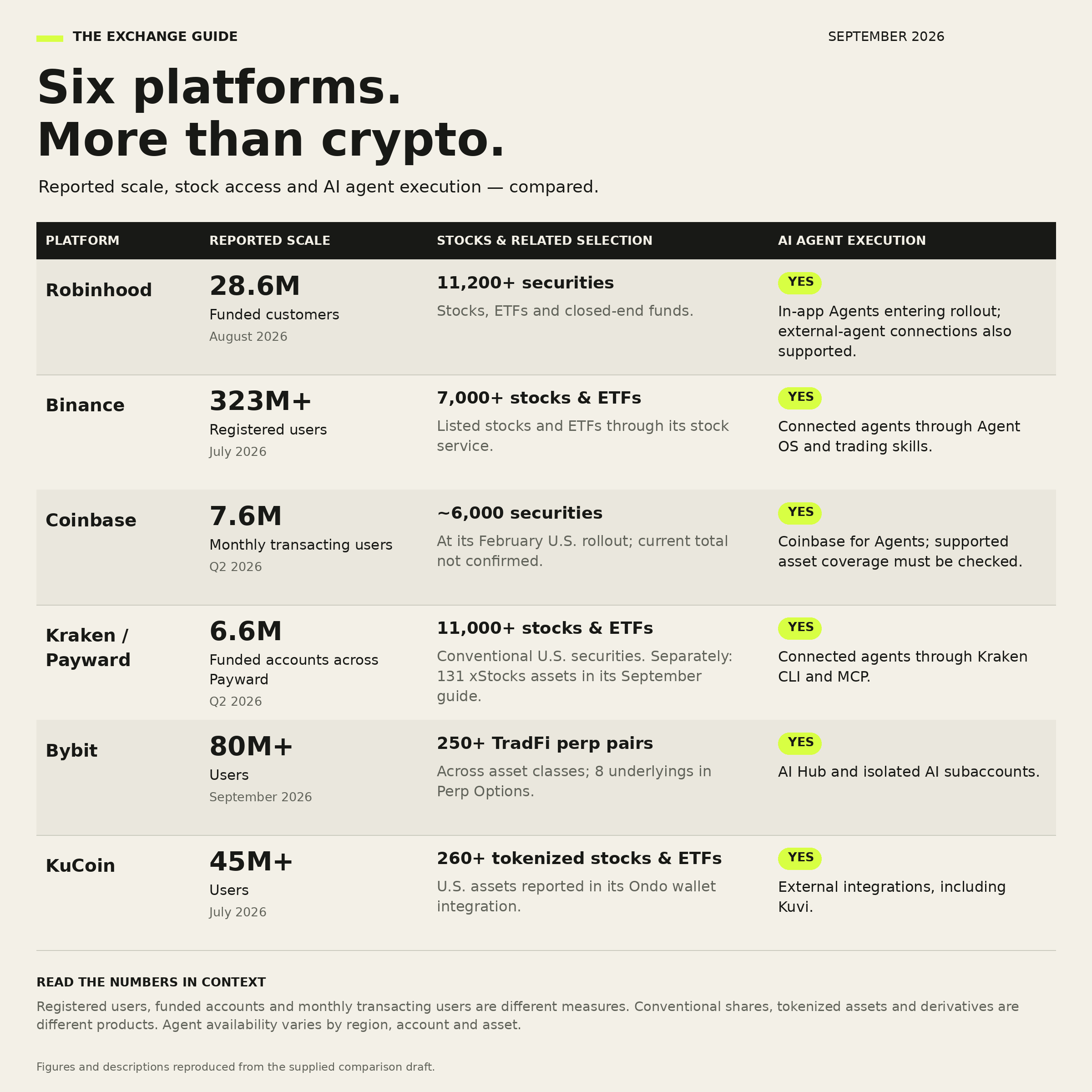
Scale sources: Robinhood, Binance, Coinbase metrics, Payward, Bybit and Blockster’s KuCoin coverage. Product sources appear in the sections below.
Registered users, funded customers and monthly transacting users measure different things. Payward’s figure covers its wider business, rather than only the Kraken app. These numbers establish context; they are not a like-for-like ranking of active traders.
What You Own When You Buy Stocks on a Crypto Platform
Conventional Stocks and ETFs
A brokerage stock purchase generally gives you beneficial ownership of shares held through the brokerage’s custody arrangements. Dividends, corporate actions, transfer options and shareholder rights depend on the security and account.
Robinhood and Kraken’s U.S. equities service offer conventional securities. Binance also describes its Stock Trading customers as beneficial owners of shares held by a partner brokerage. Funding a purchase with crypto or stablecoins does not, by itself, make the resulting investment a tokenized stock.
Tokenized Stocks
A tokenized stock product represents exposure through a blockchain-based instrument. Its legal terms determine what the holder can claim, how distributions work and whether redemption is possible.
For example, Kraken’s xStocks documentation says holders receive economic exposure without direct shareholder or voting rights. Compatible tokens can move to external wallets. That portability can be useful, but it does not make the token identical to a share in a brokerage account.
Stock Perpetuals and Options
A derivative gives exposure under a contract. It does not mean you own the referenced stock.
Perpetual futures generally have no scheduled expiry and may involve funding payments and leverage. Options have their own strike prices and expiration dates. Bybit’s Perp Options are options on perpetual contracts: the underlying is perpetual, but the option still expires.
An example: three people can each say they “bought Nvidia” while holding a conventional share, a tokenized instrument or an option. Their ownership rights, costs, liquidation exposure and exit routes can be materially different.
Robinhood: Brokerage Investing and In-App Agents

Robinhood starts from a brokerage model. Its investment guide lists more than 11,200 securities, including most U.S. stocks and ETFs and selected closed-end funds. That is a broader count than stocks alone.
Its September 2026 expansion adds Robinhood Agents, letting customers create agents inside the app for research, strategies and supported trading. Access is rolling out gradually.
Robinhood had already enabled third-party agent connections in May. The distinction in the newer product is the built-in experience. Customers do not need to approach every task through an outside agent environment.
Agents use dedicated accounts rather than unrestricted access to the entire portfolio. Permission settings matter: authorizing research is different from allowing execution without checking each order.
For longer-term investors, Robinhood Gold adds membership benefits including enhanced eligible brokerage cash interest and a 3% match on eligible annual IRA contributions. Keeping the full match requires meeting subscription and holding conditions.
The comparison to make: brokerage account features, eligible securities, retirement benefits and agent controls. Separate those from crypto features and from products offered only outside the United States.
Timing to know: weekend trading in selected equities is planned for early 2027, pending regulatory review. It is not a feature to assume is already available when opening an account.
Binance: Stock Access Alongside a Large Crypto Ecosystem

Binance’s Stock Trading documentation describes access to more than 7,000 listed stocks and ETFs, provided through Nest Trading Limited in collaboration with an external brokerage. Customers are beneficial owners of the purchased shares.
The service supports investments from $5 and uses USDC for settlement. Selected stocks support up to 24/5 trading. Its stock service should be distinguished from Binance’s separate tokenized and derivatives products.
As Blockster covered when Binance added another 25 stocks and ETFs, the attraction is bringing more investment activity into an account customers already use for crypto.
Automation is part of that expansion. Binance Agent OS connects compatible agents to platform capabilities; its agent skills include authorized trading actions. This requires checking supported tools and permissions, rather than assuming an agent has access to every Binance product.
Binance also offers Flexible Loans backed by eligible assets. Some Simple Earn collateral continues earning while pledged, but the borrowing cost and collateral risk remain separate.
The comparison to make: stock-service fees, stablecoin conversions, local availability and whether you want securities, tokens or leveraged contracts.
The global Binance offering is not interchangeable with Binance.US. A feature advertised for one entity should not be assumed available through the other.
Coinbase: Stocks, Crypto and Connected Financial Tools

Coinbase has expanded beyond crypto spot trading into conventional equities, derivatives, agent connections and borrowing.
At its February 2026 U.S. stock rollout, roughly 6,000 securities were reported available, with further expansion planned. That launch figure is a historical reference, not a verified current catalog. Coinbase describes 24/5 stock and ETF access for eligible securities.
Coinbase for Agents connects an external AI agent to a customer’s account through supported tools. Launched in June 2026, it expanded in September to support stock and ETF trading alongside crypto and derivatives. Customers should still check which markets their account can access and what permissions they grant the agent.
Coinbase also separates several products that can look similar in advertising: rewards for holding USDC, lending USDC through an onchain vault, and borrowing against crypto collateral.
Its Morpho-powered borrowing service allows eligible customers to obtain USDC against supported crypto. The published terms prohibit using those proceeds to trade on Coinbase.
The Coinbase One Card adds Bitcoin rewards for eligible purchases, with reward tiers and membership conditions.
The comparison to make: which products your account can access, subscription costs, agent-supported markets and whether a balance is simply earning platform rewards or being lent through a protocol.
Kraken: Conventional Equities, Tokenized Stocks and Borrowing

Kraken has two distinct equity propositions. Its U.S. stock service offers more than 11,000 conventional stocks and ETFs. Separately, its September xStocks guide lists 131 tokenized assets for eligible non-U.S. customers. The smaller tokenized catalog does not describe the size of Kraken’s conventional equities business.
The xStocks guide identifies 10 tokens available around the clock on Kraken Pro; other listed xStocks have different trading schedules. Tokenized product availability also differs from eligibility for the U.S. brokerage service.
For automation, Kraken CLI lets authorized agents place, amend and cancel orders. This is primarily a connection and developer-tool proposition, rather than proof of an identical consumer experience to Robinhood’s in-app agent builder.
Kraken Borrow US launched in September 2026 with up to 3× total buying power, subject to eligibility. Purchases use available cash first, with borrowing covering the excess. Borrowed purchases are restricted from leaving the platform until repayment.
There is no fixed repayment deadline, but interest accrues and collateral can be liquidated. Launch availability excluded New York and Maine.
The comparison to make: conventional equities versus xStocks, agent setup requirements, borrowing costs and the source of any advertised yield.
Bybit: Derivatives and Integrated Trading Automation

Bybit’s traditional-market expansion is especially relevant to traders seeking contractual exposure rather than a buy-and-hold stock account.
Blockster’s September derivatives report described more than 250 TradFi perpetual pairs spanning equities, commodities and ETFs. That is a mixed derivatives count, not 250 conventional stock listings.
Bybit’s September 29 expansion brought Perp Options to eight underlying assets. These options trade 24/7 and settle in USDT. Traders must account for option expiry as well as the characteristics of the underlying perpetual.
Bybit AI Hub supports connected agents, while AI subaccounts separate agent trading funds and permissions from other balances. That makes Bybit a meaningful automation comparison, not simply a platform with an AI chatbot.
Its card and Easy Earn products extend the account into spending. Supported balances can be redeemed automatically from eligible flexible earning products to fund card purchases.
The comparison to make: liquidity in the specific contract, execution fees, funding, margin requirements and the maximum authority granted to an agent.
Bybit’s restricted-country policy excludes U.S. users. An international product comparison should not be mistaken for a list of services every American reader can open.
KuCoin: Tokenized Assets and Managed Strategies

KuCoin’s offering combines exchange services, wallet access and managed products. Keeping those categories separate makes the comparison more useful.
Blockster reported that KuCoin Web3 Wallet added more than 260 tokenized U.S. stocks and ETFs through Ondo. The integration provides access through a self-custodial wallet, rather than describing a conventional brokerage stock catalog.
In September, KuCoin Wealth introduced managed strategies starting at 100 USDT. One focuses on traditional-market strategies; the other on crypto. Subscribing to a managed portfolio is a different choice from directing an agent yourself.
KuCoin has an AI assistant, KIA, and a Skills Hub. Separately, Kuvi’s KuCoin integration provides agent-driven execution through the Broker Pro Program. A “yes” for agent trading should identify that integration, rather than imply KIA alone autonomously manages every account.
The ecosystems also overlap: KuCoin Web3 Wallet added Robinhood Chain support, as Blockster covered in July.
The comparison to make: wallet custody, token issuer terms, managed-strategy conditions and external-agent permissions. KuCoin’s global terms of use list the United States among restricted locations.
AI Trading Agents Compared
An AI research assistant answers questions. A preset bot follows defined rules. An execution-capable agent can interpret instructions and call authorized trading tools. These features can coexist, but they are not interchangeable.
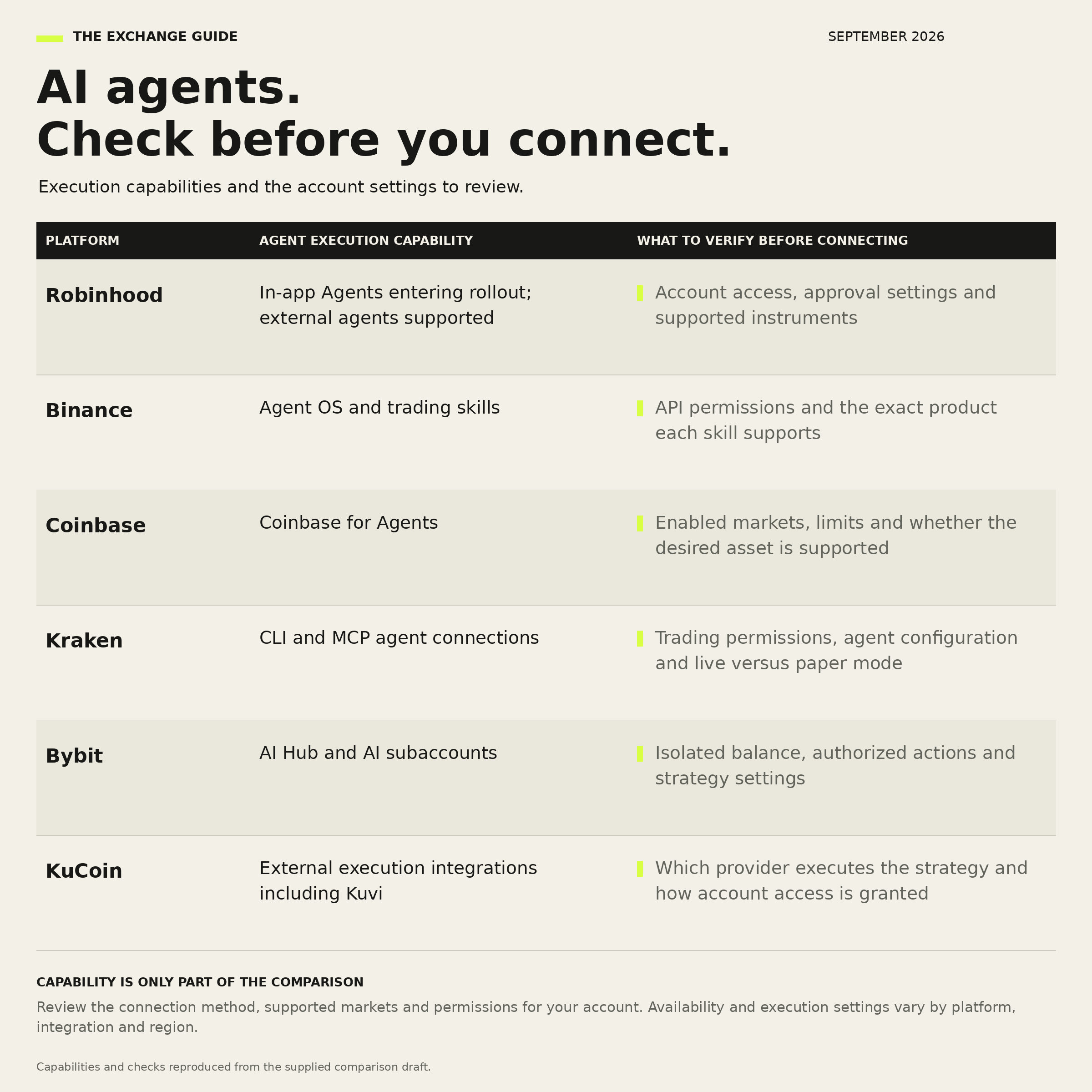
Official capability references: Robinhood, Binance, Coinbase, Kraken, Bybit and Kuvi.
A “yes” confirms an execution route exists. It does not confirm agent support for every asset, automatic access for every customer or a profitable strategy.
Useful controls include a dedicated balance, permitted markets, order-size limits, approval thresholds and the ability to disconnect the agent. Begin by understanding whether the agent can only view information, place orders, borrow or withdraw.
This connects to Blockster’s reporting on NVIDIA and more than 100 organizations building agent guardrails. Companies are developing ways to enforce software permissions as agents gain financial capabilities. That does not establish a NVIDIA integration with every platform in this guide.
Earning, Borrowing and Account Perks Compared
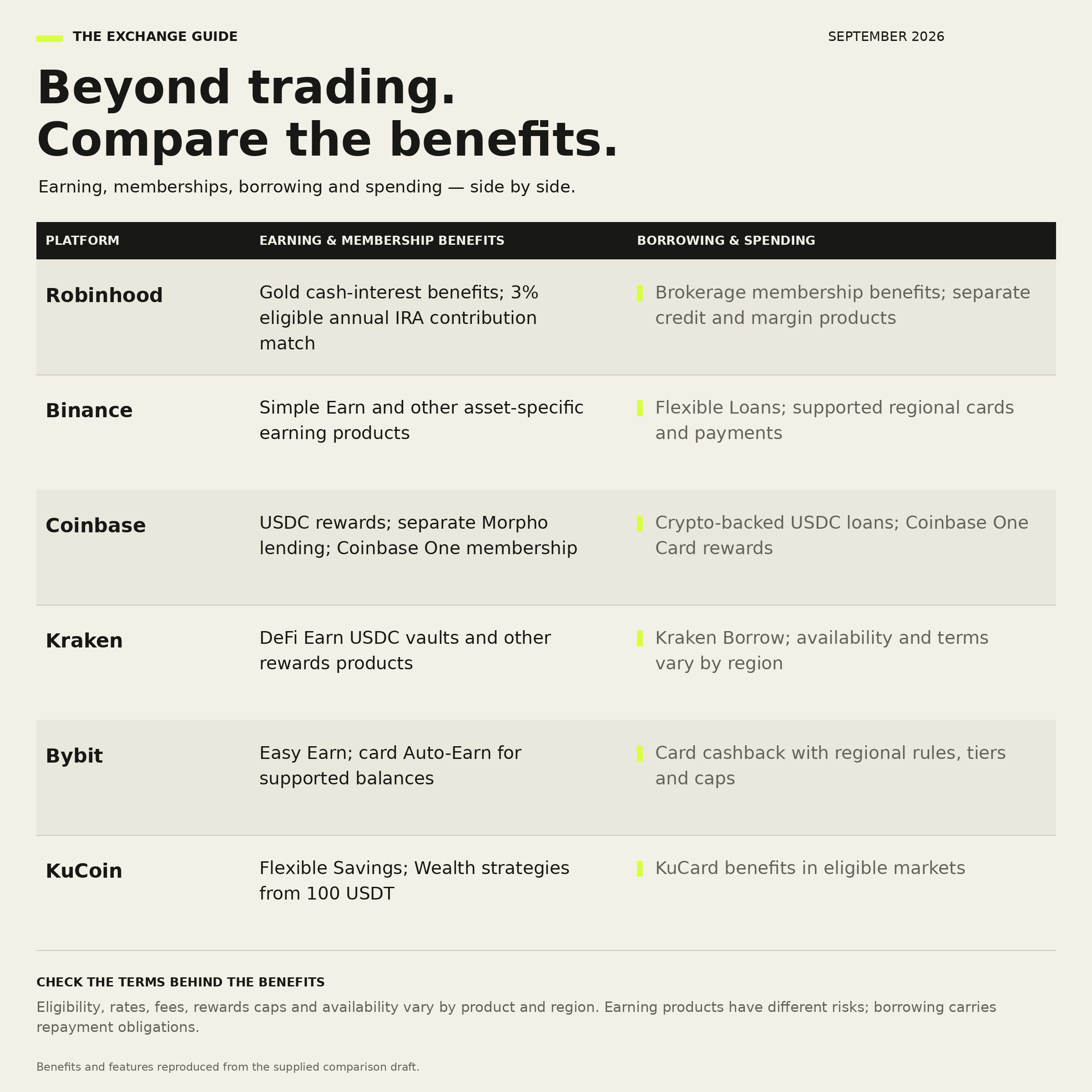
These features are not a uniform set of “free perks.” Some require subscriptions, lending, collateral, card approval or investment risk.
Cash Interest Is Different From Stablecoin and DeFi Yield
A percentage is only useful when you know what generates it.
Kraken’s DeFi Earn documentation describes allocating USDC to onchain vaults. Funding from cash may involve a conversion. Returns vary, and withdrawals can depend on liquidity and network conditions. This differs from leaving dollars in an interest-bearing cash arrangement.
Coinbase likewise distinguishes USDC lending through Morpho from its platform’s USDC holding rewards. With lending, borrowers and collateral mechanisms are part of how the return is generated.
Ask what asset you hold, whether it is lent, which entity or protocol owes you money, what protection applies and how quickly you can exit. An advertised “up to” rate is a ceiling or conditional offer, not a return every customer receives.
Borrowing Can Mean Buying Power or Usable Loan Proceeds
Kraken Borrow US increases purchasing power for supported crypto purchases. Coinbase’s crypto-backed loan delivers USDC under terms that restrict trading with the proceeds on Coinbase. Binance Flexible Loans allow specified uses that can include trading or withdrawing borrowed assets.
These are materially different products. Compare interest, opening fees, collateral requirements, liquidation triggers and permitted uses. Flexible repayment does not remove the lender’s right to act when collateral becomes insufficient.
Card Rewards and Retirement Matches Need Their Conditions
Coinbase One Card rewards depend on applicable tiers and terms. Bybit’s welcome package illustrates why headline cashback requires context: its introductory 10% offer has a qualifying period and a 110 USDT cashback cap.
Robinhood’s 3% Gold IRA match is a contribution benefit, not an annual investment yield. Retaining the full match generally requires remaining subscribed for one year and keeping the assets in the IRA for five years.
For each benefit, subtract the subscription cost and applicable fees from what you realistically expect to earn. A reward that requires more spending or borrowing than you planned may have little practical value.
How to Compare the True Cost of an Account
“Commission-free” does not necessarily mean cost-free. The meaningful comparison is the total cost of funding, trading, holding and withdrawing the position.
Check five items:
Execution: commission, platform charges, bid-ask spread and slippage.
Conversion: exchanging local currency, dollars, stablecoins or crypto.
Holding: margin interest, perpetual funding and product-specific expenses.
Access: subscriptions, paid agent data and premium tools.
Exit: withdrawal, network, transfer and redemption charges.
Binance’s stock FAQ, for example, advertises no trading commission but describes a platform fee or spread. Agent users should also consider transaction frequency: software that trades repeatedly can accumulate costs even when each individual order looks inexpensive.
For a comparison you can actually use, price the same hypothetical task on each eligible platform. Compare buying and holding $1,000 of a stock separately from running a leveraged weekly strategy. They are different use cases.
How to Choose a Platform for Your Needs
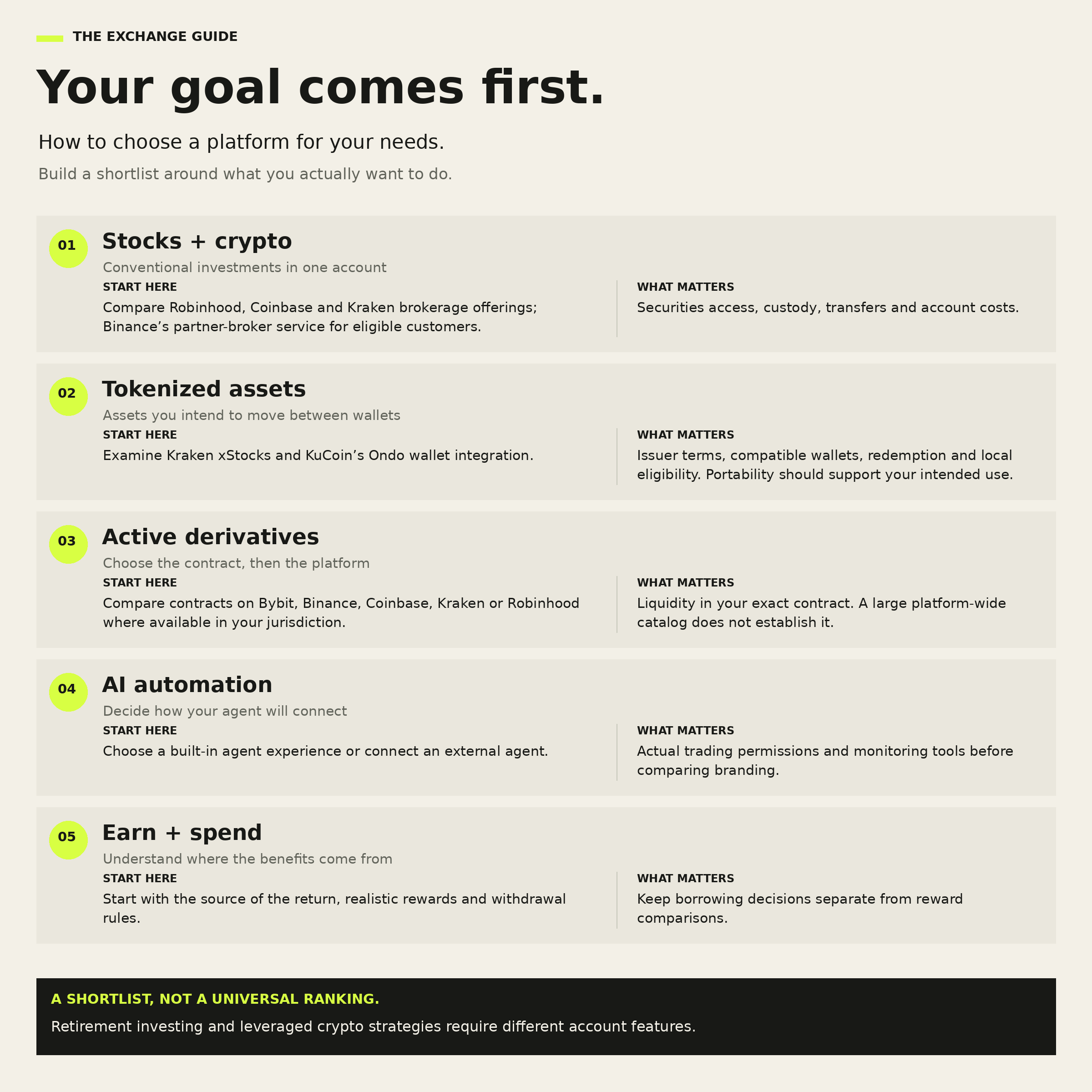
For conventional stocks and crypto in one account: compare Robinhood, Coinbase and Kraken’s brokerage offerings where available. Binance’s partner-broker stock service is another route for eligible customers. Focus on securities access, custody, transfers and account costs.
For transferable tokenized assets: examine Kraken xStocks and KuCoin’s Ondo wallet integration. Check issuer terms, wallet compatibility, redemption and local eligibility. Portability is useful only if it supports something you intend to do.
For active derivatives trading: compare the exact contracts available through Bybit, Binance, Coinbase, Kraken or Robinhood in your jurisdiction. A larger platform-wide catalog says little about liquidity in one contract.
For AI automation: choose between a built-in agent experience and connecting an external agent. Inspect the actual trading permissions and monitoring tools before comparing branding.
For earning and everyday spending: start with the source of the return, realistic rewards and withdrawal rules. Keep borrowing decisions separate from reward comparisons.
These are ways to build a shortlist, not universal rankings. Someone investing for retirement and someone managing a leveraged crypto strategy need different account features.
Frequently Asked Questions
Can You Buy Stocks on a Crypto Exchange?
Yes, some platforms offer conventional stocks and ETFs, while others provide tokenized instruments or derivatives. Read the product description rather than relying on the exchange’s name. One platform can offer several structures.
Does Binance Offer Actual Stock Ownership?
Binance’s Stock Trading FAQ describes beneficial ownership of shares held by a partner brokerage. That statement applies to the named stock service, not automatically to tokenized products or perpetual contracts elsewhere on Binance.
Which Platform Has the Most Stocks?
Among the catalogs checked here, Robinhood lists 11,200+ securities and Kraken lists 11,000+ U.S. stocks and ETFs. The categories are not identical, and this is not a market-wide ranking. Coinbase’s current full count was not confirmed.
Can AI Agents Trade Stocks and Crypto?
They can execute supported trades when authorized through the relevant platform or integration. Crypto execution support does not establish stock execution support. Check asset coverage, account eligibility and permissions for the particular agent tool.
Can You Trade Stocks on Weekends?
Sometimes, but the product matters. Selected tokenized assets and derivatives already trade on weekends. Conventional-stock services often provide extended or overnight weekday sessions. Robinhood’s announced weekend equities service remained planned at this guide’s review date.
Are Tokenized Stocks the Same as Brokerage Shares?
Not necessarily. They may track the same company while providing different legal rights, custody, dividend treatment and redemption arrangements. A token’s price exposure alone does not establish direct shareholder rights.
Is Exchange Yield the Same as a Savings Account?
No. Cash interest, stablecoin rewards, staking and DeFi lending have different structures. Check the asset, provider, protection and withdrawal terms before treating two matching APYs as equivalent.
Does No Repayment Deadline Mean a Crypto Loan Cannot Be Liquidated?
No. A loan can allow flexible repayment while still requiring adequate collateral. Falling collateral value, interest and fees can affect the position and trigger forced sales under the product’s terms.
Can U.S. Residents Use Every Platform in This Guide?
No. Bybit and KuCoin’s global services list U.S. restrictions. Binance’s global offering differs from Binance.US. Even on U.S.-serving platforms, some products have state restrictions or additional eligibility requirements.
Should You Choose an Exchange Based on Its User Count?
User count helps establish scale but does not measure the suitability of a product. Registered users are not the same as funded customers or monthly active traders. Product rights, availability, costs and controls are more useful selection criteria.
How This Guide Was Researched
This comparison combines official product documentation, company disclosures and relevant Blockster reporting. It is a desk-researched product comparison, not a hands-on performance test or a ranking of investment returns.
Figures retain their reporting dates. Unconfirmed current totals are identified rather than estimated. “AI execution” means a documented route for agents to submit supported transactions; it does not mean every customer, jurisdiction or asset is supported.
Before opening or funding an account, check the local product terms and the current order or subscription screen. Rates, asset catalogs, fees and permissions can change independently of the platform’s broader marketing.
Reporting by Lidia Yadlos


