

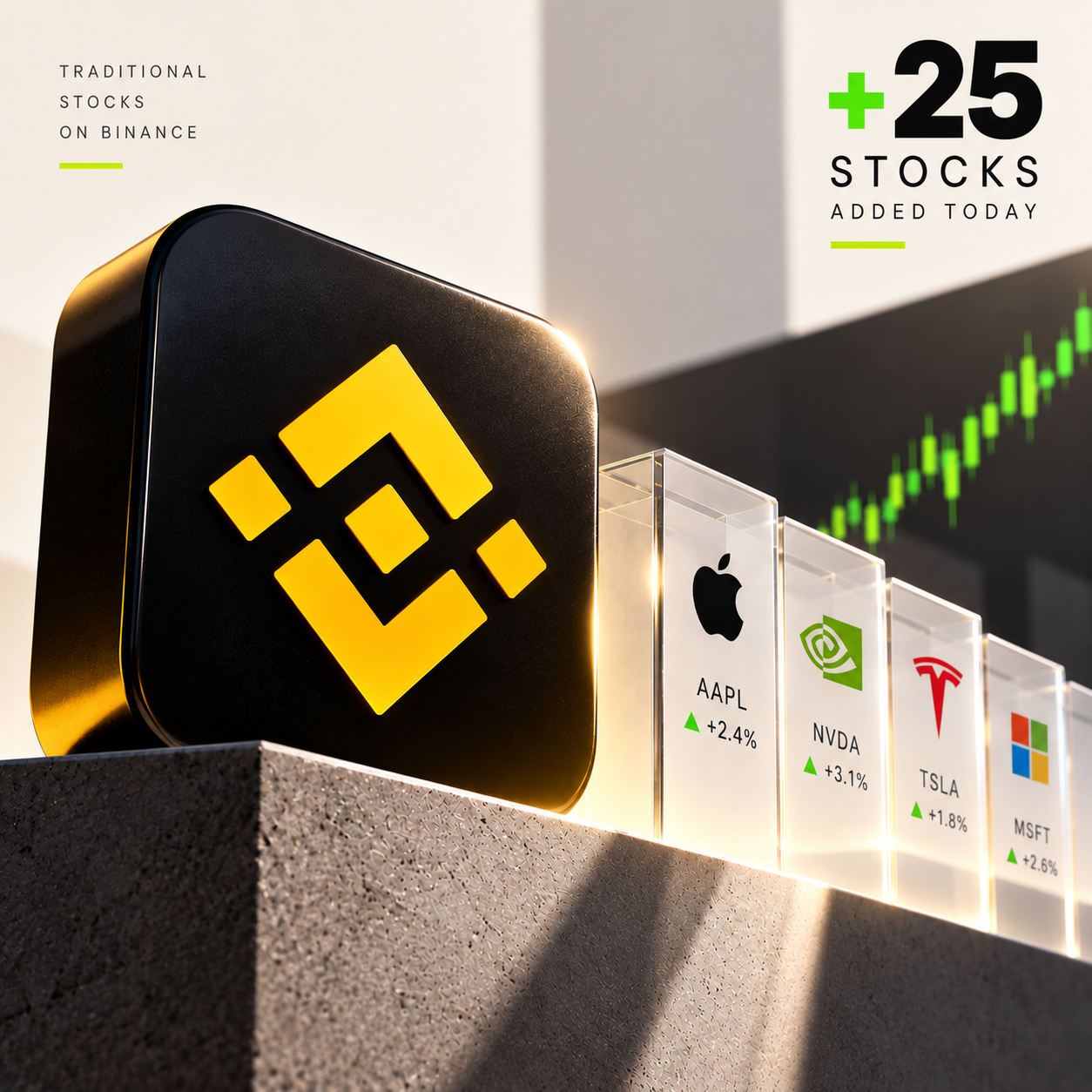
Binance is adding another 25 stocks and ETFs as the line between a crypto exchange and a traditional brokerage gets harder to see.
A crypto account used to mean Bitcoin, stablecoins and altcoins. Binance increasingly wants it to mean Apple, Nvidia and thousands of other U.S. securities too.
The exchange added 25 more stocks and ETFs to Binance Stock Trading, expanding a broader offering that Binance says gives eligible users access to more than 7,000 U.S. stocks and ETFs, fractional investing from $5 and extended trading hours.
The latest additions span aerospace, digital infrastructure, energy, precious-metals ETFs and semiconductor-related products.
For retail investors, the appeal is straightforward: keep crypto and stock exposure closer together instead of moving money between an exchange and a separate brokerage account.
The details of what you own, however, still matter.
Why Crypto Exchanges Want Your Stock Portfolio Too
Crypto exchanges already have something traditional brokerages spend heavily to acquire: millions of users comfortable moving money digitally and trading from an app.
Adding stocks gives those platforms another reason to keep that capital inside their ecosystem.
For a user who already holds Bitcoin or stablecoins on Binance, the convenience is obvious. The same broader platform can increasingly provide access to crypto, stocks and ETFs.
That puts Binance into more direct competition for investor attention with traditional brokers.
Post from @binanceView the original post on X↗
What Was Added Today?
Binance's 25 new additions include exposure across several themes currently attracting investor interest, including digital infrastructure, aerospace, energy, precious metals and semiconductor-linked products.
The mix matters because it shows Binance is not treating stocks as a side feature limited to a few mega-cap technology names.
It is building a much broader securities menu.
Binance says availability depends on a user's country or region, so not every account will have access to every product.
$5 Fractional Investing Changes the Entry Point
The broader Binance stock offering includes fractional investing starting at $5.
That matters for expensive shares because a retail investor does not need enough cash to buy one full share. Someone who wants $25 or $100 of exposure can buy a fraction instead.
Fractional shares are already common at traditional brokers. Their significance on Binance is distribution: the feature sits alongside an ecosystem built around crypto trading.
Extended trading hours add another point of overlap with tokenized markets, where investors increasingly expect assets to move outside the traditional 9:30 a.m. to 4 p.m. U.S. session.
Is Buying a Stock on Binance the Same as Using a Broker?
Not always, and this is the part investors should check before clicking buy.
Crypto platforms can offer different types of stock exposure depending on the product and jurisdiction. Some products may be conventional securities offered through regulated partners, while others can be tokenized securities or certificates representing an underlying instrument.
Those structures can differ in shareholder rights, custody, investor protections, tax treatment, settlement and availability.
A price that tracks Apple does not automatically mean the investor holds Apple shares in exactly the same legal structure as an account at a conventional brokerage.
The product documentation matters.
Post from @binanceView the original post on X↗
Who Does This Affect?
Traditional brokers face another source of competition for younger, crypto-native investors.
Crypto exchanges gain another way to keep user balances and trading activity inside their platforms.
Tokenized-equity providers face a more complicated market. Their products can offer onchain transferability and DeFi integration, while exchange-based stock products compete heavily on convenience and distribution.
For investors, the result is more choice but also more product structures to understand.
What It Means for Retail Investors
The most useful part of Binance's expansion may be convenience.
An eligible user can increasingly manage Bitcoin, Nvidia or Apple exposure without constantly moving money between separate financial apps. Fractional access also lowers the amount of capital needed to build a diversified portfolio.
That does not automatically make Binance a better place to buy stocks than a traditional broker. Fees, protections, custody, tax reporting and ownership rights can differ.
The larger trend is harder to miss.
Crypto exchanges are moving into stocks at the same time traditional exchanges and asset managers are moving securities onto blockchain rails. Blockster recently reported that tokenized equities on Solana reached $684 million in supply, with 63% of trading happening while U.S. exchanges were closed.
Both sides are moving toward the same customer.
Traditional finance wants blockchain's settlement and always-on infrastructure. Crypto platforms want the stocks and funds investors already understand.
Binance adding another 25 products is one more step toward the point where the distinction between a crypto exchange and an investment platform becomes much less useful.
Reporting by Lidia Yadlos