

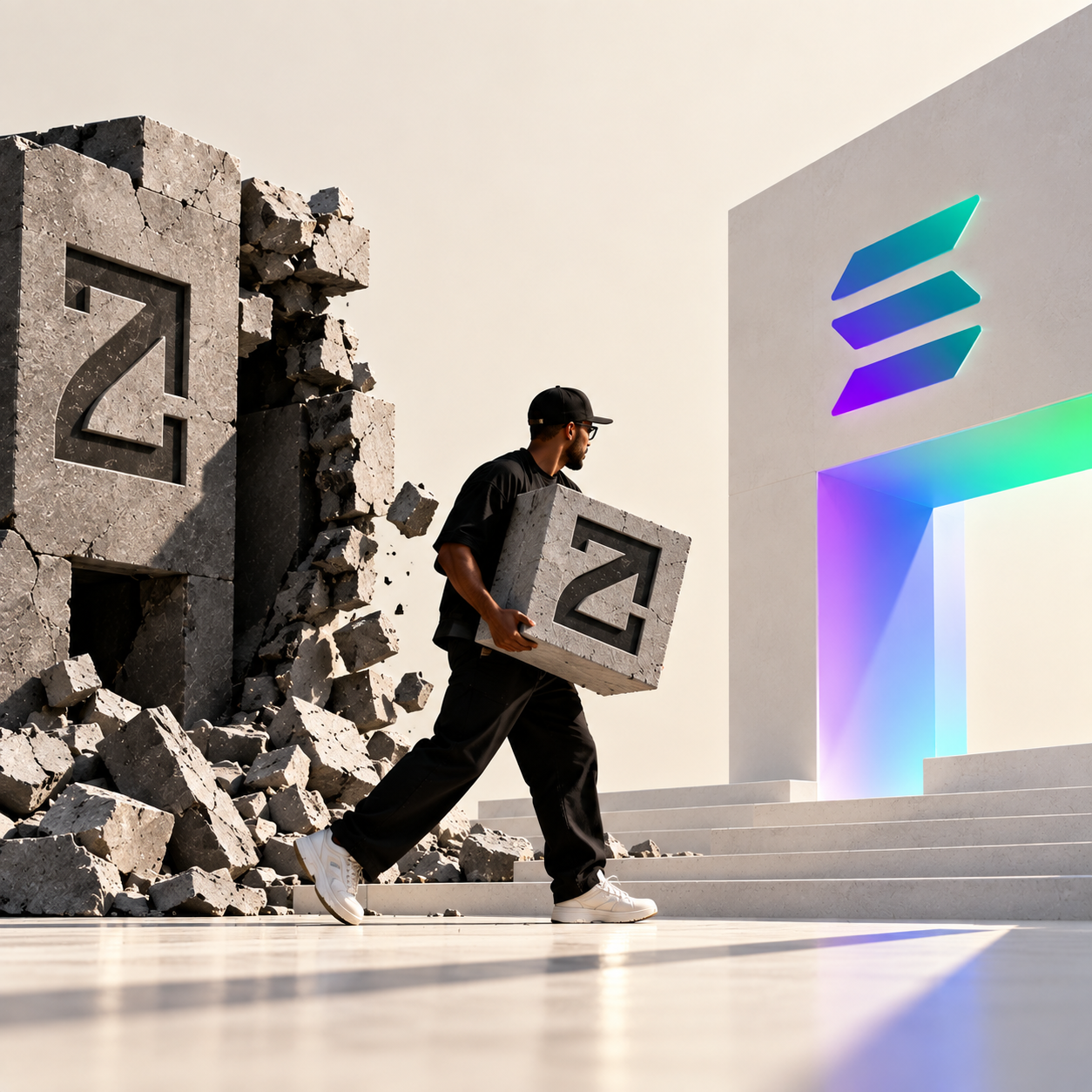
ZetaChain's proposed shutdown raises a bigger question for crypto: after years of launching new blockchains, are applications starting to consolidate around the networks that already have users and liquidity?
Crypto spent years rewarding projects for becoming blockchains. ZetaChain may be an early example of that logic running in reverse.
The project raised $27 million in 2023 to build a Layer 1 designed to connect assets and applications across chains. Now 99.4% of participating tokenholders have voted in favor of retiring that L1 and moving ZETA to Solana.
Participation reached 58%, above the required quorum. The migration is not final: another governance proposal is still needed to establish the snapshot and shutdown details.
The vote is interesting well beyond ZETA. Maintaining a blockchain is expensive. Solana already has validators, liquidity, wallets, exchanges and users. ZetaChain is effectively asking whether its resources are better spent building applications on top of that network instead.
Post from @SolanaFloorView the original post on X↗
From Building a Blockchain to Building an App
ZetaChain was created around interoperability. Its Layer 1 uses the Cosmos SDK and was designed to let developers build applications capable of interacting across networks including Bitcoin and Ethereum.
The team's priorities have since shifted toward Anuma, an AI application launched this year.
ZetaChain says Anuma has more than 300,000 users and has processed one million requests across 35 AI models.
That changes the economic calculation. Every engineer working on validator coordination, security patches and chain maintenance is an engineer not working on the application attracting users.
Moving to Solana would outsource much of that infrastructure problem to an established network.
What Happens to ZETA?
Under the current proposal, ZETA would become a native Solana SPL token on a one-for-one basis, preserving the ticker and total supply.
The exact migration process still requires another governance vote, and exchanges need time to prepare for the conversion.
For ZETA holders, that means the story is not simply that ZetaChain is shutting down. The token is intended to continue on another network, while the underlying Layer 1 would be retired.
What changes is the role of the asset and the infrastructure supporting it.
Why Solana?
Solana offers something a standalone L1 has to build for itself: an existing market.
That includes users, wallets, decentralized exchanges, stablecoin liquidity, developer tooling and integrations with major centralized exchanges.
For an application team, access to that environment can be more valuable than controlling its own validator set.
The trade-off is sovereignty. A dedicated Layer 1 can design its own economics, execution environment and governance around a specific vision. Moving to Solana means operating inside another network's technical and economic rules.
Post from @AlphaInsidersView the original post on X↗
Who Does This Affect?
ZETA holders face the most direct change because the token's home network and utility model are being reworked.
Solana potentially gains another application, token and user base, reinforcing the network effect that already attracts projects looking for liquidity and distribution.
Cosmos-based infrastructure loses a standalone chain if the shutdown is completed.
Other smaller Layer 1 projects may face uncomfortable questions from their own communities. If an application can reach more users by moving to an established network, maintaining an independent blockchain needs to justify its cost.
What It Means for SOL and the L1 Market
One migration does not prove the Layer 1 era is over. But the incentives have changed.
During the previous cycle, launching a chain could create a token, attract capital and give a project control over its own ecosystem. Today, users and liquidity are more concentrated, while mature networks have become faster and easier to build on.
For SOL holders, migrations like this can strengthen the network effect if they bring additional users, applications and transaction activity to Solana. The impact of one project is unlikely to move Solana's economics by itself, but the pattern would matter if more teams follow.
For investors evaluating smaller L1 tokens, the question is becoming sharper: what does this blockchain provide that an application could not get by building on Solana, Ethereum or another established network?
ZetaChain spent years building an answer to that question. Its community has now voted to try a different one.
Reporting by Lidia Yadlos