
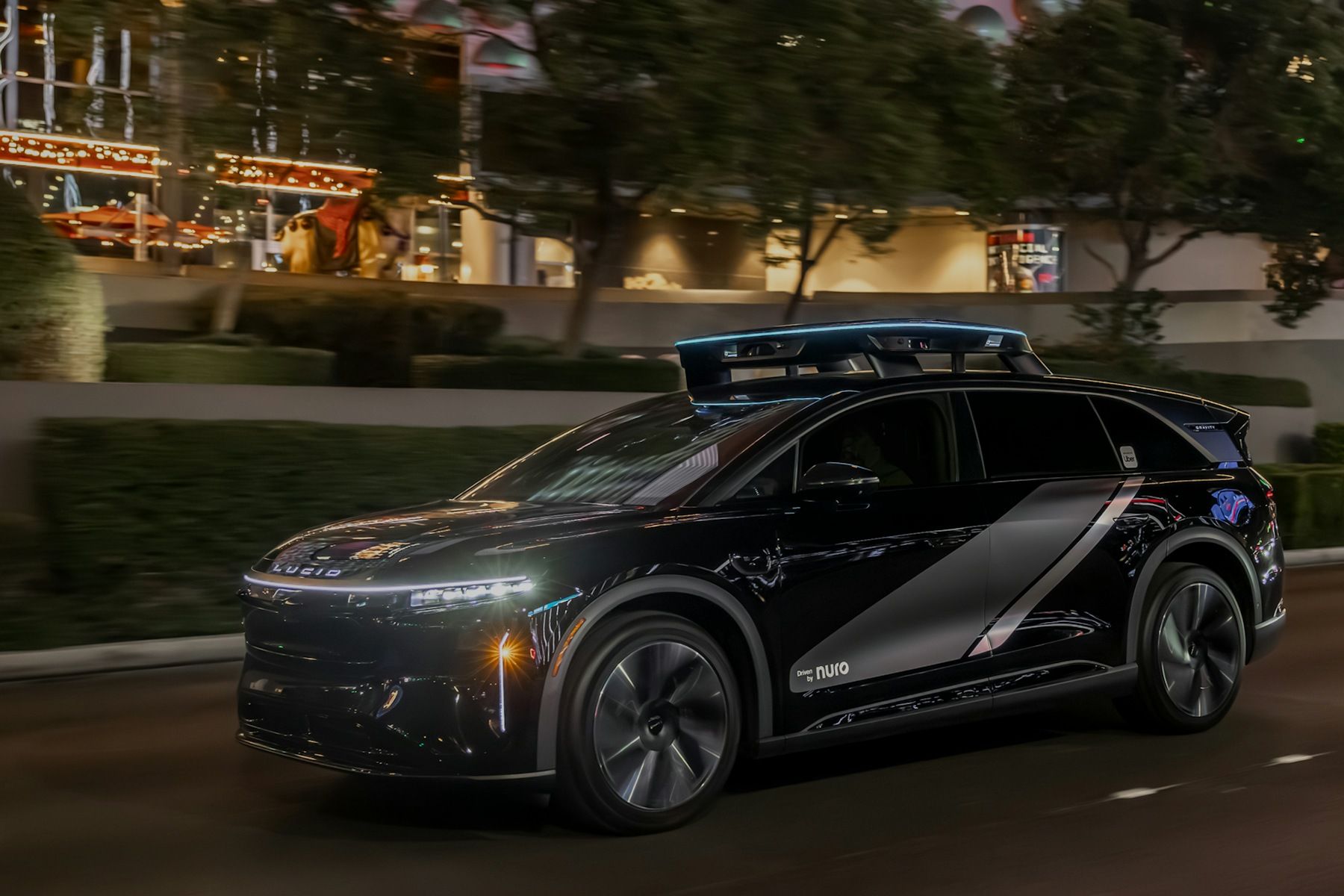
Uber's Lucid robotaxis are now being tested without a safety driver behind the wheel. Nuro, Lucid and Uber announced fully driverless public-road testing on November 24, taking their electric SUV program a step closer to carrying paying passengers.
The initial testing area covers Palo Alto, Mountain View, Los Altos and Sunnyvale. Employee rides are due to follow, with a public launch through Uber expected in the first quarter of 2027. The announcement concerns testing, so riders cannot yet assume one of these vehicles is available to book.
Lucid has delivered more than 100 vehicles for the program. The partners previously ran supervised tests in the Bay Area and Houston, beginning in December 2025. Removing the onboard safety operator changes what the system must handle on its own, rather than simply adding another vehicle to that earlier testing fleet.
Post from @nuroView the original post on X↗
Three companies split the job
This is an attempt to assemble a robotaxi business from three existing strengths. Lucid supplies the Gravity electric SUV and vehicle integration. Nuro provides the driving system. Uber brings the booking platform and, alongside fleet partners, vehicle operations.
The latest program commitment is at least 35,000 Lucid vehicles over the coming years. That is a purchasing and deployment ambition, not the size of the fleet already operating without drivers. The near-term story is the move from supervised development toward an actual passenger service.
For Uber, the arrangement offers a route to autonomous rides without having to manufacture its own car. For Lucid, it creates a potential fleet customer beyond individual buyers. For Nuro, it brings its technology into a passenger vehicle that can reach customers through an established app. Each company's contribution also becomes a dependency for the other two.
The vehicle is designed to feel like a premium ride. According to the partners' robotaxi product page, configurations can carry up to six passengers, with space for luggage. Interior screens let riders adjust music, temperature and heated seats, contact support or request a pull-over.
Those controls take on greater importance when there is no person in the front seat to answer a question. A useful autonomous ride needs to explain what is happening as well as navigate the road.
The car has to show its work
The Gravity's sensors include cameras, lidar and radar, with a roof-mounted module that can display passenger initials to help identify the correct vehicle. NVIDIA DRIVE AGX Thor supplies onboard computing. The cabin display is designed to show how the system sees its surroundings and its next actions, such as yielding or changing lanes.
That combination makes the program a concrete example of physical AI: software making decisions that move a machine through a shared environment. Blockster's reporting on Cantor's physical-AI discussion with Agility Robotics' Peggy Johnson explored the same shift from impressive demonstrations toward systems that can do useful work reliably.
The hard cases are often infrequent. A large collection of ordinary miles does not necessarily contain enough examples of unusual traffic behavior to establish how a system will respond. Nuro's November 19 research update describes using targeted simulations to address those gaps in testing.
Post from @nuroView the original post on X↗
Testing is a milestone, not the finish line
Nuro's published safety approach combines simulation, closed-course testing and public-road evaluation. It describes setting requirements for a particular operating environment, checking the system against those requirements, and monitoring performance after deployment.
The company reports more than two million autonomous miles without an at-fault incident across its experience. That is a company-reported historical figure, not a guarantee about this passenger service. The relevant question for this rollout is whether the integrated Gravity system can satisfy its operating requirements consistently as testing expands.
Nuro's engineering chief placed today's step within that broader history:
“Driverless isn't new to us, but this marks an exciting first: bringing that experience to a passenger vehicle”
— Tilo Schwarz, Vice President of Engineering and Head of Nuro Driver, Nuro
The next stage will test more than navigation. Employee rides give the partners a chance to refine pickups, passenger support and the experience inside the cabin before opening the service to the public. Charging, maintenance and fleet availability will also affect how useful the service becomes.
The AI industry's growing attention to cost per completed task has a straightforward counterpart here: the cost and reliability of completing a ride. Manufacturing a capable vehicle and removing its safety operator are necessary steps, but neither by itself establishes the economics of running a large fleet.
For now, the next date to watch is the first quarter of 2027. That is when the partners expect their Bay Area testing program to become a service passengers can request through Uber.
Reporting by Sasha Steenkamp