

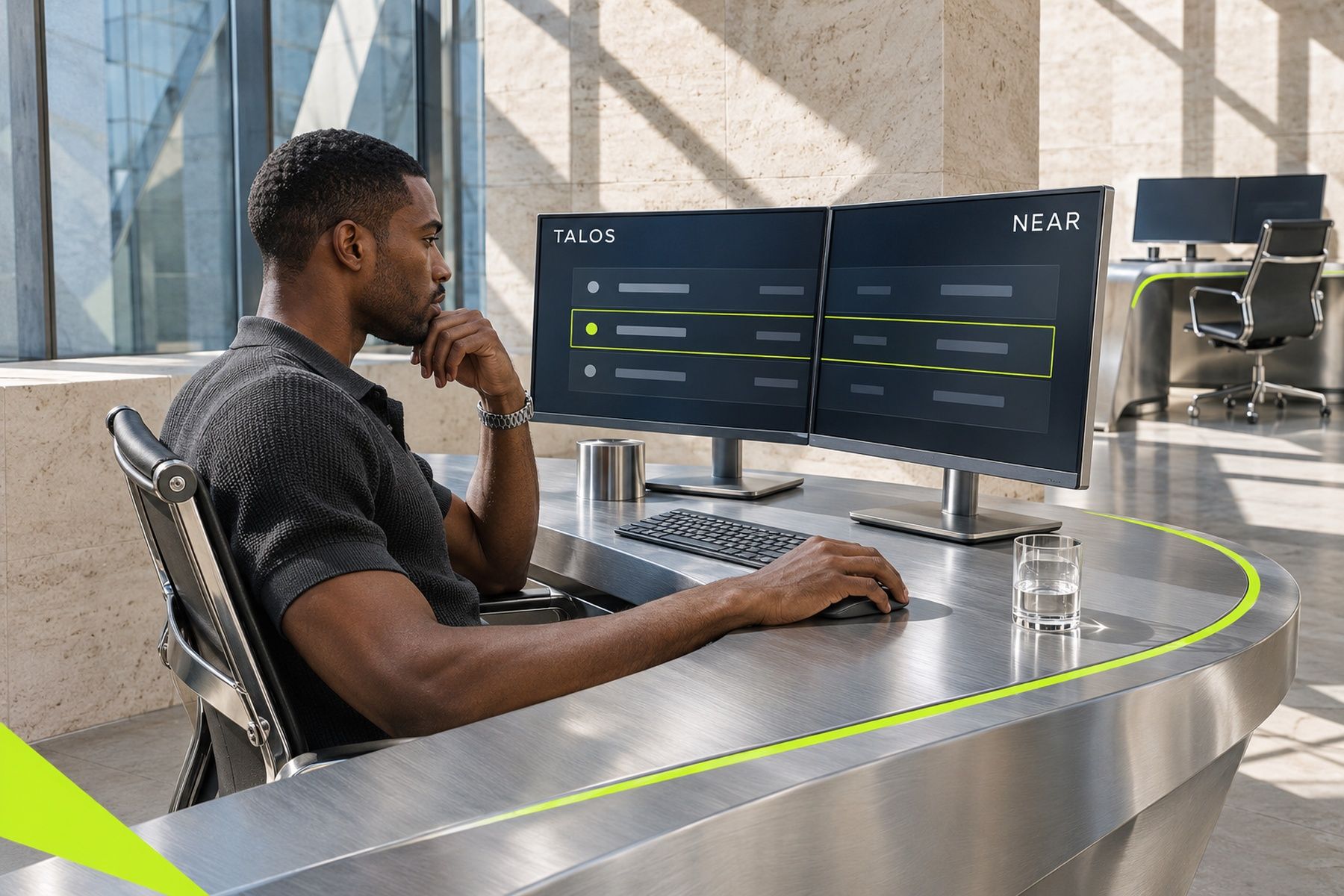
For an institutional trading desk, a better price is only useful if the trade fits the firm’s custody, approval and reporting systems. Accessing onchain liquidity has often meant adding wallets, managing bridge transfers and reconciling another set of accounts.
Talos wants to make that process simpler. The institutional trading technology provider has integrated NEAR Intents, allowing clients to request prices and execute swaps through the same workflow they already use for large spot trades, over-the-counter options and ETF creation and redemption.
The connection brings a network that has processed approximately $37 billion in cumulative swap volume into institutional trading infrastructure. DefiLlama’s current cumulative figure broadly matches the total cited in the announcement.
For NEAR, it creates another route to professional trading activity. For Talos clients, it adds a source of liquidity that can compete for their orders.
Ask for a Price. Let the Solvers Compete.
The integration uses a request-for-quote process, usually shortened to RFQ. A client specifies the trade they want to make, receives a price and decides whether to accept it.
Behind that quote, NEAR Intents uses competing liquidity providers called solvers. They bid to fill the order, sourcing inventory across more than 30 blockchains and centralized trading venues.
The trader does not need to choose every bridge or manually assemble the route between networks. Solvers compete to deliver the requested outcome, while the infrastructure handles routing and cross-chain execution.
Talos announced the connection on November 9:
Post from @talostradingView the original post on X↗
The distinction matters because this is not simply another liquidity pool. It is a quoting network that lets providers compete for each trade using inventory from multiple markets.
Competition can improve the available price. Whether it produces a better result for a particular desk will depend on trade size, available inventory and the full cost of execution.
The Custodian Still Signs
Making that process work inside institutional controls required a new signing service.
An intent is a signed message describing the transaction a client authorizes. Once a client accepts a quote, Talos constructs that message, sends it to the client’s custodian for approval and signature, and submits it for execution by a solver.
The custodian remains part of the approval process. Talos says its signing service is designed to work with different custodians, with a broader rollout planned.
NEAR Intents handles bridging and gas management. A verifier contract is designed to make settlement atomic: all parts of the swap complete together, or none does.
The resulting positions appear alongside the rest of the client’s portfolio, bringing onchain balances and holdings at custodians and centralized venues into the same view.
That is the operational appeal: a desk can evaluate another source of liquidity while keeping its existing process for authorizing trades and tracking positions.
A Connection Between Two Established Networks
Talos already has substantial trading activity running through its software. In August, the company announced that it had crossed $1 trillion in cumulative notional trading volume since inception. That measures activity across the platform’s history, rather than assets under management or volume committed to this new integration.
The opportunity onchain is also substantial. According to Talos data cited in the announcement, Ethereum decentralized exchanges processed more than $26 billion in spot volume during October 2026.
For institutions, reaching those markets involves more than connecting to an exchange. Trading, custody and operations teams need compatible approval processes, records and settlement arrangements.
Daniel Packham, Talos’s VP and Head of Provider Network, said the integration responds to requests from clients who want access through systems they already use.
“Talos clients asked for access to solver-sourced liquidity without standing up a second operating model to reach it.”
— Daniel Packham, VP and Head of Provider Network, Talos
Talos supplies the connectivity software. Clients still need to establish their own commercial arrangements with relevant providers, and availability depends on jurisdiction and onboarding.
The announcement also distinguishes network fees below one cent from the fee schedules clients must obtain during onboarding. A low network fee should not be read as the complete cost of an institutional trade.
NEAR Is Expanding Where Its Liquidity Can Be Used
The Talos connection extends a strategy already visible elsewhere in the NEAR ecosystem: put cross-chain execution inside products people already use.
Blockster previously covered NEAR.com’s addition of tokenized Nvidia, Tesla and Apple exposure through Ondo. Eligible users could access those assets using supported crypto from other networks, with NEAR Intents handling the routing.
Aurora Intents’ integration with Sui applications applied the same underlying infrastructure to another problem: helping users move from assets on one chain into lending, staking or trading positions on another.
Talos brings that approach to institutional trading desks. NEAR Intents confirmed the integration in its own announcement:
Post from @near_intentsView the original post on X↗
The next measure of success is how much trading activity follows—and whether desks consistently get competitive prices, dependable settlement and useful records.
Talos clients can request API access to begin onboarding. The integration gives NEAR a route into institutional workflows; execution quality will determine how often those institutions use it.
Reporting by Lidia Yadlos