


Robinhood customers can trade bitcoin, buy stocks and take a position on who wins a basketball game. Those yes-or-no predictions are becoming a bigger part of the company’s business.
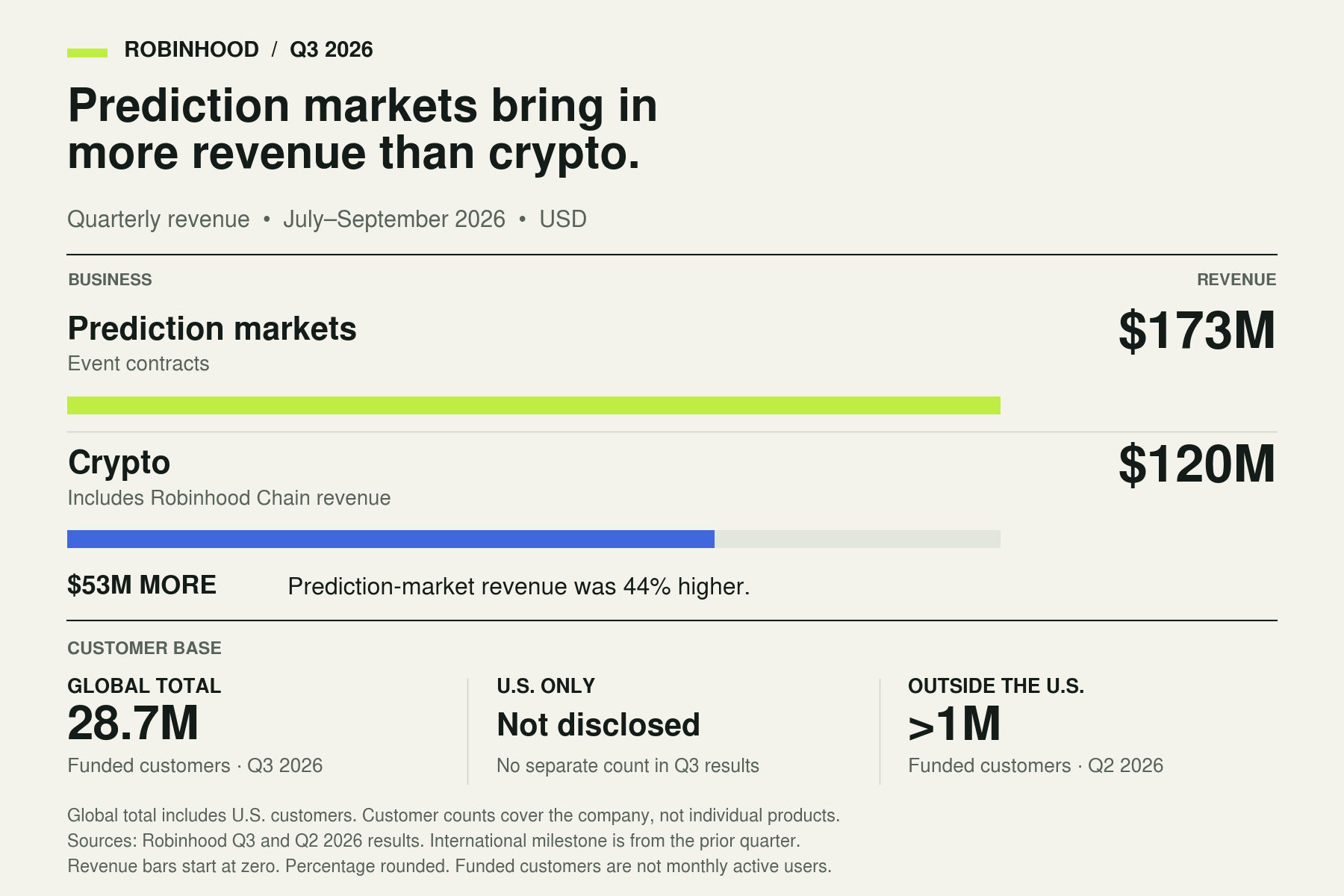
Robinhood earned $173 million from event contracts in the third quarter, ahead of $120 million in crypto revenue. Prediction-market revenue rose 11% from the previous quarter, extending its lead over crypto, according to The Block’s breakdown of the results.
Robinhood now has 28.7 million funded customers globally, up 1.9 million from a year earlier, according to its Q3 results. The company did not disclose a separate U.S. customer count in those results. Its Q2 report said funded customers outside the U.S. had surpassed 1 million; that earlier milestone is not a Q3 geographic breakdown.
The figures offer a window into how the trading app is changing. More of its business now comes from giving people a market for the events they already follow.
How a Yes-or-No Question Becomes a Trade
An event contract lets someone take a position on a specific outcome: whether a team wins a game, for example. A standard contract settles at $1 if the chosen outcome is correct and zero if it is wrong.
Imagine buying a Yes contract for 40 cents. If it settles in your favor, the return is 60 cents before fees. If it settles against you, the 40 cents is lost. Traders can also sell before settlement, at whatever price the market offers. Robinhood’s guide to event contracts explains the settlement rules and fees.
Robinhood earns commissions from that activity. Its customers traded a record 16.4 billion event contracts during the quarter, more than seven times the year-earlier total. That counts contracts traded, rather than individual customers or dollars deposited.
Post from @RobinhoodAppView the original post on X↗
The expansion reaches beyond brokerage apps. As Blockster reported yesterday, the NBA has brought Kalshi and Polymarket into its commercial business through partnerships involving league branding and official game data.
Crypto’s Recovery Has a New Ingredient
Robinhood’s crypto revenue rose 20% from the previous quarter, but the improvement needs a closer look.
Robinhood Chain contributed $26 million during its first quarter on mainnet. Excluding that contribution, crypto trading revenue fell 6% from the previous quarter to $94 million, according to The Block’s breakdown of the results. Total crypto revenue remained 55% below the year-earlier level.
The distinction matters: the blockchain added a revenue source even as the trading business weakened.
On October 13, Robinhood Crypto announced the milestone that Blockster covered as Robinhood Chain’s $100 billion in cumulative trading. That measured transactions across decentralized exchanges on the network. The earnings figures now show how the chain contributes to Robinhood’s own business.
Post from @RobinhoodCryptoView the original post on X↗
Record Revenue, Lower Profit
Across Robinhood, quarterly revenue reached a record $1.42 billion, up 12% from a year earlier. Options remained a larger revenue source than either prediction markets or crypto, bringing in $399 million.
Profit moved the other way. Net income fell 14% to $476 million, as operating expenses rose and investment-related losses weighed on results.
“Customers are trusting us with more of their assets as we deliver on our product roadmap, leading to our highest quarter ever for revenues.”
— Shiv Verma, Chief Financial Officer, Robinhood
Taken together, the results suggest Robinhood has more ways to keep customers trading when crypto activity slows. The next test is whether prediction markets and blockchain revenue can sustain that growth—and translate more of it into profit.
Reporting by Lidia Yadlos