


Wall Street’s trading day is getting harder to contain.
Intercontinental Exchange, the company behind the New York Stock Exchange, is investing in Trade[XYZ] and working with it on a U.S. market for perpetual futures built on Hyperliquid. The proposed venue would let eligible customers trade contracts linked to stocks, indices, commodities, currencies and crypto around the clock, subject to regulatory approval.
The partnership connects an established exchange operator with an onchain business that says it has already processed more than $650 billion in trading volume in just over a year. Investor Stan Druckenmiller is also among the backers joining the initiative. Financial terms of ICE’s investment were not disclosed.
Post from @tradexyzView the original post on X↗
What traders would actually be buying
A perpetual future lets someone take a position on whether an asset’s price will rise or fall, without buying the asset itself. Unlike a conventional futures contract, it has no scheduled expiration date.
That means trading a stock-linked perpetual is different from owning the stock. The trader holds a contract tied to its price, rather than shares carrying ownership rights.
Funding payments help keep perpetual prices aligned with their reference markets. Positions must also maintain enough collateral: using leverage can magnify losses and trigger liquidation when that collateral becomes insufficient.
The appeal is straightforward. News moves outside exchange hours, and traders increasingly want a way to respond before the next opening bell.
ICE wants to reach a different customer
ICE is more than the owner of the NYSE. It operates exchanges, clearing businesses and financial-data services used across global markets. In the third quarter, it reported $2.8 billion in net revenue, up 15% year over year, and $940 million in net income.
Its existing futures and clearing participation is more than 99% institutional, according to the company. That describes its customer mix, not a count of individual users.
The new business would target retail traders through a separate market and clearing structure. ICE would exclusively operate Trade[XYZ]’s regulated markets, while its existing institutional franchise would continue serving commercial hedgers.
For ICE, the opportunity is to reach customers whose trading habits differ from those of businesses managing longer-term exposure to energy, currencies and other assets.
“We see these perp markets as additive to our futures markets, not a replacement for them.”
— Jeffrey C. Sprecher, Chair and CEO of ICE, October 29 announcement
Trade[XYZ] is bringing new wallets into Hyperliquid
Trade[XYZ] develops the markets; Hyperliquid provides the underlying trading infrastructure. Their activity overlaps, so their volumes and user figures should not be added together.
Research published by Hyperdash on September 10 tracked 356,886 wallets that had traded a Trade[XYZ] market after excluding two identified clusters of manufactured wallets.
Of those, 173,794—48.7%—had never previously traded on Hyperliquid. These are wallet addresses, not verified individual people, but the research shows how Trade[XYZ] has brought fresh participation into the network.
Across Hyperliquid, DefiLlama’s October 29 snapshot showed approximately $206.93 billion in perpetual trading volume over the preceding 30 days.
The wider market includes Binance—and Robinhood
The competition extends well beyond onchain exchanges.
CoinMarketCap’s September report recorded $1.816 trillion in derivatives volume for Binance, followed by $711 billion for OKX and $434.5 billion for Bybit. Those totals include derivatives beyond perpetuals, so they provide broader market context rather than an exact comparison with Hyperliquid.
Robinhood is also expanding its offering. Its third-quarter results reported 28.7 million funded customers and highlighted the announcement of perpetual futures for eligible U.S. customers. The release did not separately report a comparable perpetuals trading-volume figure.
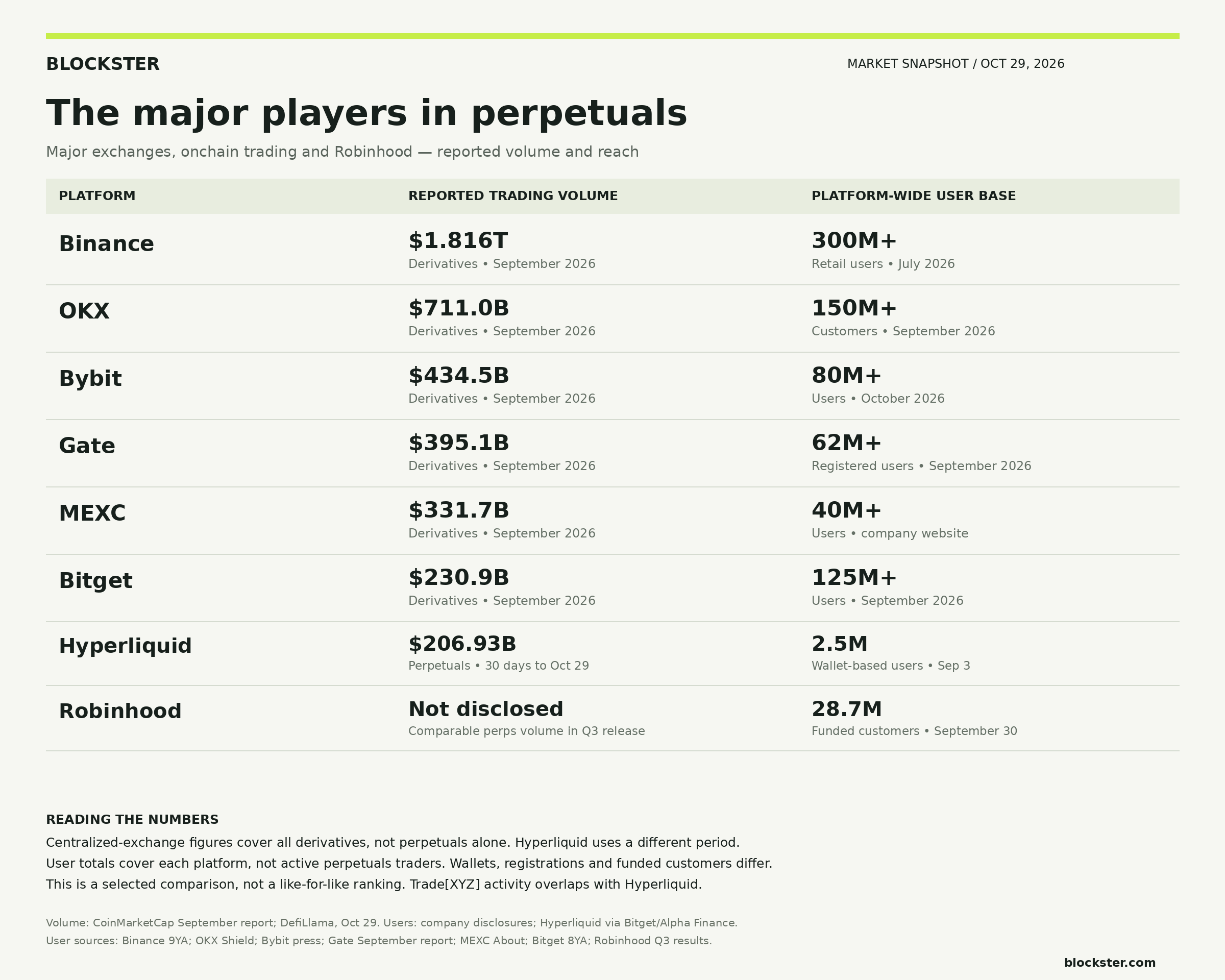
Reporting periods and definitions are shown in the table. Platform-wide users are not counts of active perpetuals traders.
Distribution could be as important as the technology
ICE expects customers to reach the proposed market through participating brokers and platforms, including its joint venture with OKX. That venture’s broker-dealer and futures commission merchant approvals remain pending.
Customers would undergo identity and anti-money-laundering checks. The proposed U.S. market still requires regulatory approvals, including those needed for leveraged trading.
The distribution strategy matters because traders may encounter these products inside services they already use. A new market does not necessarily need every customer to adopt a new app.
Post from @ICE_MarketsView the original post on X↗
Another step toward markets that stay open
The move follows other efforts to expand U.S. access to perpetuals. As Blockster recently reported, Crypto.com and OG.com have begun offering eligible U.S. customers crypto perpetuals with up to five times leverage.
ICE and Trade[XYZ] have not announced a firm launch date or final customer-eligibility details. Trade[XYZ] plans to continue operating its existing Hyperliquid markets alongside the proposed U.S. venue.
The significance is the direction of travel: established exchange operators are finding ways to bring onchain trading into their businesses. If this model gains approval and attracts customers, more familiar assets could become accessible through markets that keep running after Wall Street closes.
Reporting by Lidia Yadlos