

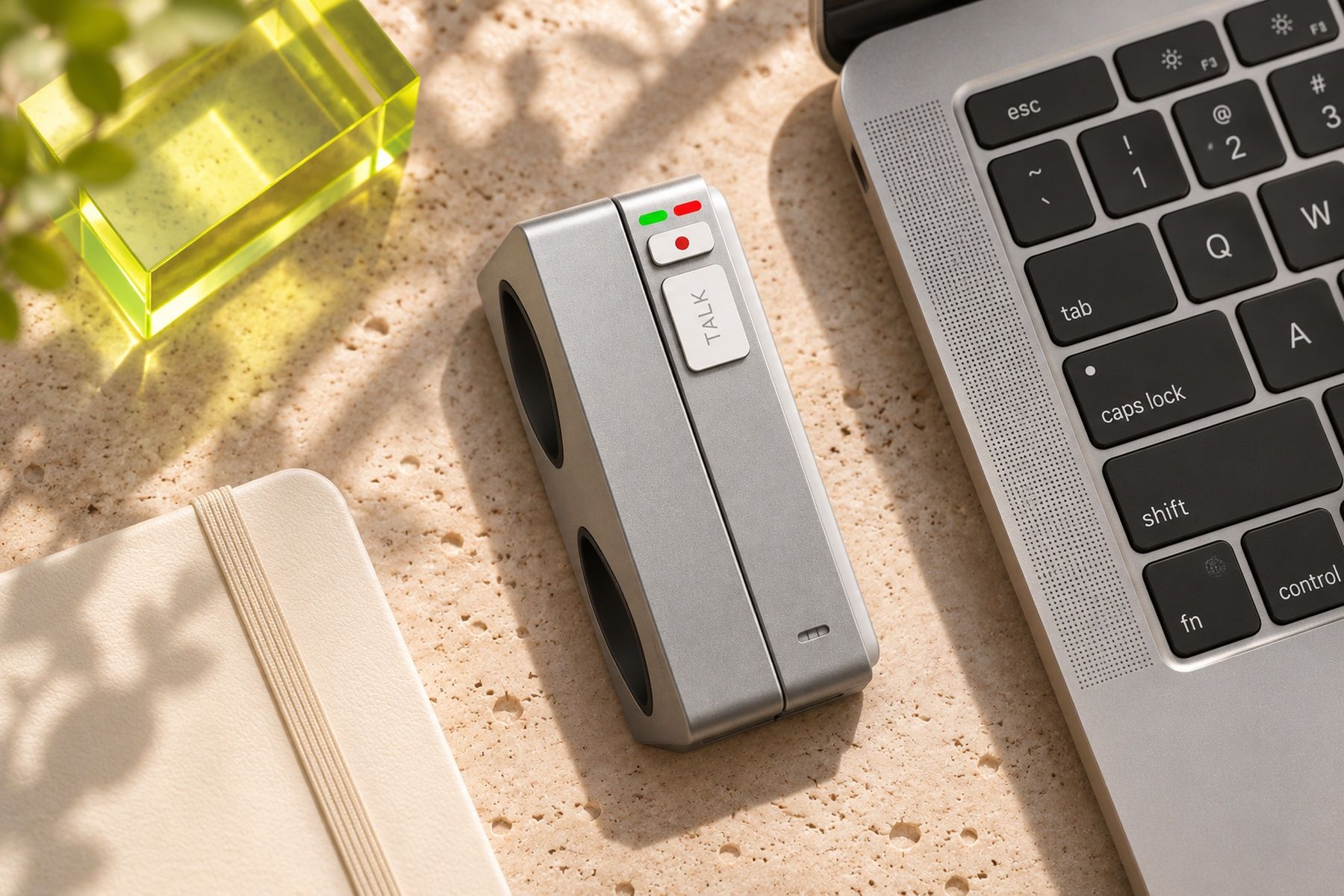
Pictured above: the Ear (note) charging case, which doubles as a recorder. The earbuds are not shown.
Nothing wants your next pair of earbuds to remember the conversation you just had. Ear (note), set for a fuller reveal on December 8, combines earbuds that record calls with a charging case that can capture conversations in the room.
The appeal is easy to understand: fewer meetings spent typing notes, fewer voice memos abandoned on a phone, and a record of what was actually said. The bigger ambition is to give AI assistants more of the information they currently miss when life happens outside a chat window.
Nothing co-founder Carl Pei confirmed the direction on November 23, describing the device as the first in a series intended to bring real-world context to AI. He shared Bloomberg reporter Mark Gurman's preview of the product, which Pei had demonstrated to the publication.
Post from @getpeidView the original post on X↗
The case has a job of its own
According to Bloomberg's preview, Ear (note) uses the earbuds for call recording and microphones in the case for in-person meetings. A companion app brings together recordings, transcripts and summaries. The case also has a Talk button for voice notes, alongside a separate recording control and indicator lights.
That makes the case more than somewhere to put the earbuds when their battery runs down. It becomes the part of the product you can place on a table, while the earbuds handle conversations through your phone.
Consider the difference between a transcript and a useful memory. A transcript preserves an hour of discussion. A useful assistant should help you recover the agreed deadline, the reason a decision changed or the question nobody answered. Those are examples of the job this category could do; they are not independently tested claims about Ear (note).
AI needs something worth remembering
The timing fits a broader shift toward assistants that do more than answer questions. Linq's $90 million funding round backs tools that let agents make calls and operate computers. Coinbase's new ChatGPT integration brings supported trading actions into a conversation, with user confirmation.
Nothing is approaching an earlier step: collecting the context an assistant would need before deciding what to do. A meeting recorder could eventually supply the instructions for a follow-up task, although recording a promise and reliably acting on it remain separate capabilities.
Pei's explanation starts with that information gap:
“AI is only as useful as what it knows about you.”
— Carl Pei, co-founder, Nothing
His hardware argument is also practical. Earbuds already have a place in people's routines. Nothing is trying to add intelligence to something people carry, rather than persuade them to find room for an entirely unfamiliar device.
Bloomberg also reports plans involving multiple AI agents and Nothing's own voice assistant. Those ambitions extend beyond the recording functions shown in the preview. They should not be confused with a confirmed list of features buyers will receive at launch.
December 8 still has questions to answer
Nothing has not announced a price. Its official teaser points to December 8, but the preview does not establish when customers will receive the device or the full terms of the accompanying service.
Post from @nothingView the original post on X↗
The details that will determine its usefulness are less theatrical than an AI launch video: how clearly it captures several people speaking, whether summaries preserve qualifications and disagreements, and how easily a user can retrieve the original passage behind an answer. Recording controls, storage and deletion will matter as much as the quality of the microphones.
Nothing has chosen a recognizable object and a recognizable frustration. On December 8, the question is how much work Ear (note) can save after the conversation ends.
Reporting by Eric Spivak