
CES 2026 is about intelligence moving into the physical world.
Across the exhibition halls, the pattern is clear: robots everywhere, AI companions stepping off screens and onto desks, health tech shifting toward longevity, and industrial systems designed to think, adapt, and operate autonomously.
That future is already taking shape. One example circulating from the show floor features a Lenovo prototype robot folding laundry in a home setting.
Post from @xPhoenixView the original post on X↗
What once felt experimental is now being presented as inevitable. Below are some of the defining highlights from CES 2026.
1. AI Moves From Software to Infrastructure
The day opened with a keynote from Siemens President and CEO Roland Busch, who described how customers are already using AI to reshape manufacturing, production, and supply chains. Joining him on stage was Nvidia CEO Jensen Huang, as the two companies announced an expanded partnership aimed at accelerating what Busch described as a new, AI-driven industrial revolution.
Post from @TechCrunchView the original post on X↗
The message was reinforced later by Lenovo, which closed the day with a sweeping presentation showing how its AI platforms are designed to support individuals through wearables, businesses through enterprise tools, and society more broadly. Lenovo CEO Yang Yuanqing appeared alongside Huang, AMD CEO Lisa Su, and Intel CEO Lip-Bu Tan, underscoring how deeply AI now cuts across the industry.
CES has always been a proving ground. In 2026, it’s increasingly a roadmap.
2. AI Companions Step Into the Physical World
Consumer-facing AI took a more tangible form at Razer, which used CES to expand beyond its gaming roots. The company unveiled two AI-powered prototypes designed to function as everyday companions, not just gaming accessories.
One, an over-ear headset dubbed Project Motoko, doubles as a general-purpose AI assistant. The other, Project Ava, moves Razer’s on-screen assistant into the physical world — a small holographic device housed in a glass tube, complete with speakers and a camera that allows it to perceive its surroundings.
Post from @shacknewsView the original post on X↗
Notably, both devices are model-agnostic. In demos, Project Motoko ran on OpenAI’s ChatGPT, while Project Ava used xAI’s Grok. Razer expects both products to reach consumers later this year, signaling growing confidence that AI companions are ready to live alongside users, not just inside apps.
3. Robots Take on Real-World Jobs
Robotics at CES 2026 leaned less toward novelty and more toward deployment.
Oshkosh Corporation outlined how autonomous machines could manage airport operations, including fueling, cleaning, cargo handling, and aircraft turnaround. The goal is fewer delays and safer operations, particularly during extreme weather. Testing with major airlines is already underway, with major hub airports expected to be early adopters.
Autonomy is also moving into transportation. CES featured a production-intent Lucid × Uber × Nuro robotaxi, built with real Level 4 autonomy and designed for premium passenger experiences.
Post from @ntworkView the original post on X↗
Unveiled at Nvidia’s showcase, the vehicle reflects how autonomous mobility is shifting from pilots to commercial readiness — combining AI, safety, and scalability for real-world streets.
In the home, Roborock showcased the Saros Rover, a robotic vacuum equipped with articulated limbs that allow it to climb and clean stairs — a long-standing challenge in consumer robotics. Still in development, the prototype signals a broader push toward machines that can operate reliably in complex, everyday environments.
Post from @PCMagView the original post on X↗
4. Health Tech Shifts Toward Longevity
Health technology at CES also showed a clear evolution — away from basic tracking and toward long-term health insights.
Withings showcased its updated Body Scan 2, a smart scale that measures up to 60 biomarkers in roughly 90 seconds. Beyond weight, it tracks heart age, vascular health, metabolic indicators, nerve function, and electrodermal activity. Priced at $600 and launching this spring, the device pairs with a subscription app that offers trend analysis and personalized guidance.
Post from @AIFrontlinerView the original post on X↗
The emphasis is no longer on fitness metrics alone, but on helping users understand — and potentially reverse — long-term health risks.
5. Brain–Computer Interfaces and Mobility Enter the Conversation
Beyond robots and AI companions, CES 2026 also highlighted early momentum around brain–computer interfaces and next-generation mobility. Samsung showcased Vision AI across devices, while Nvidia formalized its shift from “digital AI” to physical AI—systems designed to perceive, reason, and act in the real world.
On the frontier of human–machine interaction, startups like Naqi Logix demonstrated non-invasive neural earbuds capable of controlling devices without voice or touch, signaling potential breakthroughs in accessibility and interface design. Mobility innovations followed the same theme, with autonomous personal vehicles like Strutt EV blending AI navigation, LiDAR, and voice control to reimagine independence and movement.
Post from @CESView the original post on X↗
Together, these technologies point toward a future where intelligence is ambient, embodied, and increasingly autonomous.
6. Humanoid Robots Get a Brain Upgrade
One of the most consequential announcements came from Google DeepMind and Boston Dynamics, who revealed a partnership to bring advanced AI into humanoid robots — including the next generation of Atlas.
Post from @HyundaiIndiaView the original post on X↗
Boston Dynamics’ robots are already known for unmatched agility and balance. What they’ve historically lacked is adaptive intelligence. By integrating DeepMind’s AI systems, the companies aim to move beyond scripted behaviors toward robots that can reason, learn, and adapt in real-world environments.
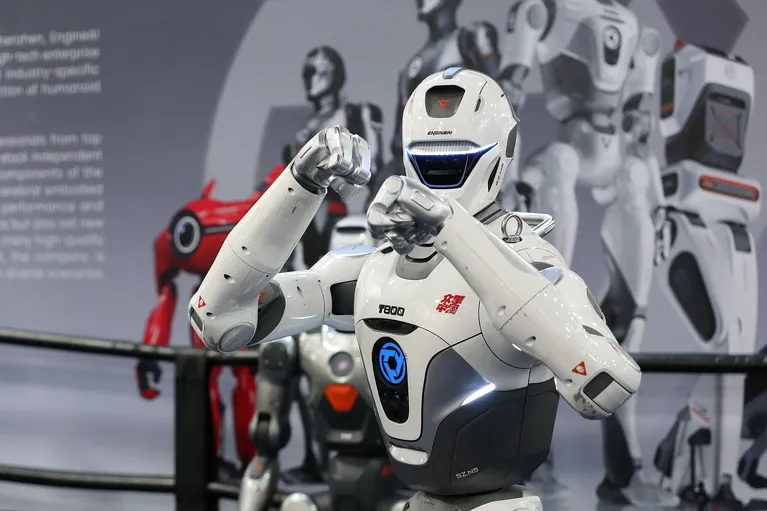
The shift reflects a broader industry trend: humanoid robots are moving from impressive demos to practical deployment. Analysts see this convergence of embodiment and intelligence as essential for real-world use cases, from manufacturing and logistics to healthcare support and disaster response.
The partnership also intensifies competition in a fast-moving field that includes Tesla, Figure AI, and several Chinese robotics firms racing to build general-purpose humanoid workers.
Post from @ChinaDailyView the original post on X↗
7. AI Powers the Next Energy Frontier
CES 2026 also highlighted how AI is reshaping energy infrastructure.
Commonwealth Fusion Systems (CFS) announced a collaboration with Nvidia and Siemens to accelerate the development of nuclear fusion. At CFS’s Massachusetts facility, construction of its SPARC fusion reactor is about 70% complete.
Post from @CFS_energyView the original post on X↗
As part of the partnership, the team is creating a “digital twin” of the reactor — a detailed simulation that allows researchers to test scenarios, analyze data, and compress years of experimentation into weeks. CFS CEO Bob Mumgaard said the approach is already speeding progress toward ARC, the company’s first planned commercial fusion power plant, expected to come online in the early 2030s.
The Bigger Picture
Across consumer tech, robotics, health, energy, and infrastructure, CES 2026 revealed a common theme: AI is no longer just an interface — it’s becoming an operating layer for the physical world.
That trajectory aligns with a view recently articulated by Elon Musk, who has said he expects "AI-powered humanoid robots to eventually outnumber humans," arguing that embodied intelligence will be one of the biggest catalysts driving the next phase of AI’s growth.
CES 2026 offered an early glimpse of what that future might look like — not as science fiction, but as an emerging industrial reality.
Read Related Coverage on AI, Crypto, and the Next Phase of Tech
How AI, Productivity & Crypto Converge: Nvidia’s $65B revenue forecast marks the next phase of AI infrastructure and shows how agentic systems are driving unprecedented productivity.
Agentic AI Is Changing How Software Gets Built: From Meta’s acquisition moves to emerging autonomous workflows, agentic AI is redefining how software is developed and executed.
Cardano’s Thomas Mayfield on 2026: Mayfield explains why this year will be the inflection point where AI moves from assistance to being trusted to act on our behalf.
Reporting by Lidia Yadlos