
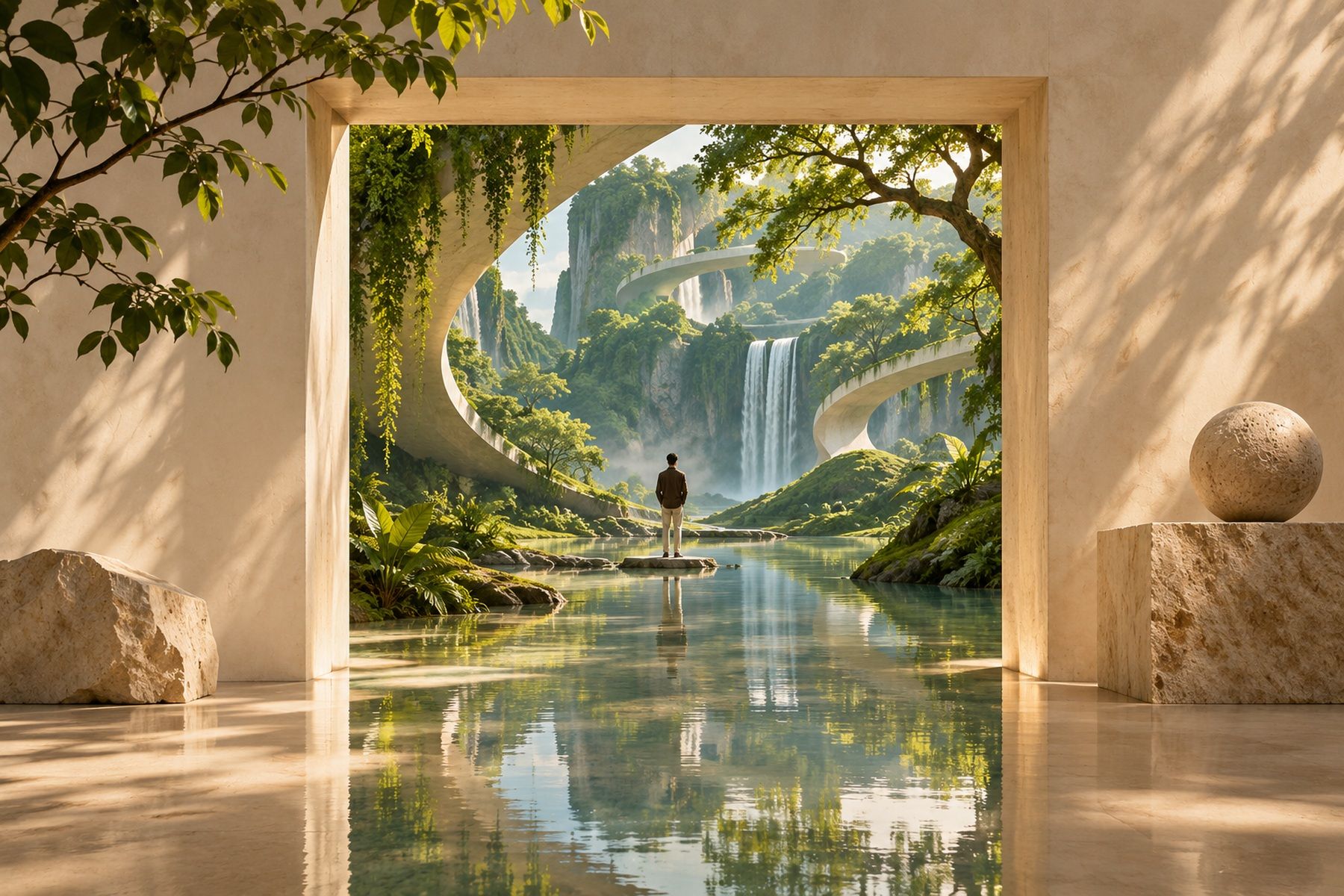
Google's latest creative AI release is something you can move around inside. Genie 4 is rolling out through Project Genie to eligible Google AI Ultra subscribers, following its earlier research preview.
The November 18 update lets users alter a generated environment while exploring it: change the weather, introduce a character or redirect the action with a new prompt. Sound is generated alongside the scene, including ambient audio and dialogue.
A world that responds instead of a video that plays
The distinction is interaction. A generated video follows a sequence; a world model responds to what the user does next. That makes the format interesting for creative prototypes, experiments and experiences that sit somewhere between a film and a game.
The update also introduces a Project Genie agent to help construct worlds conversationally, plus a gallery for discovering, sharing and remixing them. Google AI Pro members can join a waitlist rather than assuming immediate access.
These features should not be confused with a complete game-development engine. A compelling moment inside a generated scene is only one component of a reliable, repeatable interactive product.
The older model gets a different upgrade
Google is keeping Genie 3 in the model picker. Its update includes sessions of up to three minutes per generation, panorama-based starting environments and linked worlds. The three-minute figure belongs to Genie 3, not a newly announced Genie 4 duration.
“Genie 4 remains an early, evolving area of research.”
— Google DeepMind, Genie 4 research overview
Google's research overview acknowledges problems with long-term consistency, object permanence and complex physical interactions. A door, object or spatial relationship can drift as a session continues.
That qualification makes the practical use clearer: explore an idea, test a mood or develop an interactive concept, while checking what the system actually preserves. Alongside the builder tools in Blockster's Gemini Hydrogen coverage, Genie shows Google pursuing both sides of creation—the software used to build experiences and the experiences generated directly.
Reporting by Lidia Yadlos