

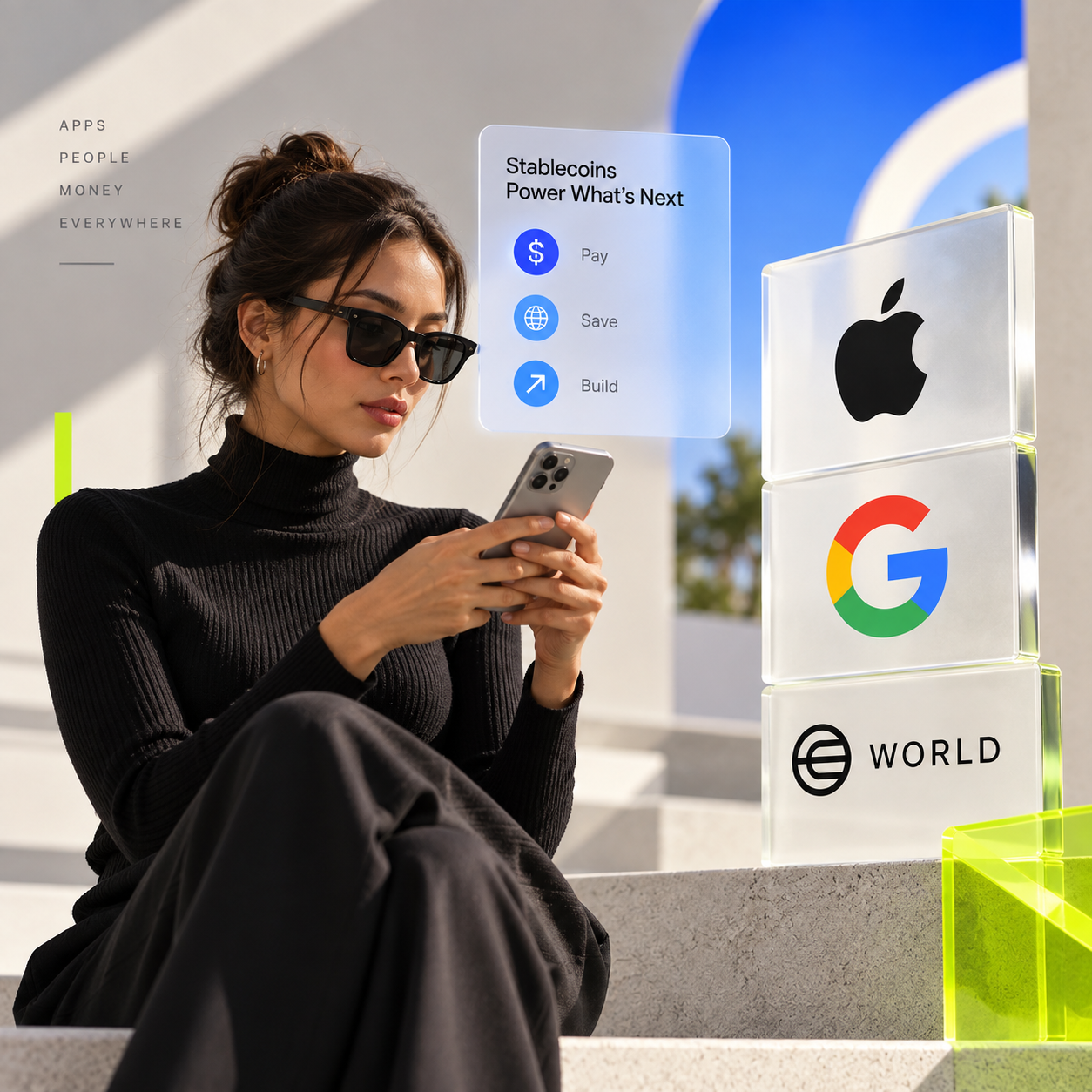
Apple Pay and Google are hiring for stablecoin and tokenization expertise just as World Money begins pushing stablecoins into a consumer app available across more than 150 countries.
Apple and Google have not announced stablecoins of their own. What they are doing is arguably more revealing: both are hiring people who understand how stablecoins, tokenized deposits and blockchain-based payments fit into products used by hundreds of millions of people.
The timing matters. World has just launched World Money across more than 150 countries, giving users access to supported stablecoins and other financial services through an app designed to feel much closer to fintech than a traditional crypto wallet.
In the U.S., World says Stripe powers a funding flow that lets users move money into supported stablecoins through Apple Pay.
That combination offers a glimpse of where stablecoins may be heading next. The technology can move into the background while familiar consumer apps become the interface.
Post from @AshCryptoView the original post on X↗
Apple Pay Is Looking Beyond Cards
Apple is recruiting a Financial Product Strategy Lead for Apple Pay, with familiarity in stablecoins, tokenized deposits and blockchain among the preferred qualifications.
That does not mean Apple is about to issue an Apple stablecoin. It does mean digital dollars and tokenized bank money have become relevant enough to Apple Pay's future strategy that the company wants people who understand them.
Apple has historically kept tight control over how crypto interacts with its ecosystem. A stablecoin does not need to be an Apple product, however, for Apple to benefit from the growth of blockchain payments. Apple Pay can remain the interface consumers recognize while another financial rail handles settlement underneath.
For a retail user, that could make crypto payments feel less like crypto.
Google Is Building Expertise Around the Same Market
Google is separately recruiting Web3 expertise spanning stablecoin payment rails, tokenized deposits, real-world assets and digital-asset custody.
Google's path is different because Google Cloud already works with blockchain infrastructure and digital-asset companies. The new hiring points toward a broader question: how much of the financial stack eventually moves onto programmable rails while consumer-facing products remain familiar?
World Money Shows What That Could Look Like
World Money turns that abstract idea into something consumers can already understand.
The app is rolling out across more than 150 countries and allows users to hold and send supported stablecoins alongside other financial services. In the U.S., the Apple Pay funding flow means a user can begin with an interface they already know rather than navigating an exchange, bridge or unfamiliar wallet process.
World is not Apple or Google, and its launch does not prove either company will follow the same model. It does show how quickly the line between a crypto wallet and a mainstream financial app is disappearing.
Post from @worldcoinView the original post on X↗
What It Means for Retail Investors
The opportunity is the infrastructure underneath the apps, not an Apple or Google stablecoin.
If consumers can move from Apple Pay directly into stablecoins, issuers gain distribution, companies such as Stripe and MoonPay handle the movement between traditional money and crypto, and blockchains compete to settle those transactions. Crypto exchanges could lose some of their role as the default entry point.
For investors, the signals to watch are specific: which stablecoins Apple and Google support, which networks they settle on, and which companies control the conversion from dollars into digital assets.
World Money offers an early preview. Apple Pay provides the familiar interface, Stripe handles the funding connection, and stablecoins sit underneath. The next stablecoin winners may be decided less by crypto users choosing them and more by which ones get built into the apps everyone already uses.
Reporting by Lidia Yadlos