
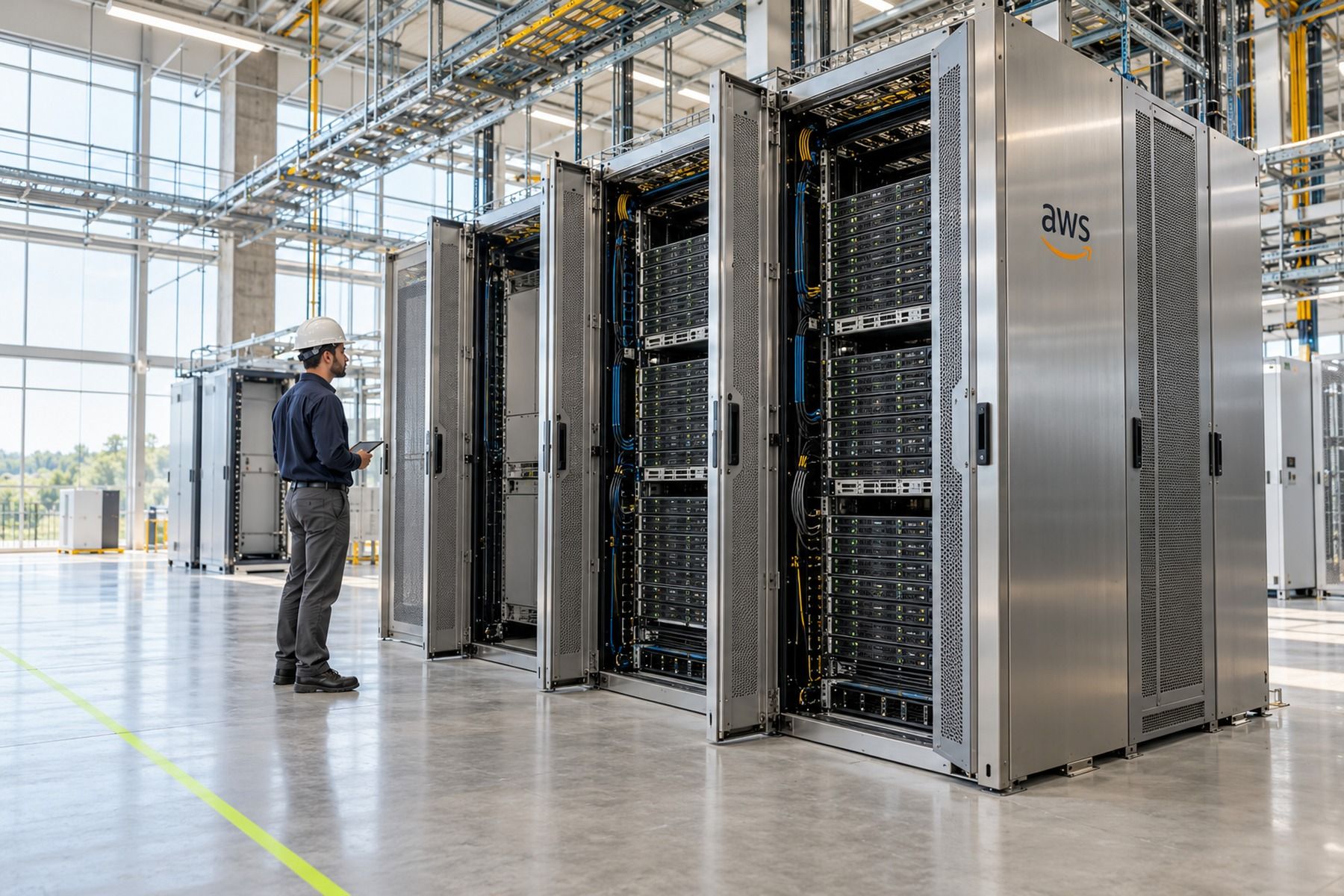
Amazon is selling more computing power than ever. Building enough capacity to keep up is consuming even more cash.
The company’s October 29 earnings report showed AWS revenue rising 39.3% to $46 billion, its fastest growth in nearly five years. Amazon also reaffirmed approximately $220 billion in cash capital spending for 2026. That is its company-wide budget, with most directed toward AWS—not a separate $220 billion AI fund.
Investors wanted more reassurance. Shares fell roughly 7% in after-hours trading Thursday, as overall sales and earnings missed expectations and the holiday-quarter outlook disappointed.
For anyone following the AI investment boom, Amazon offers a revealing test: strong demand can arrive well before the cash returns shareholders want.
Post from @sebasaherreraView the original post on X↗
The Numbers Behind the Tension
Amazon’s quarterly results show a business expanding while paying heavily for its next stage of growth.
| Measure | Latest result |
|---|---|
| Third-quarter revenue | $201.9 billion, up 12% |
| AWS revenue | $46 billion, up 39.3% |
| AWS operating profit | $17.8 billion |
| Operating cash flow, past 12 months | $168.3 billion |
| Free cash flow, past 12 months | Negative $42.4 billion |
| Expected 2026 cash capital spending | Approximately $220 billion |
Amazon attributed the free-cash-flow decline primarily to higher equipment and property investment, largely reflecting AI. A year earlier, the comparable cash-flow figure was positive $14.8 billion.
Free cash flow measures what remains after operating cash pays for investment in long-term assets. A negative number can therefore coexist with substantial accounting profits: the business earns money, then spends even more building capacity.
That distinction matters. The investment may produce future returns, but shareholders have to judge how long they will wait—and how much more spending comes first.
Customers Are Taking the Capacity
On the earnings call, CEO Andy Jassy reported an AWS backlog of $578 billion and said customers were taking new capacity almost as quickly as Amazon installed it.
He also said inference—the computing used to run AI models after training—already accounts for more than half of AWS’s AI revenue. That points to demand extending beyond building models into using them.
A backlog represents business expected under customer commitments; it is not cash already collected. Still, it gives investors something more concrete to assess than predictions about AI’s eventual popularity.
The next step is turning those commitments into paying workloads at an attractive cost.
Post from @stocksavvyshayView the original post on X↗
Why Amazon Keeps Building
The timing gap is built into the cloud business.
In his shareholder letter earlier this year, Jassy explained that Amazon pays for land, power, buildings and equipment before billing customers—typically six to 24 months earlier, depending on the component. Rapid expansion can therefore put pressure on cash flow even when demand is strong.
His latest comments suggest Amazon intends to keep moving. Jassy expects capital spending to rise further in 2027 and projects AWS revenue growth above 40% in both 2027 and 2028. Those are management expectations, not guaranteed results.
Asked about the scale of investment, he made Amazon’s position clear:
“We can fund this plan. I think it will forever change the size of Amazon.”
— Andy Jassy, CEO of Amazon, October 29 earnings call
What Investors Should Watch Next
Our reading is that three measures deserve attention together: cloud growth, operating margins and cash left after investment. Rising sales alone cannot establish whether the expansion is earning enough.
This builds on the question in Blockster’s recent look at AI’s growing investment bill: customers need to find the technology useful enough to keep paying, while providers need to deliver it profitably.
The implications also reach beyond Amazon. As our energy investment coverage explored, more computing requires physical infrastructure. That creates opportunities for suppliers, but investors still need to examine their costs, contracts and valuations.
Amazon’s results show why the AI boom can be commercially promising and financially demanding at the same time. The next test is whether today’s construction bill becomes tomorrow’s cash-generating capacity.
Reporting by Eric Spivak