

Prediction markets are growing up fast. What began as a retail playground for betting on elections, crypto prices and Federal Reserve decisions is rapidly attracting hedge funds, proprietary trading firms, institutional investors and AI-powered trading systems.
As billions of dollars flow through platforms like Polymarket and Kalshi, prediction markets are evolving into a legitimate financial market for pricing uncertainty.
Prediction Markets Reach Institutional Scale
Combined monthly trading volume across Polymarket and Kalshi reached approximately $13.7 billion in June, with July already surpassing $11 billion before the month is over. Kalshi recently reported its annualized trading volume has climbed to around $178 billion, while institutional trading activity has increased sharply over the past six months.
The surge in activity is attracting institutions that increasingly view prediction markets as tools for pricing uncertainty rather than online betting platforms. Federal Reserve decisions, inflation reports, elections, sporting events and regulatory announcements have become tradable events that investors can use to hedge risk or express market views.
That institutional shift is already taking shape. Infrastructure providers including Clear Street, Marex and Jump Trading have expanded access for professional investors, while firms such as AQR, Susquehanna and OKX have advertised specialist roles focused on prediction markets. The ecosystem is steadily building the same foundations that helped transform crypto into an institutional asset class.
Post from @KalshiView the original post on X↗
Why AI Is Becoming Part of the Market
AI is accelerating that evolution. Prediction markets are particularly well suited to AI because every contract has a definitive outcome. Modern AI trading agents connect directly to exchanges through APIs, monitor thousands of live markets and analyze everything from economic data and breaking news to social media sentiment. If an AI determines the market is mispricing the probability of an event, it can automatically place or adjust a trade in real time.
In practice, these systems rarely operate alone. Quantitative firms combine AI models that estimate probabilities with traditional algorithmic trading systems that handle execution, risk management and position sizing. The result is faster, more informed decision-making rather than fully autonomous investing.
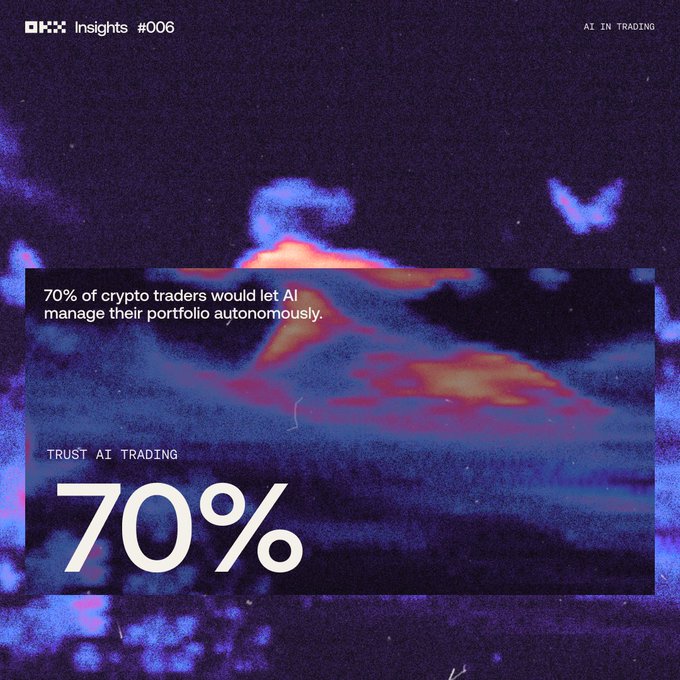
In a recent survey of 1,400 U.S. crypto traders, OKX found that 70% would trust AI to manage their portfolios autonomously, either with full discretion or within predefined risk limits.
Nearly 79% said better AI-powered trading tools would influence which exchange they use, while Gen Z traders were more than three times as likely as Baby Boomers to hand complete control of their portfolio to an AI. The findings suggest AI is quickly becoming an expected part of the trading experience, not simply an institutional advantage.
Post from @okxView the original post on X↗
Can AI Actually Beat Human Traders?
Not consistently—at least not yet. One of the largest public studies, Prediction Arena, gave six frontier AI models $10,000 each to trade autonomously on Kalshi and Polymarket over nearly two months.
Every model lost money on Kalshi, while performance on Polymarket was significantly stronger, averaging -1.1%. One model correctly predicted the outcome of more than 70% of settled markets, demonstrating that forecasting accurately doesn't necessarily translate into profitable trading.
The findings reinforce an important point: trading is about more than making the right prediction. Liquidity, execution costs, timing and position sizing all determine whether an accurate forecast becomes a profitable trade. AI is improving rapidly, but today's models still struggle to consistently outperform experienced quantitative trading strategies.
What This Means for Retail Traders
Institutional participation doesn't mean retail traders are being pushed out.
In fact, deeper liquidity, tighter spreads and more efficient pricing generally improve the trading experience for everyone. The trade-off is that obvious pricing inefficiencies disappear much faster as professional firms and AI-powered trading systems continuously search for opportunities across multiple markets.
It's the same evolution that transformed equities, foreign exchange and cryptocurrencies. Retail traders can still participate successfully, but they're increasingly competing in a market that is deeper, faster and more efficient than it was just a few years ago.
The Bigger Picture
Prediction markets are no longer just betting platforms—they're becoming a legitimate financial market.
Post from @watchernewsxView the original post on X↗
The shift is happening on both sides. Institutions are investing in infrastructure and deploying AI-powered trading systems, while retail traders are increasingly embracing the technology themselves.
According to OKX's latest survey, 70% of crypto traders would trust AI to manage their portfolios, and 79% say better AI tools would influence which exchange they use.
That's why Wall Street is paying attention. The opportunity isn't simply betting on future events—it's participating in the growth of a new financial market.
Reporting by Lidia Yadlos