
Flare already helps XRP holders put their assets to work in lending and other financial applications. Now, its contribution to the network behind XRP is receiving greater recognition.
The XRP Ledger Foundation added Flare to its recommended validator list on October 28, citing its participation in governance, contributions to the ecosystem and alignment with the ledger’s core values.
The announcement comes as XRP and Ripple’s dollar stablecoin, RLUSD, gain wider access to financial institutions and trading platforms. For Flare, which already connects XRP holders to RLUSD borrowing, that expansion could create a larger market for its services.
Post from @XRPLFView the original post on X↗
A recognized role in keeping XRP Ledger running
Validators help the XRP Ledger agree on which transactions happened and in what order, preventing problems such as the same money being spent twice.
Each server uses a Unique Node List, or UNL, to determine which validators’ votes it considers. The Foundation’s recommended list helps operators identify reliable participants, although operators retain control over their own selections, as XRPL’s documentation explains.
Flare’s inclusion strengthens its standing as a contributor to infrastructure its own products depend on. Running an XRPL validator does not carry a direct XRP reward; the incentive is supporting the reliability and development of the network.
The Foundation also announced that Anodos Finance had been removed at its own request, ahead of its validator shutting down by the end of October. It thanked the team for its contributions to the ecosystem.
Post from @XRPLFView the original post on X↗
XRP-backed lending gives Flare a direct RLUSD connection
Flare’s financial applications revolve around FXRP, a representation of XRP created through its FAssets system. FXRP can interact with smart contracts and DeFi applications while the underlying XRP remains on the XRP Ledger.
As Blockster covered when the lending market launched, holders can mint FXRP, move it to Ethereum and use it as collateral to borrow RLUSD through Sentora’s market on Morpho.
The appeal is straightforward: access dollar liquidity while retaining exposure to XRP. Borrowers still need to manage interest costs and collateral levels, including the possibility of liquidation.
That use case is part of a broader pattern. Blockster’s October 21 coverage of DefiLlama’s Flare report highlighted approximately 129 million FXRP deployed in DeFi against roughly 145 million in circulation—close to 90%. Lending accounted for approximately 52% of deployed FXRP.
Those figures reflect the report’s historical snapshots, but they show how central credit and collateral have become to FXRP’s use.
Making those services easier to use
Access to financial applications is only useful if holders can navigate them.
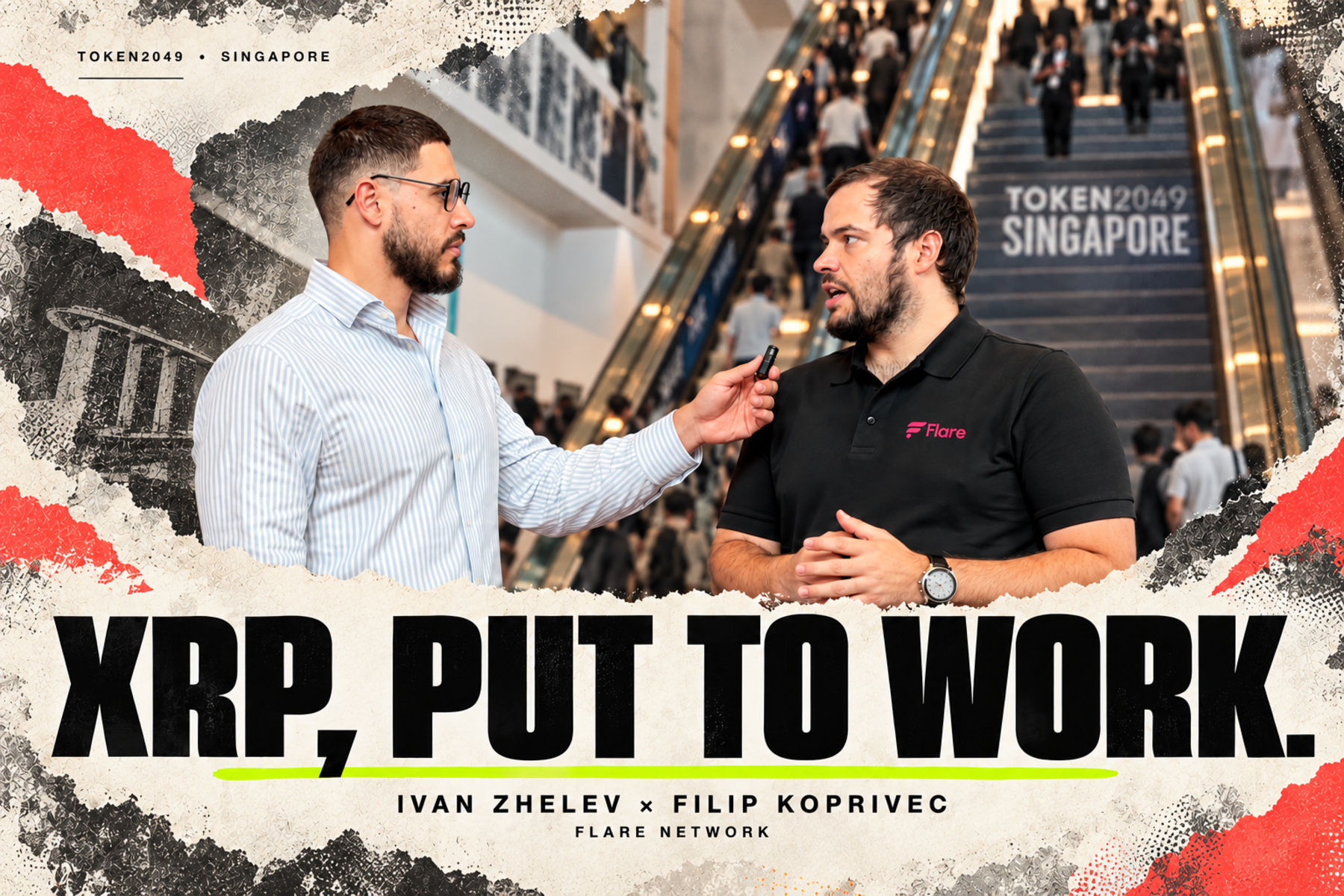
In Blockster’s recent TOKEN2049 interview, Flare’s Filip Koprivec told Ivan Zhelev that asking XRP holders to adopt another wallet created an obstacle. Flare Smart Accounts address that problem by allowing instructions from an XRP Ledger wallet to trigger supported actions on Flare.
“You don’t have to leave your XRP wallet.”
— Filip Koprivec, Flare, speaking with Blockster
Koprivec described earning yield through that experience and outlined simpler borrowing as a next objective. The goal is to let holders choose an action from a familiar wallet while the system handles the steps across networks.
For Flare’s growth, that matters: reducing the work required to use a product could help it reach XRP holders who have stayed away from DeFi because the process felt too complicated.
Ripple’s mainstream expansion could bring a larger market
The potential audience for those services is widening.
On October 27, Ripple and BNY announced expanded cooperation that includes custody support for XRP and RLUSD. BNY also intends to enable clients to mint and redeem RLUSD directly through the bank, subject to final internal and regulatory approvals. The companies are exploring tokenized trade finance as another application.
A day later, Ripple reported that RLUSD had reached $2.6 billion in market capitalization, with availability across Coinbase, Robinhood, Binance, Kraken and OKX.
For Flare, this creates a potential path to growth. Wider access to XRP could bring more holders looking to borrow against it, while deeper RLUSD liquidity could help lending markets accommodate that demand. Creating additional FXRP would also increase use of Flare’s minting and data-verification infrastructure.
That is an opportunity, rather than an automatic benefit. Flare would need to attract those users and integrations; its validator recognition does not establish a commercial agreement with Ripple or BNY.
Still, the pieces are becoming more closely connected: institutional access to XRP and RLUSD, existing markets for XRP-backed credit, and tools that make those markets easier to use. Flare’s opportunity is to turn those connections into financial services people return to—and a lasting role in XRP’s expanding economy.
Reporting by Eric Spivak