
Staking helps secure a blockchain, but it can leave holders waiting to access their capital. Faroo is bringing liquid staking to Pharos with a token designed to keep that position usable while staking rewards accumulate.
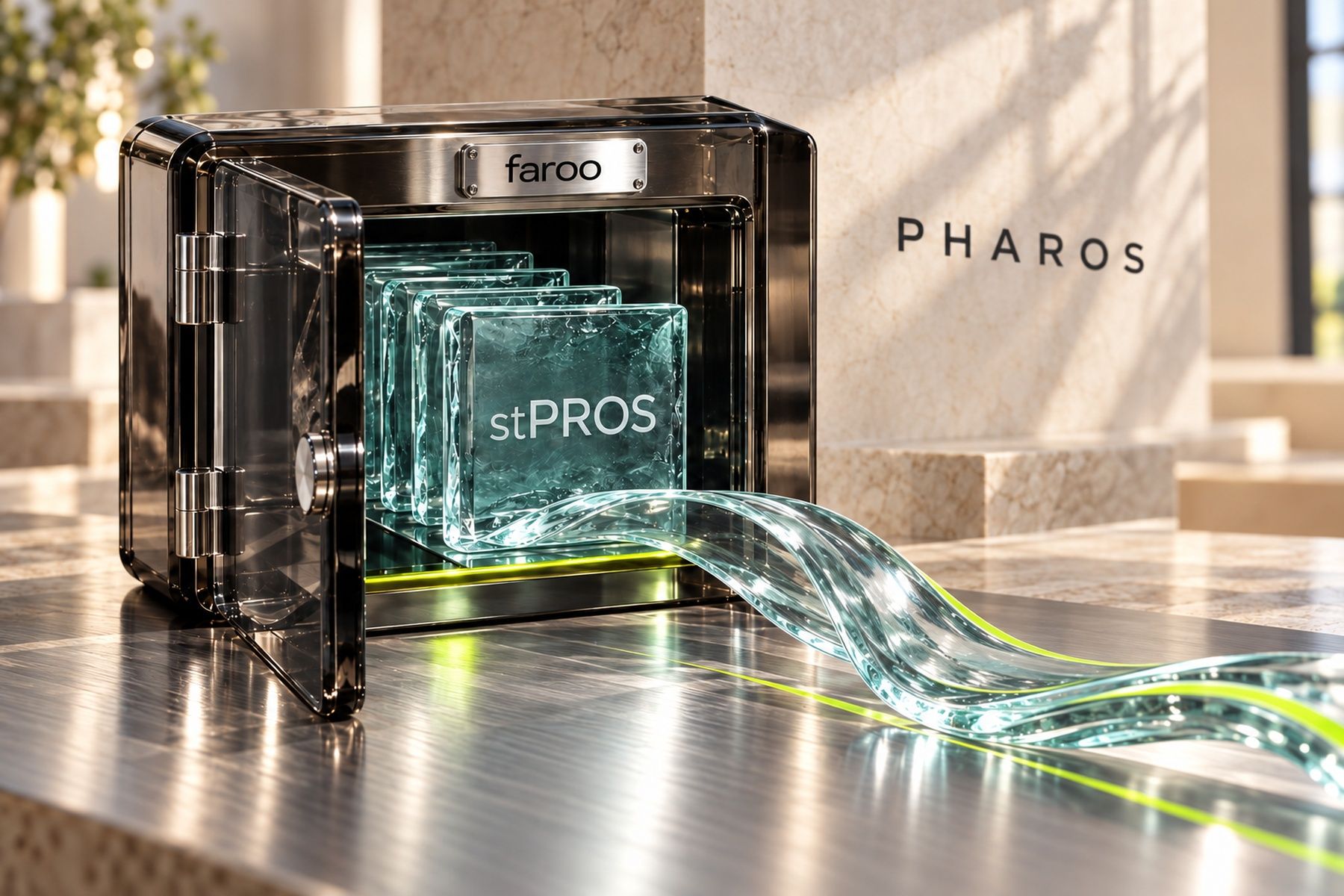
The protocol launched stPROS on October 28, allowing users to stake PROS and receive a transferable token representing their staked position. Holders can retain their exposure to network staking rewards while moving stPROS between wallets or using it in compatible decentralized finance applications.
According to Faroo’s announcement, its dApp is available through Binance Web3 Wallet and OKX Web3 Wallet from launch. Those entry points let users access the protocol through their wallet’s built-in interface, reducing the network setup involved in getting started.
Post from @FarooxyzView the original post on X↗
How stPROS Earns Staking Rewards
Faroo uses an exchange-rate model to account for staking rewards.
Instead of regularly increasing the number of tokens in a holder’s wallet—a mechanism known as rebasing—the protocol reflects accumulated rewards in the amount of PROS redeemable for each stPROS.
A holder’s stPROS balance therefore does not change simply because staking rewards accrue. The underlying redemption value changes instead, with rewards automatically compounded.
That structure is intended to make stPROS easier for other applications to account for. A lending market or decentralized exchange can track a stable number of token units while accounting separately for their changing value.
It does not, however, eliminate trading slippage. The price available when selling stPROS on an exchange still depends on the liquidity and conditions in that market. The protocol’s redemption exchange rate and a secondary-market trading price are different measures.
Faster Redemptions Depend on New Deposits
Faroo also introduces a fast-redemption mechanism that matches incoming staking activity with pending withdrawal requests.
When new minting occurs while redemptions are being processed, the system can use that activity to fulfill requests sooner, reducing the need to wait through the normal unbonding process.
The practical distinction is that faster redemption depends on available incoming liquidity. It should not be read as a guarantee that every withdrawal will settle immediately.
For users, liquid staking creates two potential routes out of a position: transferring or selling the liquid token where a market exists, or redeeming it through the protocol. The timing and amount received can differ between those routes.
Faroo published a launch-day walkthrough showing how users can begin staking PROS through its interface.
Post from @FarooxyzView the original post on X↗
An RWA Yield Product Is Next
Faroo plans to introduce tbPROS and its points incentive system in late November 2026.
The proposed tbPROS product will explore combining native staking with financial structures linked to real-world assets. Faroo describes this approach as “Hybrid Yield,” bringing together blockchain staking rewards and returns associated with underlying financial cash flows.
The announcement does not identify the specific assets, counterparties or final return structure for tbPROS. Those details will determine how the product works and how its yield differs from native staking.
The points program is planned around three areas: retaining assets, using Faroo products and contributing to ecosystem growth. Faroo says it will reward long-term stPROS holders and active early participants.
These are the next planned modules, separate from the liquid staking functionality launched today.
Building Financial Applications Around Pharos
Faroo is the first project selected under Pharos’ $10 million ecosystem incubation initiative. The announcement also states that Faroo secured a $10 million post-investment valuation. The program’s size and the company’s valuation are separate figures; the announcement does not disclose the amount invested in Faroo.
Bifrost previously confirmed Faroo’s incubation and valuation in its July update. Faroo’s staking architecture incorporates Bifrost’s SLPx technology, adapted for the Pharos network.
The launch fits the broader strategy Pharos CEO Wish Wu described in Blockster’s Korea Blockchain Week interview: building applications that give holders more ways to use assets after they arrive onchain.
“We want those assets to flow in our ecosystem, not only just stay there.”
— Wish Wu, Co-founder and CEO of Pharos, speaking previously to Blockster
That ambition now has another application in stPROS. Its usefulness will grow with the markets and protocols that support it—giving holders places to trade, provide liquidity or use their staking positions across Pharos.
Reporting by Sasha Steenkamp