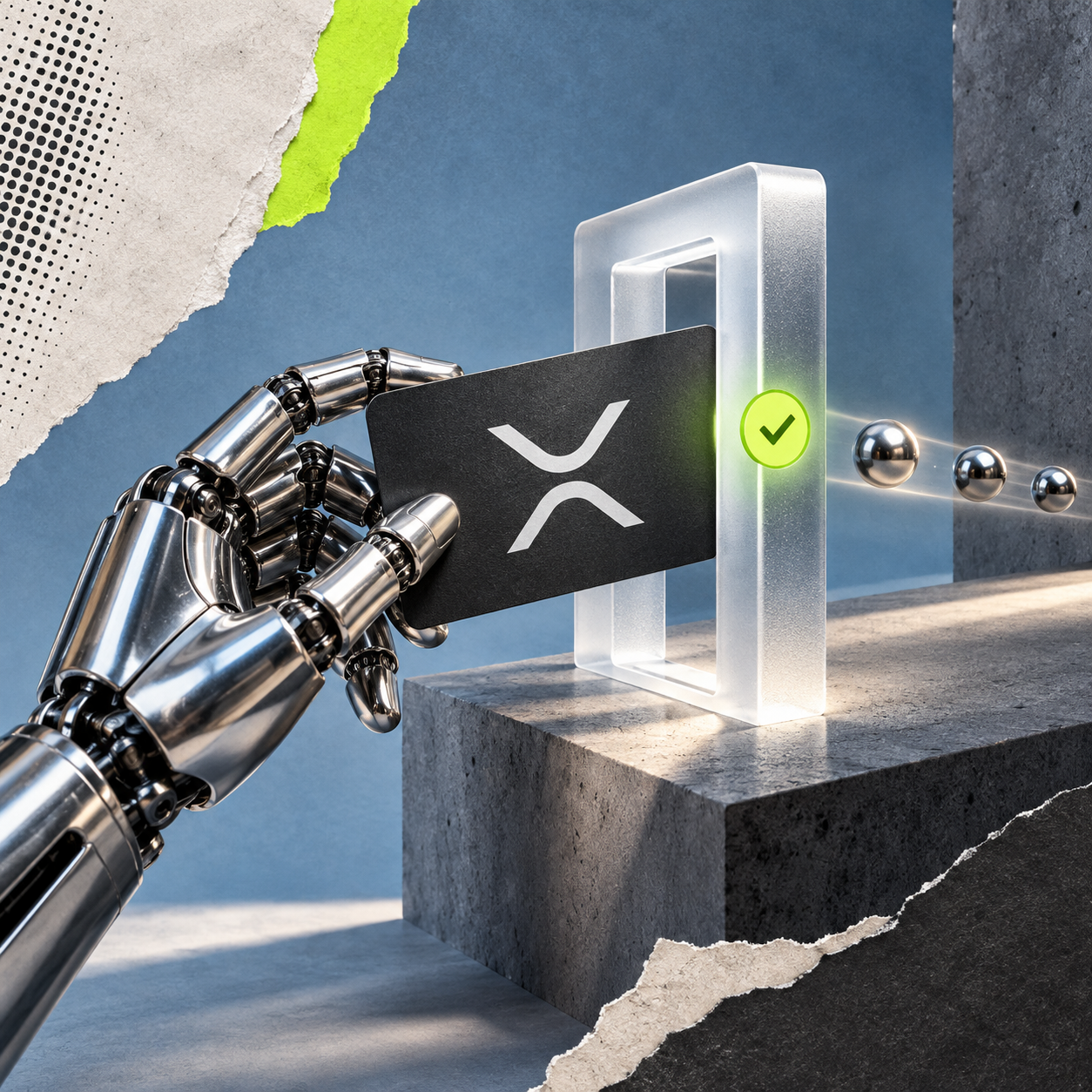


AI is advancing faster than economies can adjust. Automation is being deployed simultaneously across industries, productivity is rising, and entire job functions are already being phased out — not gradually, but all at once. That kind of acceleration doesn’t just change technology cycles; it creates economic pressure before new systems are ready to absorb the shock.
—
Against that backdrop, it’s no coincidence that AI agents are suddenly dominating headlines across crypto.
Over the past week, some of the industry’s most influential players — from Crypto.com to TRON — have pushed AI agents from roadmap speculation into public view.
Mass-market launches, long-term infrastructure commitments, and increasingly explicit signals all point to crypto positioning autonomous software as its next major interface layer.
What’s unfolding is a convergence moment. As work becomes more automated and traditional income structures come under pressure, blockchain-based systems are evolving to manage capital, move value, and operate continuously on behalf of users.
Crypto.com Pushes AI Agents to the Mainstream
Crypto.com didn’t quietly announce AI agents — it marketed them to over 100 million people.
Post from @cryptocomView the original post on X↗
During Super Bowl 60, the company aired a prime-time commercial unveiling ai.com, a new platform that allows users to reserve usernames and queue for personalized AI agents. According to CEO Kris Marszalek, these agents are designed to handle real, everyday tasks: managing emails, scheduling meetings, canceling subscriptions, shopping, and planning travel.
Marszalek framed the launch as something larger than a feature update:
Our mission with AI.com is to accelerate artificial general intelligence by building a decentralized network of autonomous, self-improving AI agents that perform real-world tasks for the good of humanity.
Crypto.com previously scaled to more than 150 million users by acquiring one of the most recognizable domains on the internet and backing it with aggressive global marketing. This time, the hook isn’t payments or cards — it’s AI agents positioned as digital counterparts that work on your behalf.
Early traffic reportedly overwhelmed the site within hours of launch, reinforcing the point: when AI agents are framed as tools people immediately understand, demand follows fast.
Justin Sun: AI Is Crypto’s “ChatGPT Moment” Waiting to Happen
While Crypto.com focused on distribution, TRON founder Justin Sun focused on what’s still missing.
Justin Sun argues that crypto’s real growth today still comes from stablecoins and payments — but those alone won’t drive the next adoption wave. What the industry lacks, he said, is an AI-native breakthrough comparable to ChatGPT’s impact on consumer AI adoption.
In Sun’s view, crypto still needs its ChatGPT moment.
Post from @CointelegraphView the original post on X↗
Rather than simply optimizing blockchains, AI agents could replace complex wallets, fragmented interfaces, and manual workflows with intelligent systems that act directly on users’ behalf.
Sun tied that vision back to what already works: stablecoins and cross-border payments as crypto’s current “workhorse” rails, with AI becoming the layer that makes those rails feel effortless to mainstream users.
Vitalik’s Line in the Sand: What “Real DeFi” Actually Means
As AI agents move closer to handling money autonomously, the question of what kind of financial infrastructure they rely on becomes critical.
That’s where Vitalik Buterin stepped in this week with a sharp distinction.
Vitalik argues that “USDC savings interest does not count as DeFi,” and that the more meaningful direction lies in crypto-native, overcollateralized algorithmic stablecoins — systems where risk is transparent, transferable, and borne by liquidity providers rather than hidden behind centralized balance sheets.
Post from @BSCNewsView the original post on X↗
He also adds nuance to the RWA debate. Even if algorithmic stablecoins include real-world assets as collateral, they can still represent an improvement — provided they remain overcollateralized and diversified enough that failure in any single asset doesn’t compromise the system as a whole.
Vitalik apoints beyond the dollar itself, suggesting the long-term goal should be moving away from USD-centric accounting toward diversified, index-based units of account.
Why does this matter for AI agents? Because agents don’t just need wallets — they need credible settlement layers. If autonomous software is going to move value continuously and at scale, the market will care deeply whether that value sits on centralized dollar yield loops or on transparent, crypto-native risk structures.
The Infrastructure Layer Is Quietly Catching Up
While Crypto.com and TRON grabbed attention, other ecosystems have been queitly laying the groundwork that makes agentic AI viable in the first place.
Fetch.ai recently demonstrated the first AI-to-AI payment for a real-world transaction — a milestone showing that agents can transact economically without human intervention.
NEO, through its sister initiative SpoonOS, is pushing open frameworks for decentralized agent coordination and development.
Meanwhile, 0G Foundation is tackling the hardest layer of all: decentralized AI infrastructure itself — the data, compute, and execution environment agents will need to operate reliably at scale.
What ties these efforts together is a shared assumption: agents need wallets, settlement rails, and persistent execution environments. Without blockchains, agents are just software. With blockchains, they become economic actors.
Editor’s Note: Why AI Agents + Autonomous DeFi Could Matter More Than People Expect
AI is rolling out at an unprecedented pace — and it’s happening everywhere, all at once. Companies are adopting automation faster than labor markets can absorb the change, and entire departments are already being cut as efficiency gains accelerate. That creates an unavoidable reality: there will be economic shock before there is economic balance.
This is where the convergence with crypto becomes important.
Autonomous DeFi systems already generate passive, onchain yield without human intermediaries. Add AI agents into the mix, and those systems no longer just pay — they can allocate, rebalance, and manage capital automatically on behalf of users. If agent-driven investing, saving, and risk management become widely accessible, crypto stops being purely speculative and starts functioning as an alternative income layer during a period of economic transition.
In other words, as AI reshapes work, autonomous finance may help cushion the adjustment — not by replacing jobs, but by giving people programmable, self-directed financial systems that operate continuously in the background. If this stack matures quickly, AI agents and DeFi together could offer something rare in modern markets: income that scales with automation, not against it.
At Blockster, we believe the fastest path to this future doesn’t come from crypto replacing traditional finance — but from traditional financial institutions working alongside public blockchains like Ethereum and others to introduce agent-driven financial products responsibly.
Banks still hold massive customer bases, deep distribution, and — critically — trust. Through partnerships with public blockchains and regulated stablecoin providers, banks are uniquely positioned to act as the on-ramp for agentic DeFi systems. In that model, users don’t need to become crypto-native overnight; AI agents can quietly operate behind familiar interfaces, helping customers earn yield, manage savings, and optimize capital passively.
Much of today’s debate — in Washington and across banking — centers on control: who governs stablecoins, who owns the rails, and who bears risk. AI agents may be the missing layer that aligns incentives. Properly designed, they allow banks, blockchain networks, and users to coexist — with automation handling execution, DeFi providing yield, and institutions offering oversight, compliance, and scale.
Post from @OndoFinanceView the original post on X↗
If that alignment emerges, this won’t be a zero-sum battle between TradFi and crypto. It will be a cooperative system — and one where financial infrastructure finally evolves at the same pace as the technology reshaping the global economy.
Reporting by Lidia Yadlos