
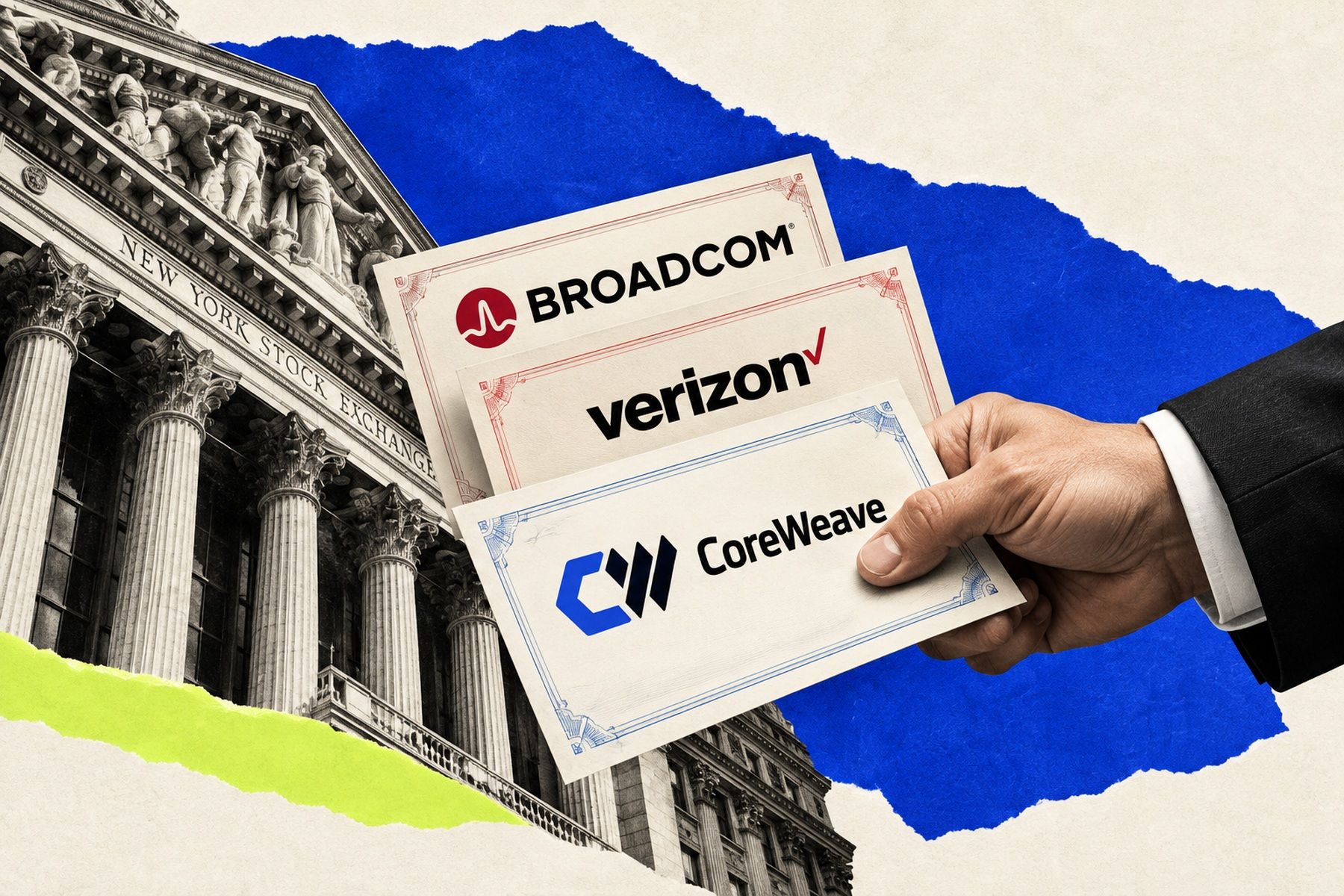
Broadcom, Verizon and CoreWeave are among nine companies that have objected to tokenized versions of their shares trading on OKXICE, the planned venue from crypto exchange OKX and Intercontinental Exchange, the parent of the New York Stock Exchange.
The objections, listed in OKXICE’s October 15 public notice, put corporate issuers at the center of a question facing Wall Street’s move onchain: who decides where a company’s stock can trade, and what protections follow it?
The other six companies are Cerebras Systems, AppLovin, Applied Digital, Rocket Lab, Applied Optoelectronics and UnitedHealth Group. The notice records their objections without explaining each company’s reasoning. It does not establish that Broadcom, Verizon or CoreWeave oppose every form of tokenization.
A 30-Day Window to Say No
The SEC opened the door on September 17 with its Innovation Exemption. The temporary framework allows qualifying venues to trade tokenized U.S. stocks through permissioned liquidity pools without registering as national securities exchanges. It is scheduled to run for five years, with conditions including trading limits and equivalent shareholder rights.
When an unaffiliated third party tokenizes a company’s shares, the venue must notify the company and wait at least 30 calendar days. A timely objection prevents that venue from offering the tokenized stock under the exemption. If the company does not object, trading may proceed subject to the remaining conditions.
That decision applies to the particular venue. It is not a blanket opt-out from every future tokenized market.
Post from @SECGovView the original post on X↗
Price, Liquidity and Company Control
Applied Optoelectronics has offered a clearer account of its concerns. According to The Block’s account of Wall Street Journal reporting, the company cited uncertainty about effects on its stock price, liquidity and volatility, as well as the possibility that investors could mistake an unsponsored product for something the company endorsed.
“At this stage, we don’t see a clear benefit to AOI or our shareholders that justifies these uncertainties”
— Applied Optoelectronics spokesperson, as reported by Barron’s
The statement captures a practical hurdle for platforms: additional trading access must offer issuers enough benefit to justify the operational and reputational questions it creates.
Nasdaq has separately said it intends to opt its own shares out of these venues. In its issuer FAQ, the exchange operator argues that the exemption allows markets to operate without the same real-time best-price displays and consolidated reporting used across conventional U.S. equities markets.
Nasdaq warns that this could make it harder for investors to compare execution prices and for companies to understand trading in their own stock. Its position is also a reminder that supporting blockchain infrastructure does not mean supporting every proposed market design.
What Would Investors Actually Own?
OKXICE’s notice describes a third-party model in which each token represents a security entitlement to one underlying share, backed one-for-one through an SEC-registered, FINRA-member broker-dealer. The venue requires equivalent rights, including dividends and voting rights, with procedures for corporate actions.
Trading would use permissioned liquidity pools on X Layer, pairing stock tokens with USDC, USDG or USDT. Participants would need identity and sanctions checks. The notice does not specify a launch date.
That legal structure matters. As Blockster’s guide to tokenized-stock ownership, dividends and risks explains, products carrying the same company name can confer different rights. A ticker alone does not tell an investor whether they hold shares, an entitlement to shares or a separate instrument tracking their price.
Securitize’s October 8 announcement offers a concrete example of the entitlement model. The company said its stock tokens preserve applicable shareholder rights and are expected to become available on OKXICE, subject to the venue’s launch and requirements. Its initial trading platform uses Solana; that should not be confused with OKXICE’s planned X Layer venue.
Post from @SecuritizeView the original post on X↗
The Next Test Is Issuer Participation
The objections arrive as distribution expands, including the growth covered in Blockster’s report on Robinhood Chain’s first 100 days. That expansion does not resolve questions about ownership, execution or corporate consent.
For OKXICE, the immediate test is which stocks remain available when trading begins. For issuers, it is whether the venue can demonstrate reliable pricing, clear investor communications and a reason to participate. The nine objections show that securing a regulatory pathway and winning companies’ confidence are separate milestones.
Reporting by Lidia Yadlos