
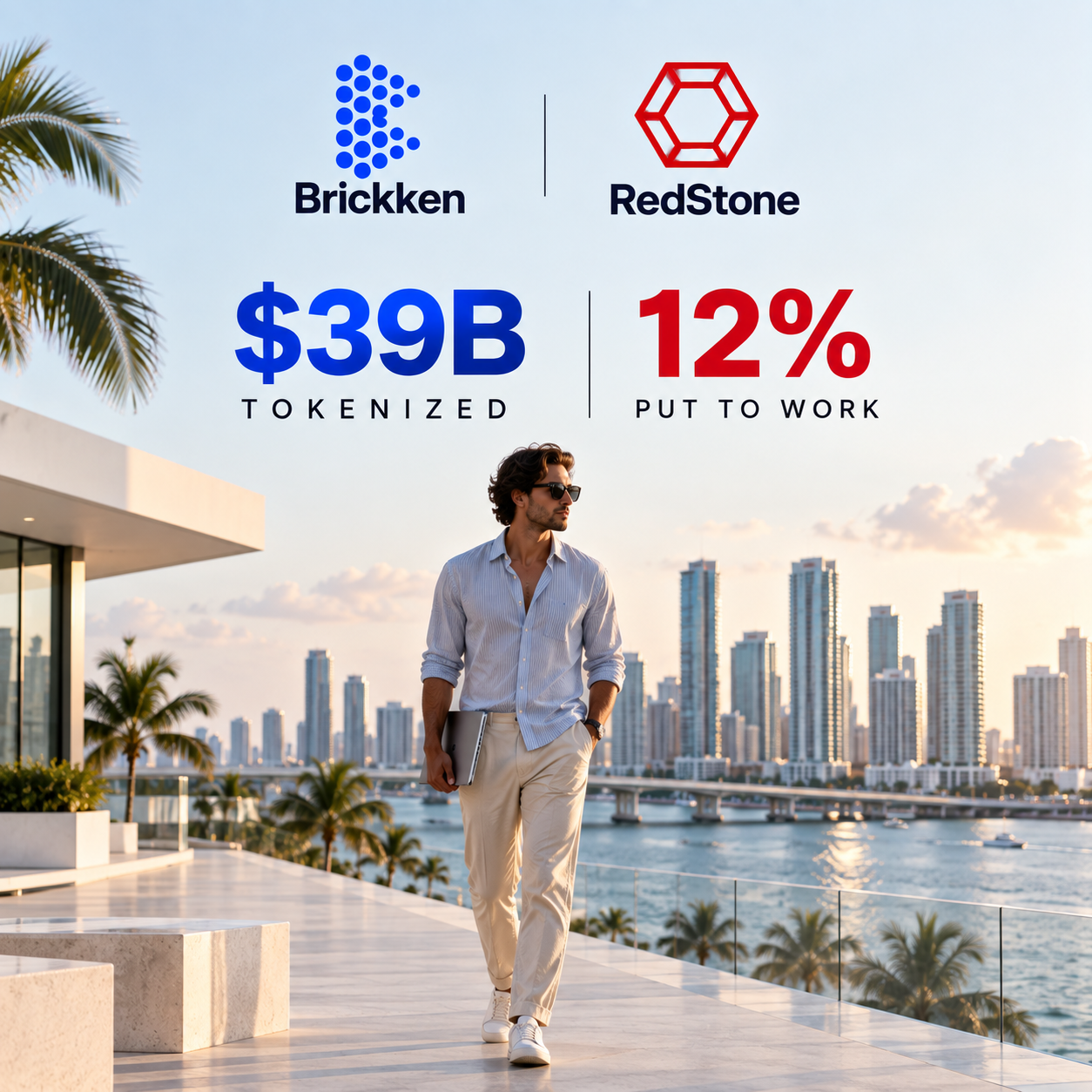
The tokenized real-world asset market has grown to roughly $39 billion onchain, excluding stablecoins. Yet getting assets onto a blockchain is only part of the challenge. Much of that capital still has limited ability to move through lending, collateral and other onchain financial markets.
That is the problem Brickken and RedStone are trying to solve. Their new partnership will give eligible assets tokenized through Brickken access to RedStone pricing, Credora credit ratings and T+0 redemption and liquidation infrastructure.
The idea is to give tokenized equity, debt, funds and private credit more to do after issuance. It also fits a shift Blockster has been tracking across the RWA market: creating the token is increasingly the starting point, while pricing, liquidity, risk and settlement determine whether it becomes useful financial infrastructure.
Post from @redstone_defiView the original post on X↗
Tokenization Is Only Step One
Brickken provides the infrastructure for issuing and managing tokenized private-market assets. Under the partnership, eligible assets created through its platform can access RedStone price feeds across the blockchains where those assets operate.
Reliable pricing becomes particularly important when a tokenized asset moves into lending. A protocol needs a dependable value before it can determine how much somebody can borrow against an asset, monitor collateral health or decide when a liquidation is necessary.
RedStone already provides price feeds across more than 110 chains and works with more than 200 clients. Its oracle infrastructure is also used for tokenized products including BlackRock’s BUIDL, Apollo ACRED and Hamilton Lane SCOPE.
Blockster recently covered OpenEden bringing BNY Investments’ high-yield bond fund to BNB Chain, where RedStone is similarly providing pricing infrastructure and preparing T+0 settlement support.
“Tokenization is the first stage of an asset’s onchain lifecycle. The next question is what that asset can actually do once it gets there,” said Matt Gurbiel, VP of Business Development at RedStone. “Reliable pricing, credit information and efficient redemptions and liquidations are all part of making tokenized assets usable in financial markets.”
Giving Tokenized Assets a Credit Score
Pricing is only one part of the partnership. Eligible Brickken assets can also receive Credora ratings on an A+ to D scale, giving investors and protocols another way to evaluate credit risk before putting capital to work.
That becomes more important as tokenization moves beyond Treasury bills and money-market funds into private credit, debt and other assets where the financial strength of the borrower or issuer matters. Credora ratings are already used across onchain lending markets representing more than $200 million in combined TVL, according to the companies.
“With RedStone, Brickken clients now get verifiable pricing, credit visibility and a clean settlement path on every eligible tokenized asset, from issuance onward,” said Brickken CRO and co-founder Ludovico Rossi.
Blockster previously covered Credora’s push into institutional-style onchain credit ratings when stETH received an A+ rating accompanied by a modeled probability of default. The concept is familiar from traditional markets: investors need a common language for comparing risk before larger amounts of capital can move in.
T+0 Settlement Could Make More RWAs Useful as Collateral
The third piece is RedStone Settle, which provides T+0 redemptions and liquidations for eligible real-world assets. This gives lending markets a potential route to redeem or liquidate an asset when a borrower can no longer meet the requirements of a loan.
Put together, the three pieces address different stages of the same problem. Pricing establishes what an asset is worth, credit ratings help quantify its risk, and settlement provides a way to exit when the asset needs to be redeemed or liquidated.
RedStone has been assembling similar infrastructure across the RWA market. Its earlier partnership with REAL combined oracle pricing with Credora risk intelligence, which Blockster covered as part of the push toward institution-ready tokenized assets.
Post from @redstone_defiView the original post on X↗
The $39B RWA Market Is Entering Its Next Phase
The first wave of RWA tokenization proved that traditional financial assets could exist on public blockchains. The next phase is about making those assets behave more like components of an active financial system rather than tokens sitting in wallets.
Brickken and RedStone approach that challenge from different sides. Brickken handles issuance, management and distribution, while RedStone adds infrastructure around pricing, credit and settlement after an eligible asset reaches the blockchain.
That combination becomes more relevant as tokenized markets expand from Treasuries into private credit, funds and other less-liquid assets. The next competitive advantage may be less about who can tokenize another asset and more about whether that asset can be priced, borrowed against, liquidated and put to work once it gets there.
For a tokenized RWA market already measured in the tens of billions of dollars, that is where much of the next infrastructure race is likely to happen.
Reporting by Lidia Yadlos