
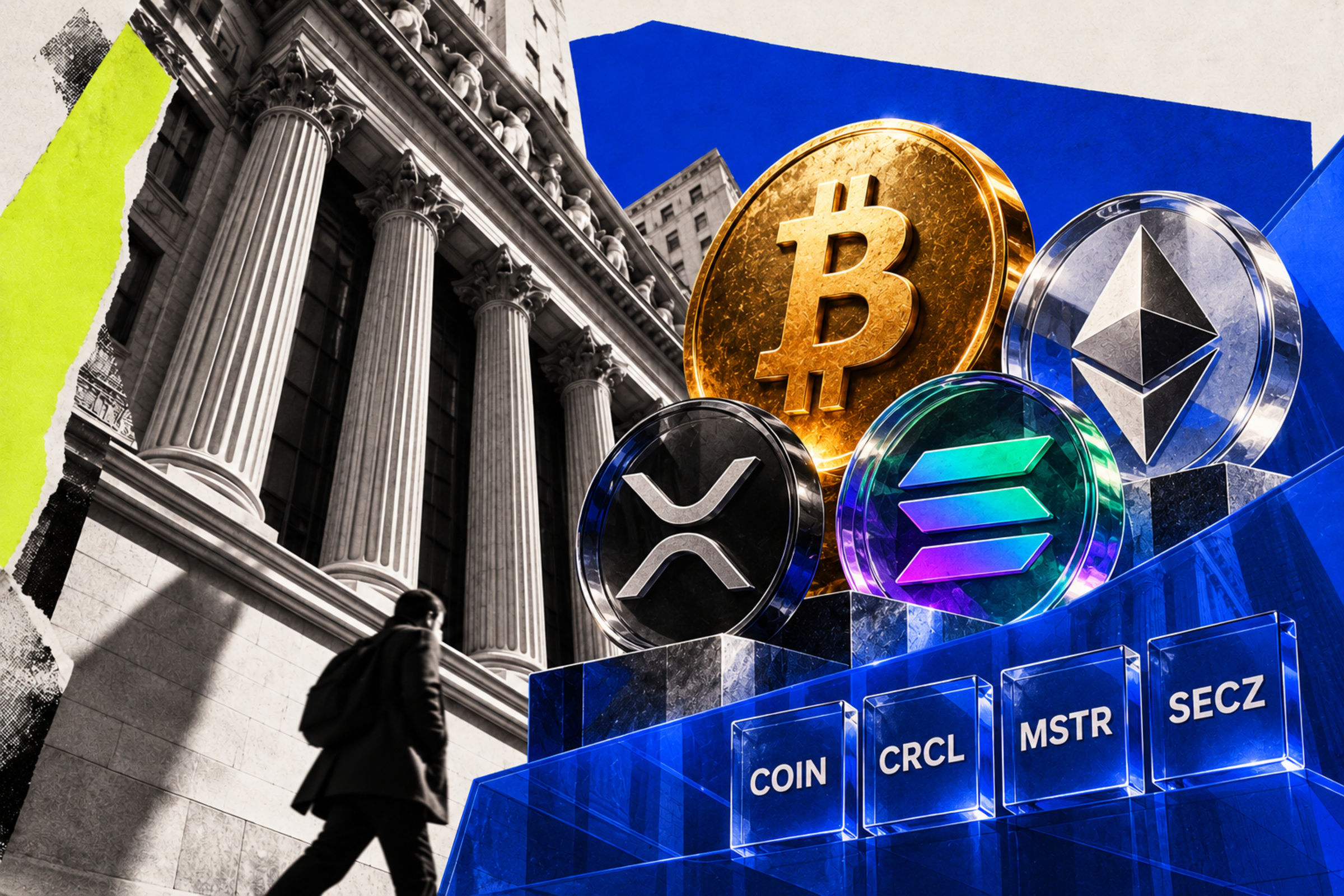
Bitcoin climbed back above $82,000 on Thursday, reversing an earlier drop below $80,000 as buyers returned during a volatile session. XRP recovered toward $1.33, while Solana moved back toward $105. The rebound offered some relief after renewed inflation concerns put pressure on cryptocurrencies and other risk assets, according to Thursday’s market reporting.
The recovery follows a difficult stretch. As Blockster reported in its October 8 analysis of Bitcoin’s retreat toward $82,000, rising oil prices, elevated Treasury yields and withdrawals from Bitcoin ETFs had already weakened the rally toward $87,000.
Thursday’s bounce repairs part of that damage. The broader performance figures show how much ground the largest cryptocurrencies still need to recover.
A Strong Quarter Hasn’t Erased the Year’s Losses
Across Bitcoin, Ethereum, XRP and Solana, the trailing-quarter picture is considerably stronger than the year-to-date performance.
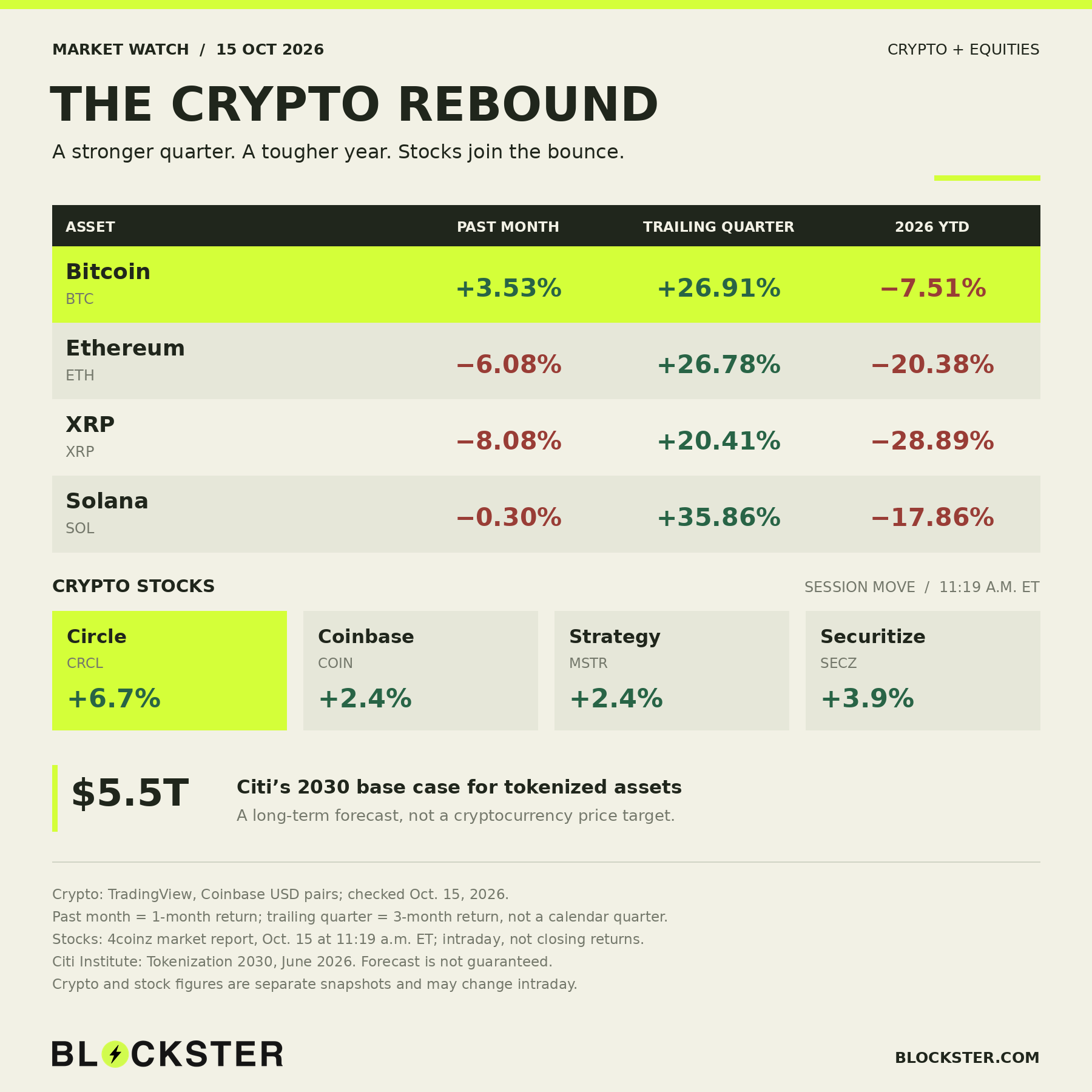
Source: TradingView Coinbase USD performance snapshots checked October 15, 2026. The monthly column uses TradingView’s one-month return; the trailing quarter uses its three-month return, rather than calendar-quarter performance. Intraday snapshots may differ by observation time.
Solana has the strongest trailing-quarter performance of the four, gaining almost 36%, while Bitcoin has held up best over the past month and remains closest to recovering its year-to-date losses.
Ethereum and XRP tell a more uneven story. Both have advanced more than 20% over the trailing quarter, yet their negative monthly returns show that the recovery has recently lost momentum.
That unevenness also featured in Blockster’s October 12 market roundup, when smaller cryptocurrencies including LayerZero attracted attention. Strength in individual tokens does not necessarily mean the whole market is moving together.
Why Circle, Coinbase, Strategy and Securitize Rose
At 11:19 a.m. ET, Circle was up 6.7%, while Coinbase and Strategy each gained 2.4%. Securitize rose 3.9% in the same market snapshot.
The shared backdrop was Bitcoin’s recovery and an easing in Treasury yields during the rebound. Lower yields can reduce some of the pressure on risk assets, although that does not establish a company-specific reason for every stock’s move.
Strategy holds Bitcoin on its balance sheet, making its shares particularly sensitive to changes in Bitcoin’s value.
Coinbase benefits when stronger market participation supports trading activity and demand for its services. A price rebound can improve expectations for that business, although rising prices alone do not guarantee higher revenue.
Circle provides exposure to stablecoins and digital payments through USDC. Alongside the market rebound, investors were assessing a fresh European regulatory development.
Securitize provides exposure to tokenized investments. Its gain was consistent with the broader improvement in sentiment toward digital-asset businesses; the price move alone does not establish a separate catalyst.
Circle’s additional headline was the European Banking Authority’s classification of USDC as a “significant” e-money token under MiCA, the EU’s crypto framework. The designation recognizes its scale and brings additional supervision. It should not be read as a regulatory endorsement of Circle’s shares. The Block reported the designation.
Inflation Still Matters More Than One Rebound
The pressure behind the selloff has not disappeared. Stronger-than-expected inflation figures revived concerns about further Federal Reserve tightening. Higher interest rates make borrowing more expensive and increase the appeal of interest-paying assets, creating a tougher environment for speculative investments.
Bitcoin nevertheless showed some resilience during the wider market weakness.
“The fact that BTC is showing some relative strength amidst [Wednesday’s] carnage is worth paying attention to.”
Source: Investopedia’s October 15 market report.
That relative strength is encouraging, but sustaining a recovery requires buyers to keep absorbing supply after the initial bounce.
Corporate purchases remain one source of demand. In Blockster’s October 14 report on Strive, the company disclosed buying 2,822 BTC for approximately $235 million, bringing its holdings to 35,595 BTC. Those purchases demonstrate continued appetite from a committed treasury buyer, even as prices fluctuate.
Beyond Today’s Price Moves: Citi’s $5.5 Trillion Outlook
Daily price swings can make it difficult to keep the longer-term picture in view. As we discussed in yesterday’s Blockster Briefing, Citi Institute projects that tokenized financial assets could reach $5.5 trillion by 2030 in its base case, with U.S. equities and Treasuries expected to lead adoption. The forecast concerns assets brought onto blockchain networks, rather than the total cryptocurrency market.
“We forecast a $5.5 trillion base case for tokenized assets by 2030”
Read Citi Institute’s Tokenization 2030 report.
Post from @WuBlockchainView the original post on X↗
That shift is already taking shape. In yesterday’s report on JPMorgan, Goldman Sachs and the banks moving onchain, we examined how major institutions are developing blockchain payments, tokenized funds and access to crypto trading. These are projects whose progress needs to be measured over years as well as quarters.
On the distribution side, Solana shared an xStocks post reporting 175,000 holders of tokenized Nvidia stock, NVDAx. It is a company-reported adoption measure—not the amount invested or an investment return—but illustrates how traditional equities are reaching blockchain users.
Post from @solanaView the original post on X↗
For investors, that means looking beyond whether Bitcoin finishes today above or below $82,000. Are more customers using these services? Are tokenized markets attracting lasting liquidity? Are the businesses providing them turning adoption into revenue?
Citi’s projection does not guarantee higher prices for every token or crypto-linked stock. It does give readers a reason to widen their perspective: daily prices measure immediate sentiment; sustained usage and business growth help reveal where longer-term value may develop.
Watch the October 14 Blockster Briefing with Electra, presented by Talk Society.
Reporting by Lidia Yadlos