Elon Musk's vision for a fully integrated AI ecosystem is rapidly materializing. Tesla's Optimus humanoid robots have reached a new milestone — they can now read computer screens, operate software interfaces, and perform tasks that were previously exclusive to human workers.
—
Combined with distributed GPU computing from Tesla's vehicle fleet and enhanced AI vision powered by Grok, Musk's constellation of companies is converging into a unified machine intelligence platform.
Optimus Learns to Read Screens
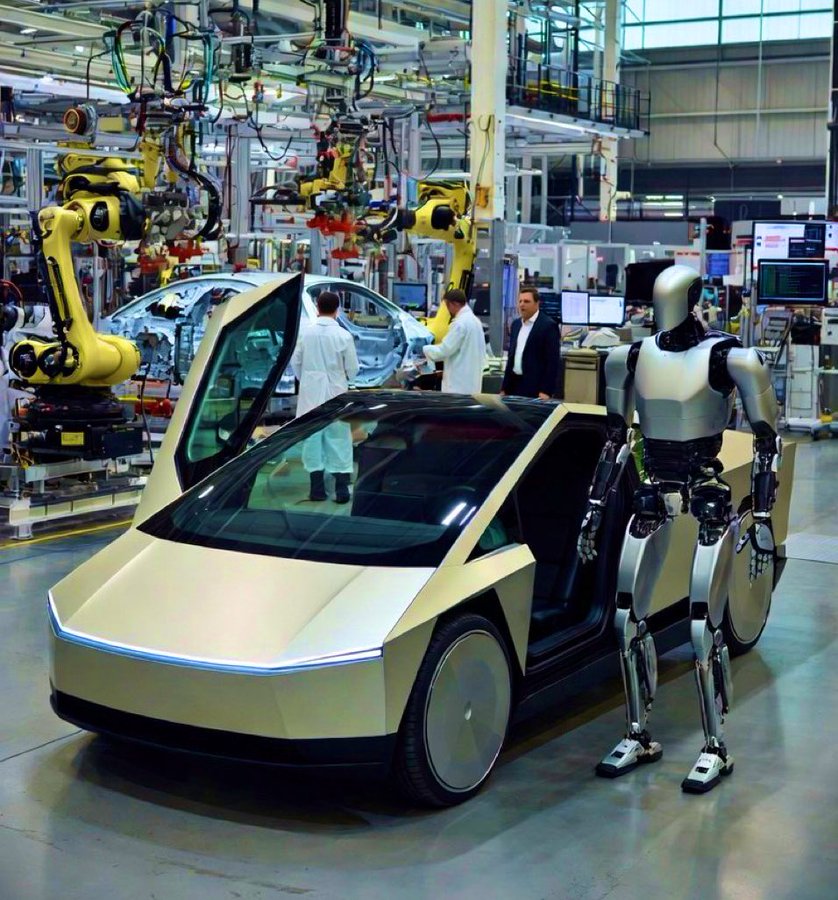
Recent demonstrations have shown Optimus robots functioning as AI agents capable of interpreting on-screen information, navigating digital interfaces, and executing complex workflows. This is a significant leap from earlier iterations that focused primarily on physical tasks like picking up objects and walking.
The robots are now being positioned as general-purpose workers that can handle both physical and cognitive labor — from warehouse sorting to data entry and administrative tasks.
Musk has been vocal about the economic implications. During Tesla's Q1 2025 earnings call, he stated:
I think Optimus will be the most valuable product ever made by any company. The potential market for a humanoid robot is — everyone on Earth would want one. It's going to be the biggest product ever.
Tesla had began limited production of Optimus units in 2025, with broader commercial deployment expected by 2026 and 2027. The robots are already performing autonomous tasks inside Tesla's own factories, including sorting battery cells.
Post from @CyberRoboooView the original post on X↗
Tesla Cars as a Distributed Supercomputer
One of the most underappreciated aspects of Musk's strategy is the distributed compute network built into Tesla's vehicle fleet. Every Tesla equipped with the Full Self-Driving (FSD) computer contains powerful AI inference chips. When vehicles are parked — which, for most cars, is roughly 95% of the time — that processing power sits idle.
Musk has outlined a model where Tesla owners could rent out their vehicle's GPU capacity to power Optimus robots and other AI workloads. This effectively turns millions of parked Teslas into a massive, decentralized compute grid — similar in concept to distributed computing networks, but owned and operated through Tesla's hardware ecosystem.
Musk addressed this directly at a Tesla shareholder event, saying:
Tesla has more AI inference compute deployed than any other company on Earth. Every car with FSD hardware is essentially a node in a distributed AI network.
This gives Tesla a structural advantage over competitors in the humanoid robotics space. Companies like Figure AI and Boston Dynamics must rely on centralized cloud infrastructure, while Tesla can tap into a fleet of over 7 million vehicles worldwide.
Grok AI Powers Enhanced Robot Vision
Musk's AI company xAI, which developed the Grok large language model, is playing a direct role in Optimus's evolution. Grok's multimodal capabilities — particularly its advanced computer vision — are being integrated into the robots' perception systems. This allows Optimus to better understand its environment, recognize objects, read text, and make real-time decisions.
The synergy between xAI and Tesla has been a point of discussion among analysts, particularly after xAI's valuation surged to $80 billion following its latest funding round. The integration of Grok into Tesla products creates a feedback loop: Tesla vehicles generate real-world training data, Grok processes and learns from it, and Optimus robots deploy the improved models in physical environments.
Post from @niccruzpataneView the original post on X↗
The Ecosystem Play
What sets Musk apart from other players in the AI and robotics space is the vertical integration across his companies:
Tesla provides the hardware platform, manufacturing scale, and distributed GPU network
xAI (Grok) delivers the AI models for language understanding, vision, and reasoning
Optimus serves as the physical deployment layer for AI agents in the real world
Tesla Energy and battery technology ensure power efficiency for both vehicles and robots
Each product feeds into and strengthens the others. Tesla's camera and sensor data trains better AI models. Better AI models make Optimus more capable. More capable robots increase Tesla's addressable market. It's a flywheel that no single competitor currently replicates.
The Trillionaire Trajectory
Musk has publicly stated he believes he will become the world's first trillionaire, and Wall Street is increasingly taking that prediction seriously. With Tesla's market cap already exceeding $1 trillion at various points and the Optimus program potentially opening a multi-trillion-dollar humanoid labor market, the math is starting to work in his favor.
Goldman Sachs has projected the humanoid robot market could reach $38 billion by 2035, while some bullish estimates place it significantly higher if robots achieve cost parity with human labor. Musk himself has suggested Optimus could eventually be priced around $20,000 to $25,000 per unit — less than a car.
Post from @teslaownersSVView the original post on X↗
Whether or not the trillionaire milestone arrives on schedule, the convergence of Tesla's vehicle fleet, xAI's Grok models, and Optimus robots represents one of the most ambitious integration plays in technology history. The pieces are falling into place — and the market is watching closely.
Reporting by Blockster Newsdesk