


Singapore — Foresight Ventures, in partnership with Bitget Wallet, has released a groundbreaking report that sheds light on how blockchain, DeFi, and crypto wallets are transforming access to finance globally. The new "PayFi" model is at the center of this revolution, merging high-yield decentralized finance tools with real-world usability.
—
Blockchain Is Breaking Down Barriers
Traditional finance systems are expensive, slow, and inaccessible to billions. Cross-border remittances in Africa cost as much as 8.2%, with delays stretching into days. Blockchain changes that. With average transaction fees around $2, direct peer-to-peer transfers via crypto slash costs by up to 80%, while ensuring transparency through open ledgers.
"We're seeing a paradigm shift. Crypto wallets and PayFi infrastructure are becoming the default financial layer for the digital-first generation."
Forest Bai, Co-Founder of Foresight Ventures
In countries like Morocco and Vietnam, where more than 70% of the population remains unbanked, stablecoins provide a lifeline. They let users store value in dollar-pegged assets, bypass local currency volatility, and tap into global markets without needing a bank account.
From Traditional Finance to On-Chain Revolution
Globally, 1.7 billion people remain unbanked, excluded from mainstream financial systems. The traditional system also suffers from inefficiencies, with average global remittance fees of 6.65%. Blockchain technology—decentralized, borderless, and transparent—is solving these legacy problems.
Crypto wallets, once seen as simple storage tools, are evolving into comprehensive financial platforms. The PayFi model captures this shift, turning crypto wallets into gateways for earning, saving, and spending—all in one place.
What’s Broken in Traditional Finance:
Excessive Costs: High fees for international payments, especially in low-income regions.
Limited Access: Financial exclusion in regions like Southeast Asia, Africa, and Latin America.
Inefficient Savings: Interest rates below 1% in many developed economies keep capital idle.
What Blockchain Unlocks:
Access to Stable Yields: Through DeFi protocols, users can earn 5%-8% APY.
Dollar-Denominated Stability: Stablecoins like USDT and USDC offer price-stable assets and bypass restrictions on local currencies.
Direct Access: Individuals can engage in cross-border payments, remittances, and investing without banks.
Introducing PayFi: Earn While You Spend
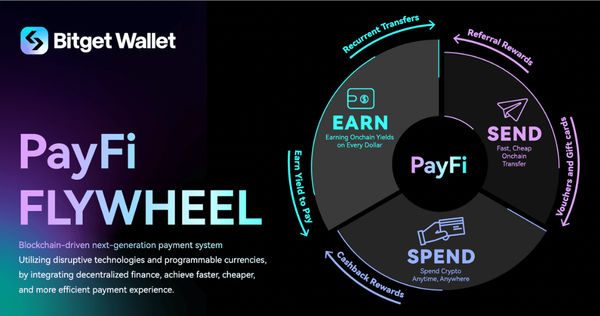
PayFi is a novel approach that connects DeFi yield generation with everyday transactions.
Users can earn 5%-8% APY through DeFi tools such as staking and liquidity provision.
These earnings automatically flow into wallets and become instantly available for real-time spending via smart contracts. In addition to enabling passive income, PayFi empowers users in unbanked regions to access USD-equivalent stablecoins, turning idle capital into productive, income-generating assets.
Wallets Are the New Financial Super Apps
Modern crypto wallets now function as full-featured financial hubs. They serve as wealth builders, allowing users to grow capital seamlessly through integrations with DeFi protocols like AAVE and Compound. As payment tools, wallets support multiple cryptocurrencies and enable global transactions at a fraction of the cost.
They also act as remittance engines, facilitating fast, wallet-to-wallet cross-border payments without intermediaries. Bitget Wallet, for example, offers trading, asset management, and payment functions—delivering a one-stop financial solution for users around the world.
A Glimpse Into the Future
As more users shift to wallets as primary financial tools, the PayFi model is expected to drive the next decade of digital finance. With over 1.7 billion unbanked people globally and savings yields under 1% in developed nations, the opportunity is massive.
"We see a future where wallets are the new bank accounts, and DeFi is the default savings tool," said Alice Li, Head of North America for Foresight Ventures. "PayFi is not just innovation—it's inclusion."
Reporting by Lidia Yadlos