Berlin — The first day of the Cardano Summit 2025 opened at Berlin’s Gasometer with a strong message from Cardano Foundation CEO Frederik Gregaard, who called attendees an “army of changemakers.”
He urged the community to “rebuild” through collaboration and innovation, emphasizing that “the next chapter is yours to write.” His message set the tone for a day focused on blockchain’s expanding real-world role across enterprise, regulation, and social impact.
Post from @F_GregaardView the original post on X↗
1. Building the Digital Trust Economy
The Blockchain Research Institute’s Chief Catalyst, Douglas Heintzman, introduced a new report, “Introducing Digital Trust Infrastructure: The Foundation for the New Digital Economy.” He described how a five-layer framework — encompassing trusted data fabric, digital identity, registries and exchanges, programmable value, and universal basic intelligence — could reshape global commerce.
“We need a new infrastructure on which to build the next economy. The internet gave us connectivity. Blockchain gives us integrity. By embedding trust at every layer — from identity to value — we can unlock an economy that is more efficient, transparent, and inclusive than anything that came before.”
Douglas Heintzman
2. Enterprise Adoption and AI Integration
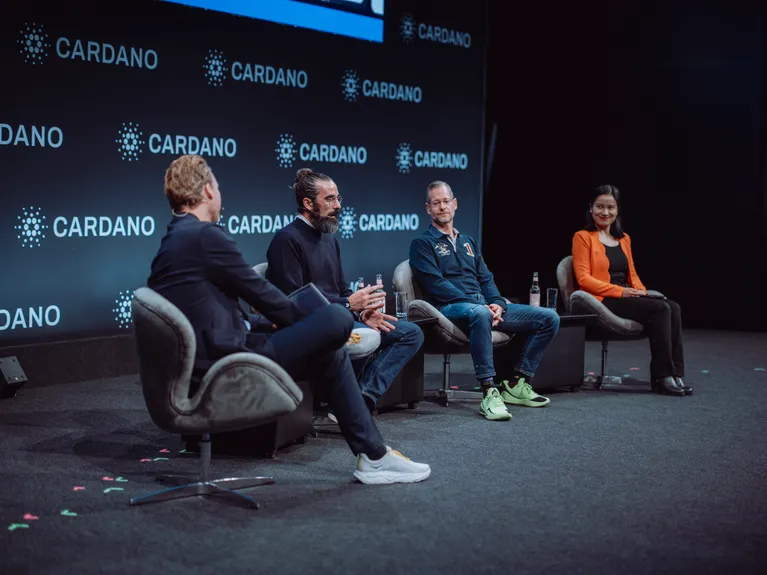
In a panel led by Business Insider’s Dr. Inga Michler, executives from Johnson & Johnson, Blockom, and the United Nations discussed blockchain’s growing utility in healthcare and data management.
“For healthcare, blockchain isn’t a buzzword — it’s becoming a backbone. It gives every stakeholder — from manufacturers to regulators to patients — a single, tamperproof source of truth that can save lives and prevent fraud.”
Florian Krueger-Herbert, Head of Technology Innovation & Venture Building EMEA at Johnson & Johnson
Pankhuri Bansal, Blockchain Expert at the UN and founder of Blockom, added that “blockchain or AI can’t exist in siloes,” explaining that while blockchain records data, “AI makes sense of it.”
3. Regulation, Trust, and Financial Shifts
A regulatory session explored the growing acceptance of blockchain within traditional finance. Bernhard Kronfellner, Partner at the Boston Consulting Group, said:
“The fear of missing out is real. Two years ago, banks were cautious. Now, two-thirds of our conversations are about stablecoins, tokenized deposits, and how to integrate blockchain without breaking compliance. The conversation has gone from if to how fast.”
Bernhard Kronfellner
Joachim Schwerin, Principal Economist at the European Commission, praised Europe’s early recognition of blockchain’s value:
“Ten years ago, we identified blockchain as a key breakthrough technology for every policy field — not only finance but also economy, IP, and energy.”
Post from @Cardano_CFView the original post on X↗
4. Tim Draper on Decentralization and Confidence
In a fireside chat with BTC ECHO’s Sven Wagenknecht, venture capitalist Tim Draper emphasized decentralization as the foundation of trust.
“Decentralization is trust in its highest form,” Draper said. “When power and control are distributed, corruption becomes harder, innovation becomes easier, and people gain confidence that their money and data are secure. That’s the real value — it restores faith in the system itself.”
Tim Draper
His remarks captured the summit’s recurring theme — decentralization as both a technological and social trust mechanism.
5. Education, AI Agents, and Enterprise Innovation
The Cardano Foundation announced a new Cardano Academy course with the Blockchain Research Institute on Coursera, titled “Introduction to Generative AI and Blockchain: Cardano Academy Custom Edition.” The course explores how AI and blockchain can combine to solve challenges that neither could tackle alone.
Filippo Frangioni, Product Manager at Novo Nordisk, said:
“We’re entering a phase where AI isn’t just assisting business — it’s making decisions. But for that to work, enterprises need verifiable data they can trust. That’s where blockchain becomes indispensable.”
Filippo Frangioni
Griffin AI Founder Oliver Feldmeier, who announced a new AI agent developed in partnership with the Cardano Foundation, called it “the next logical step for enterprise intelligence.” He added, “AI can analyze, predict, and automate — but blockchain ensures those processes are accountable. Together, they create a system where trust and intelligence evolve hand in hand.”
Post from @CardanoSummitView the original post on X↗
6. Humanitarian Impact and Governance
Cardano’s Alexandre Maaza was joined by representatives from UNDP, UNHCR, and the World Food Programme to discuss how blockchain is helping scale humanitarian aid.
“To tackle global problems, we need the speed and scale only digital technology can provide. Blockchain gives us that — it creates an auditable, transparent trail that builds trust between donors, agencies, and the people we serve.”
Intersect’s Jack Briggs also spoke on decentralized governance, emphasizing coordination and community participation. He highlighted that Cardano’s ecosystem achieved “the largest resource Treasury allocation in blockchain history,” underscoring its unique model of integrity and collective decision-making.
7. Announcements and Closing Remarks
Among several new releases, Swiss watchmaker Maurice de Mauriac unveiled the MDM X Cardano watch, featuring Cardano blockchain integration and AI-powered digital passports by Tokenance, with delivery expected in mid-2026.
Gero Wallet launched Dashboard 2.6, introducing the Gero Crypto Card and perpetuals trading powered by Strike Finance — its most advanced update yet.
Post from @ddlezuView the original post on X↗
The day closed with Cardano Foundation CTO Giorgio Zinetti, who praised the ecosystem’s growing unity: “Events like this build communities within communities,” he said. “That’s how real scale happens.”
Reporting by Lidia Yadlos