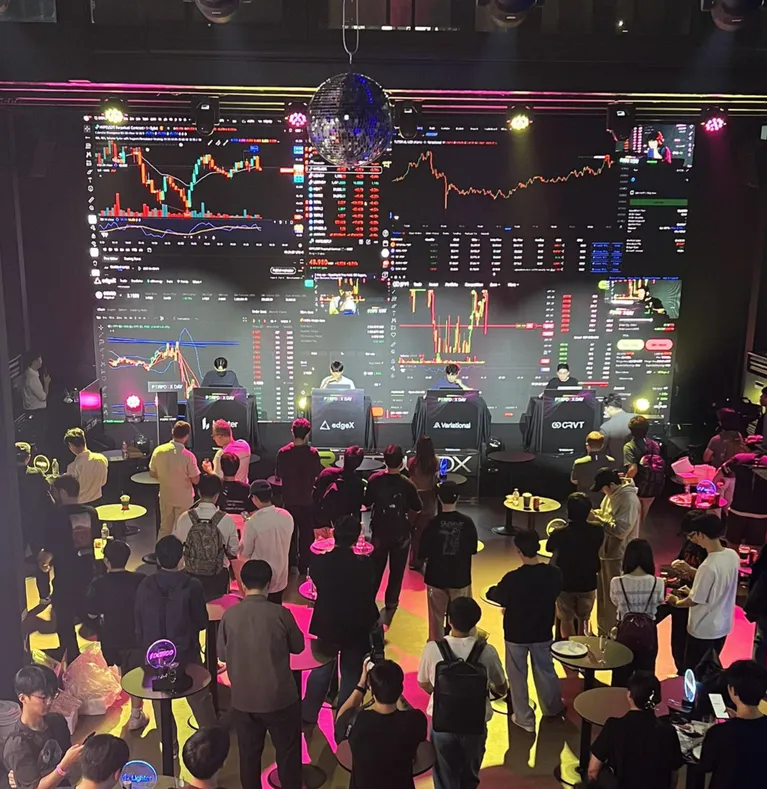
In Seoul, cryptocurrency trading has stepped out of the shadows and onto center stage, turning into a spectacle that feels closer to an esports final than a financial competition. Audiences gather around enormous displays showing real-time price action, and the energy in the room rises and falls with every swing.
There is no sense of quiet concentration here. It is a full-scale event, complete with announcers, production lighting, and the type of tension you would normally reserve for a championship match. For a city that already treats gaming as a cultural pillar, this kind of evolution feels surprisingly logical.
The Rise of Crypto Market Entertainment
To understand why this works so well in South Korea, it helps to look at the scale of the industries involved. The global esports market is now valued at more than 2 billion dollars, and South Korea remains one of its most influential hubs. Meanwhile, the crypto trading market processes trillions of dollars in derivatives volume each month, with perps alone consistently outpacing spot markets.
When two industries this large begin to overlap, the result is more than a trend. It turns into a cultural moment that captures both financial ambition and digital identity. The streets of Seoul have always been at the intersection of these forces, which is why this new hybrid feels like a natural extension of the city’s pulse.
Post from @DocumentingBTCView the original post on X↗
The competitive format works because perpetual futures are easy for an audience to follow. Every competitor starts with the same amount of capital and the winner is simply the person who grows that capital the fastest. This creates a clear narrative arc that even beginners can understand. Instead of months of trading performance, you are watching minute-by-minute strategy under pressure. It mirrors the mechanics of a speedrun or a tactical showdown, where every small decision can swing the entire outcome.
“That's not even a stretch, crypto has been esports for years."
@Wassieweb3
There is also a psychological familiarity to the way these events are structured. Younger audiences are used to watching streamers trade, gamble, craft, speed trade, and optimize in real time. The difference now is that the action is happening on a stage with a crowd responding to every choice. Millions of viewers across platforms like Twitch and YouTube already consume financial content in a gaming format.
Turning this passive consumption into a live competitive show is not as disruptive as it might seem. It is a smooth progression toward a world where financial skill becomes a visible, shareable, and aspirational performance.
The Tension Underneath
Even with all the excitement, there is a tension woven throughout the event that you cannot ignore. Derivatives trading is risky, and the volatility that makes it fun to watch also makes it dangerous for inexperienced participants. When a stage, a crowd, and a scoreboard are added to the equation, the seriousness of the underlying financial risk can fade into the background.
The line between performance and exposure becomes thin, and audiences may internalize the idea that these trades are less severe than they really are. It turns the financial stakes into emotional stakes, which changes how people relate to risk.
At the same time, it raises questions about the future of financial education. If trading becomes entertainment, then education must adapt to this new cultural language. People learn differently when they are emotionally invested, and they also forget differently when the environment shifts to a spectacle. It introduces a complicated challenge.
How do you celebrate innovation in financial culture without accidentally normalizing high-risk behavior? How do you ensure the audience understands the difference between strategic execution and simple luck when they are cheering every candle move as if it were a game-winning play?
A Glimpse Into the Future of Crypto Culture
Events like this reveal how rapidly crypto is merging with lifestyle. It is no longer just an asset class or a technology sector. It is becoming a cultural space where identity, competition, and digital expression blend together. That shift matters because culture is what usually dictates adoption. When markets feel social and accessible, people approach them with curiosity instead of hesitation. It creates a sense of belonging, and belonging has always been one of the strongest drivers of participation.
“Seoul basically turned crypto trading into a spectator sport.”
@marilyn100x
The broader trend here is that crypto is learning from the playbook of gaming. Esports grew from local internet cafes to a global industry worth more than a billion dollars through community, competition, and shared spectacle. Crypto has a similar foundation. It is global, digital, community-driven, and powered by online identity.
When you combine those traits with markets that already process enormous amounts of volume daily, it becomes clear why these competitive events resonate. They show us what happens when trading becomes not only a tool for wealth but a place for performance.
Post from @BunsanXBTView the original post on X↗
Final Thoughts
What is happening in Seoul is more than a novelty. It is a preview of how financial culture may evolve in a world where digital entertainment shapes behavior more than textbooks ever could. When trading becomes a spectator sport, the markets themselves take on a new emotional texture. People respond to them the way they respond to games, music, or live sports. That shift will influence how communities form around assets, how education develops, and how risk is interpreted by an entire generation.
Crypto has always blended technology and finance, but it is now stepping into the cultural arena with a confidence we have not seen before. Esports and trading might seem unrelated at first glance, yet both rely on skill, psychology, fast decision-making, and a constant flow of information. They are built on the same mental architecture, which is why their fusion feels so natural in the digital age.
If this is where the culture is heading, then the next decade of crypto will be shaped not just by innovation, but by how people choose to experience markets together. The social layer is becoming just as important as the financial one, and that may end up being the biggest story of all.
Reporting by Lidia Yadlos