
As artificial intelligence makes it easier than ever to create fake identities and deepfake content, a new startup is building tools designed to verify that users online are actually human.
—
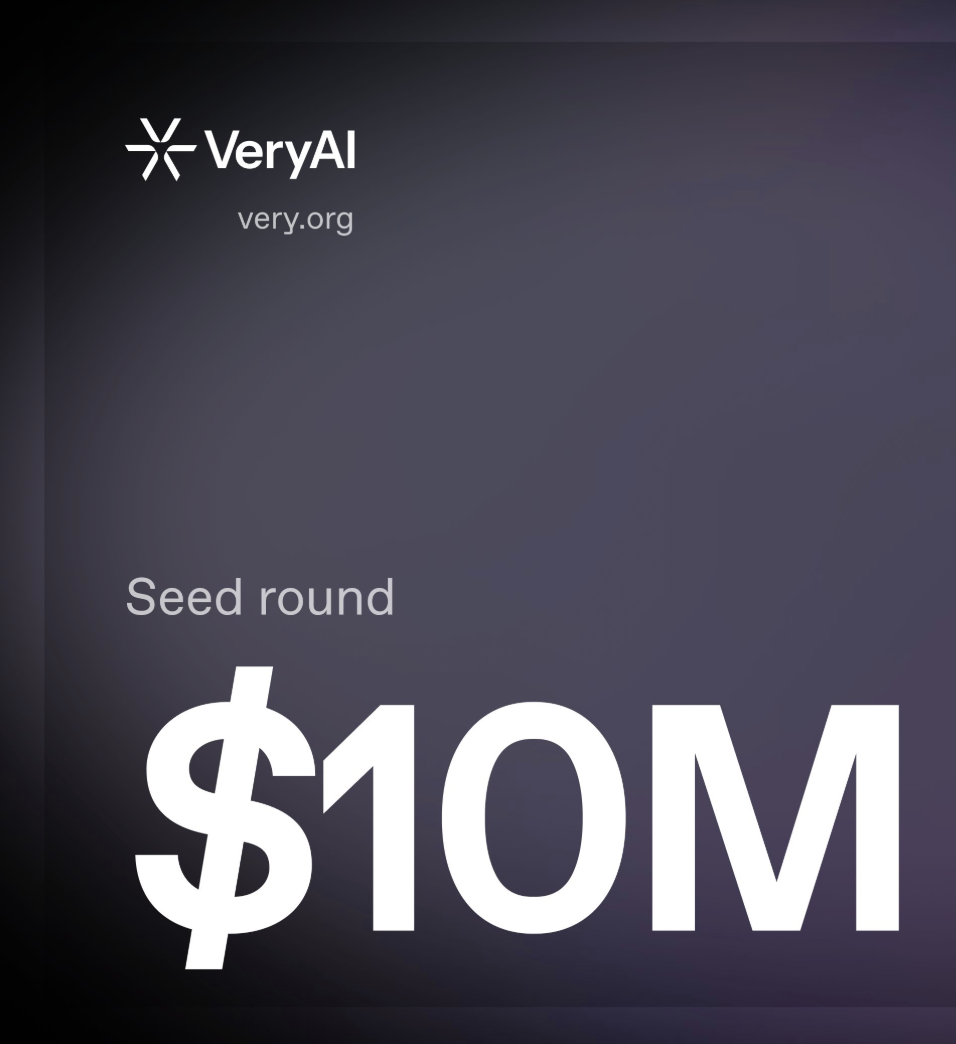
VeryAI announced it has raised $10 million in seed funding led by Polychain Capital, with additional participation from the Berggruen Institute and Anagram. The funding coincides with the launch of the company’s first product: a hardware-free palm-scan identity verification system built to combat AI-driven fraud.
Post from @VeryAIView the original post on X↗
A New Approach to Identity Verification
Traditional authentication systems — including facial recognition, CAPTCHAs, and two-factor codes — are increasingly struggling to keep up with advances in AI-generated content. According to industry data cited by VeryAI, system compromise times have increased by 22% since 2023, with successful breaches now occurring in an average of 48 minutes.
VeryAI’s solution focuses on palm biometrics, a form of identification that is highly unique and rarely publicly exposed. Using only a smartphone camera, the system captures a palm scan without requiring any specialized hardware.
The company says its technology achieves a false acceptance rate of roughly 1 in 10 million when verifying one hand, compared with about 1 in 1 million for many facial recognition systems. When both hands are scanned, the rate drops to approximately 1 in 100 trillion.
“Privacy is a human right, but deepfakes and synthetic content are exposing weaknesses in current verification systems,” said Zach Meltzer, founder and CEO of VeryAI. “VeryAI is building the next generation of identity verification — solutions that are accurate, private, and easy to use.”
Built for Crypto and Fintech Platforms
VeryAI is designed as a business-to-business platform that allows companies such as crypto exchanges and fintech platforms to integrate palm verification into their authentication systems.
Partners will pay based on monthly user verifications, while users simply verify their identity through their smartphone camera. The platform is built on Solana, where palm-scan identity registrations are recorded onchain. Solana co-founder Anatoly Yakovenko is also an angel investor in the project.
Post from @VeryAIView the original post on X↗
Protecting Privacy With Zero-Knowledge Technology
To preserve user privacy, VeryAI uses Zero Knowledge Proofs (ZKPs) and the Solana Attestation Service, allowing users to prove their identity across decentralized applications without revealing personal information.
The system also integrates Light Protocol’s ZK compression technology, which stores minimal data on-chain while verifying state off-chain to reduce storage costs. Rather than storing actual palm images, VeryAI keeps only irreversible biometric feature representations that cannot be reconstructed into an image.
Once verification is completed, the system generates a non-traceable identifier confirming that a real person performed an action, without linking that activity to an identifiable individual.
Team and Research Collaboration
VeryAI’s leadership team includes CEO Zach Meltzer, who previously worked on identity systems at Galxe, helping scale the platform to more than 34 million users and over 6,000 partners. The company’s Chief Science Officer, Hua Yang, is a palm biometrics researcher with more than 50 publications and patents.
VeryAI has also added Matthew Groh, Assistant Professor at Northwestern University’s Kellogg School of Management and Principal Investigator of the Human-AI Collaboration Lab, as an advisor. The company plans to collaborate with Northwestern on research focused on improving resilience to deepfakes and detecting AI-generated media.
Post from @itszachView the original post on X↗
Building “Proof of Reality”
The company describes its broader platform as “Proof of Reality,” a system designed to distinguish real human users from synthetic identities. With the rise of AI agents, automated bots, and deepfake content, Meltzer believes verifying human identity will become a critical layer of internet infrastructure.
“Every major platform today — from finance to social media — is facing the challenge of AI-driven fraud,” said Olaf Carlson-Wee of Polychain Capital. “VeryAI’s palm verification technology could become a new standard for trust online.”
The newly raised capital will be used to expand the Proof of Reality platform and develop additional tools designed to verify human users in an increasingly AI-driven internet.
Reporting by Lidia Yadlos