The debate around artificial intelligence is rapidly shifting.
For the past two years, policymakers have focused on AI safety, regulation, misinformation, and national security. Now a different question is beginning to emerge in Washington:
If AI becomes the largest wealth creation engine in modern history, should ordinary Americans own a piece of it?
That conversation moved into the spotlight this week following reports that President Donald Trump is exploring ways for Americans to directly participate in the economic upside generated by leading AI companies.
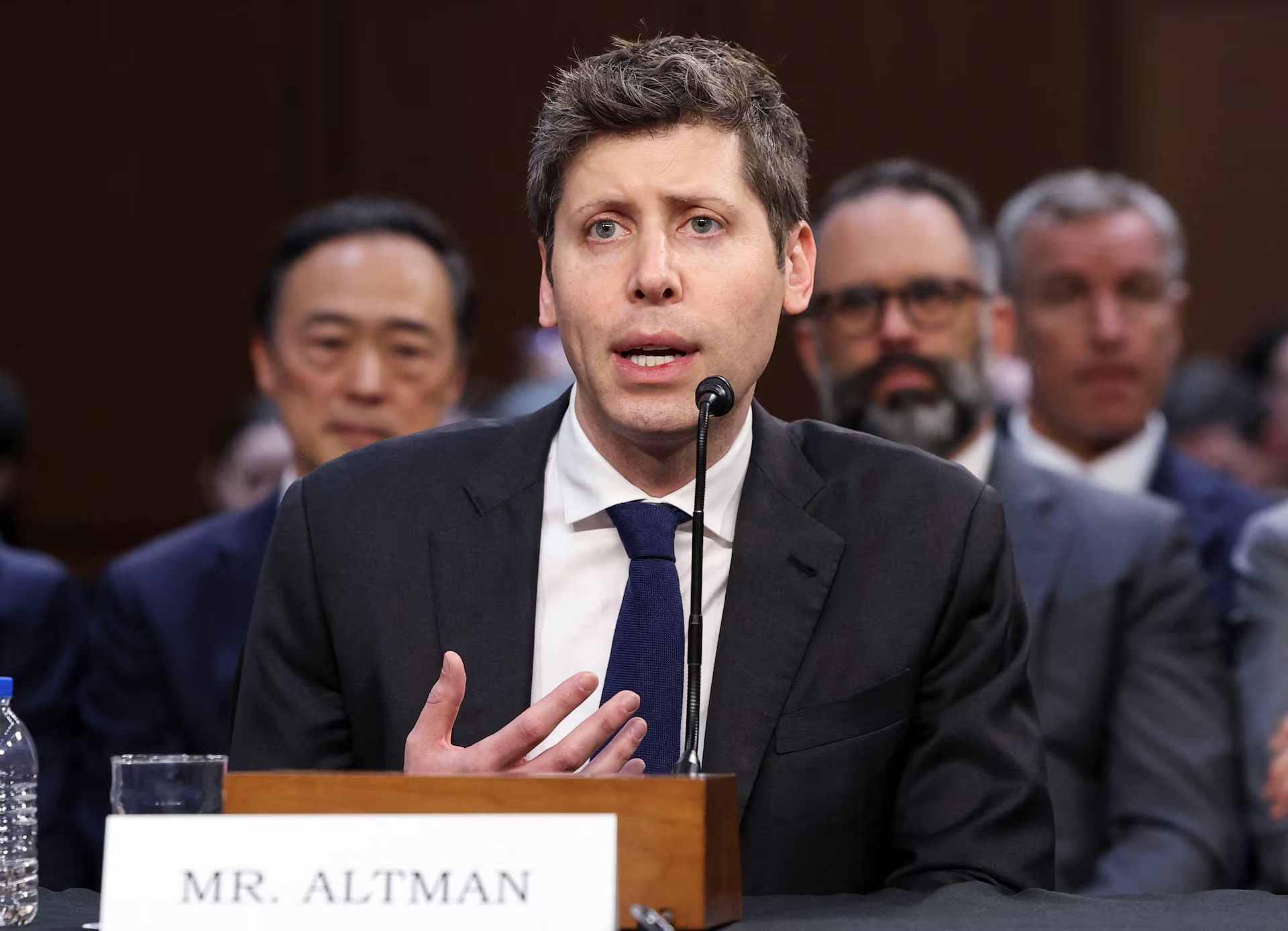
The discussion comes just days after OpenAI CEO Sam Altman met with Senator Bernie Sanders to discuss public ownership models for artificial intelligence firms, according to recent reporting.
While Trump, Altman, and Sanders approach the issue from very different political perspectives, all three are now engaging with the same fundamental idea: the public may deserve a stake in the AI economy.
Post from @BullTheoryioView the original post on X↗
From Private Fortunes to Public Wealth
The conversation gained momentum after Sanders introduced the American A.I. Sovereign Wealth Fund Act.
The proposal would create a federally managed investment fund designed to give Americans exposure to the economic value generated by major AI companies.
Sanders argues that AI systems are built using humanity's collective knowledge, data, research, creativity, and experience. If those systems go on to create trillions of dollars in economic value, he believes the public should benefit alongside investors and founders.
In an opinion piece outlining the proposal, Sanders compared the idea to sovereign wealth funds that convert national resources into long-term public assets.
The concept has drawn comparisons to Norway's sovereign wealth fund, which transformed oil revenues into a public investment vehicle now worth more than $2 trillion.
The difference is that instead of oil, the resource in question would be artificial intelligence.
Why Sam Altman Matters
What surprised many observers wasn't Sanders' proposal. It was Sam Altman's willingness to engage with it.
The OpenAI CEO reportedly requested the meeting with Sanders and expressed openness to broader conversations around public participation in AI wealth creation, although he reportedly pushed back on the scale of Sanders' proposal.
Altman has long warned that advanced AI could dramatically reshape labor markets while concentrating enormous wealth among a small number of companies.
Years before ChatGPT became a global phenomenon, Altman publicly discussed concepts such as universal basic income and mechanisms that would allow society to share in the gains produced by automation.
Today those discussions look far less theoretical.
OpenAI's valuation has climbed into the hundreds of billions of dollars. Competitors such as Anthropic and xAI have attracted massive funding rounds as investors race to gain exposure to what many believe could become a multi-trillion-dollar industry.
Post from @DropSiteNewsView the original post on X↗
The White House Is Paying Attention
The discussion expanded further after reports emerged that President Trump is exploring ideas that could allow Americans to directly benefit from the AI boom.
According to commentary circulating online following remarks aboard Air Force One, Trump is expected to meet with AI executives to discuss potential approaches to public participation in AI-driven wealth creation.
While details remain limited, the significance lies in the fact that the conversation is now reaching the highest levels of government.
The idea that citizens should somehow participate in AI-generated wealth is no longer being discussed only by academics and economists.
It is now being discussed by technology executives, lawmakers, and the White House.
The New Oil Is Intelligence
The AI ownership debate reflects a broader shift in how policymakers view artificial intelligence.
Historically, major sovereign wealth funds have been built around physical resources such as oil, gas, or minerals.
AI presents something different. Its underlying resource is knowledge.
Modern AI models are trained using vast amounts of publicly available information, books, scientific research, websites, software code, media archives, and human-generated content.
Supporters of public ownership argue that because society collectively contributed to the creation of these systems, society should share in the economic gains they produce.
Critics argue that such proposals would discourage innovation, undermine investment incentives, and create unprecedented government involvement in private technology companies.
The debate is only beginning.
What It Means for Investors
For investors, the emergence of public ownership discussions introduces a new variable that few valuation models currently account for.
Until now, investors have focused on AI adoption, infrastructure spending, competition, regulation, and technological progress.
The possibility of government participation in AI wealth creation introduces an entirely new category of policy risk.
Questions around governance, ownership rights, profit distribution, and public participation could eventually become as important as model performance and market share.
Even if Sanders' proposal never becomes law, and even if Trump's discussions ultimately lead nowhere, the broader conversation is unlikely to disappear.
As AI companies become larger, more profitable, and more economically influential, pressure will likely grow to ensure the benefits extend beyond founders, venture capital firms, and institutional shareholders.
Post from @Crypto_JargonView the original post on X↗
The Most Important Number Isn't 50%
Much of the public debate has centered around Sanders' proposed 50% ownership figure.
But that may not be the most important number.
The more important number may be zero.
For decades, the assumption was that AI companies would remain entirely private enterprises whose economic gains accrued primarily to shareholders.
That assumption is now being challenged.
Whether the final answer is 50%, 10%, 1%, or some entirely different model, one thing is becoming increasingly clear:
The conversation is no longer about whether AI will create enormous wealth. It's about who gets to own it.
Reporting by Lidia Yadlos