

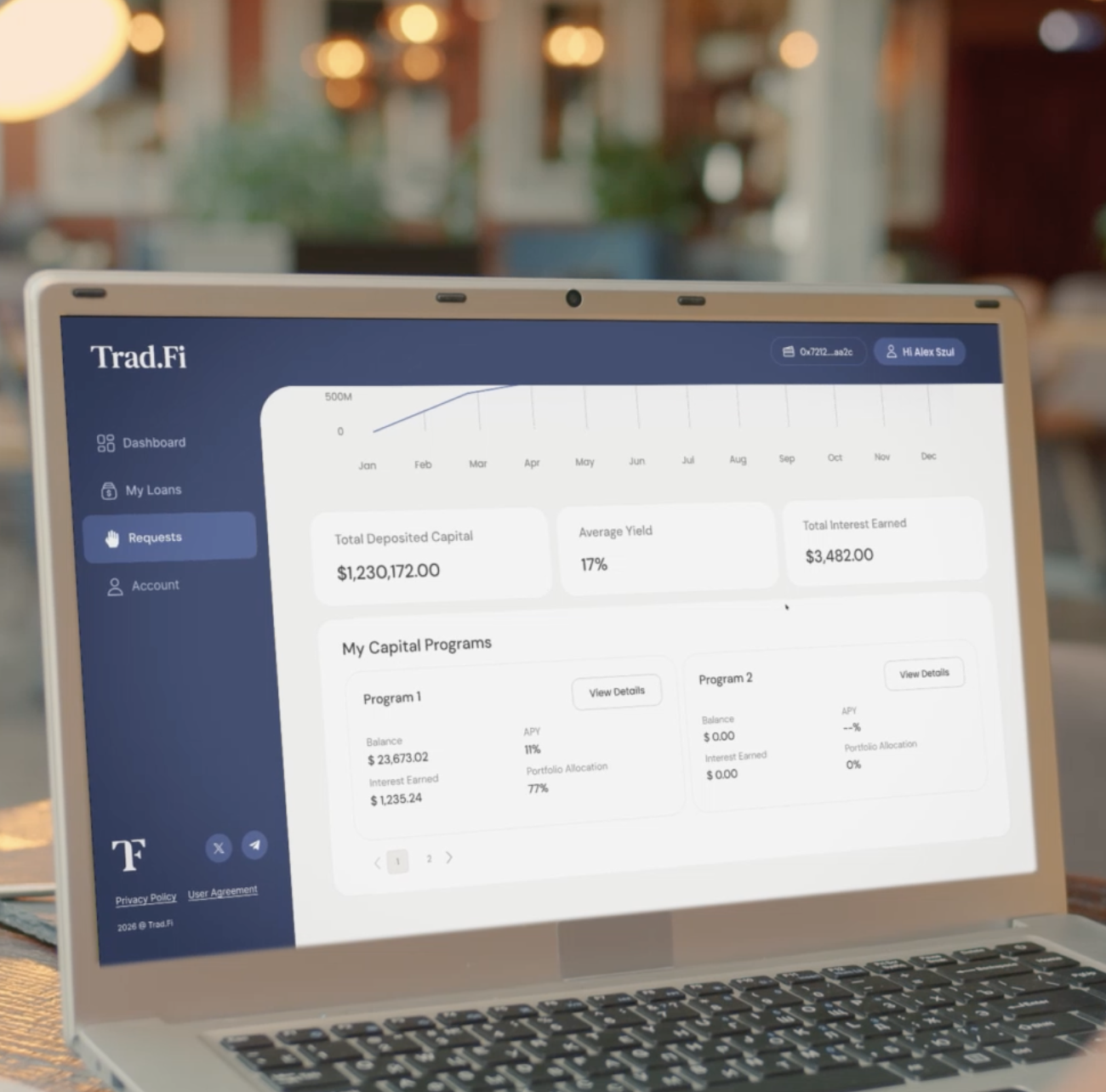
Real-world asset tokenization has largely focused on Treasury bills, private funds and institutional lending. Trad.Fi wants to bring a different corner of the economy on-chain: equipment financing for small and medium-sized businesses.
The company announced plans to move up to $650 million in private credit onto blockchain infrastructure over the next four years through a partnership with W3.io, a programmable finance platform focused on treasury automation and on-chain capital management.
The initiative targets the U.S. equipment finance market, a sector that facilitates more than $1 trillion in annual financing activity across industries ranging from industrial manufacturing and electrical contracting to solar installations and AI infrastructure.
Post from @w3arew3View the original post on X↗
Modernizing an Industry Still Built on Paperwork
Equipment financing plays a critical role in the U.S. economy, allowing businesses to purchase machinery, industrial systems and other high-cost assets without paying the full amount upfront.
Yet much of the industry continues to rely on manual underwriting, fragmented documentation and approval processes that can take weeks or even months to complete.
Trad.Fi says its platform reduces that timeline to as little as a single business day through automated underwriting and digital workflows.
"Small businesses lose deals waiting for financing," said Alexander Szul, CEO of Trad.Fi. "The only way to fix that is to move the capital, the records and the workflow onto programmable rails."
The company focuses on sectors including industrial electrical projects, residential solar, AI compute infrastructure and other equipment-intensive industries.
Bringing Private Credit On-Chain
Under the partnership, W3 will provide the programmable treasury infrastructure powering Trad.Fi's lending operations.
Capital deposited into the program can continue earning yield until a loan is ready to be funded, after which funds are automatically deployed through W3's workflow engine.
Each loan will also generate a Programmable Credit Record (PCR), an on-chain record designed to provide investors and lenders with real-time visibility into the underlying credit position and collateral backing the loan.
The system will operate on Avalanche and is intended to create a more transparent and auditable framework for private credit than traditional off-chain processes.
According to W3 CEO Porter Stowell, the goal is to make treasury and lending infrastructure programmable while ensuring capital remains productive throughout the lending lifecycle.
Post from @w3arew3View the original post on X↗
Real-World Assets Continue Expanding
The announcement comes as tokenized real-world assets continue gaining momentum across blockchain markets.
The sector surpassed $20 billion in on-chain value during 2026 as financial institutions increasingly explore how blockchain infrastructure can improve transparency, settlement and operational efficiency.
While much of that growth has been concentrated in tokenized Treasuries and institutional lending products, Trad.Fi's approach focuses on financing tied directly to physical economic activity.
The company believes bringing equipment finance on-chain could help unlock faster capital deployment while creating verifiable records for investors and lenders.
Looking Beyond the Initial Program
Trad.Fi says its existing pipeline already supports up to $650 million in planned originations over the next 48 months.
The company also plans to launch an on-chain investment vehicle that will provide eligible participants with exposure to the underlying private credit generated through the platform. Additional details, including the third-party operator overseeing the vehicle, are expected in the coming weeks.
As tokenized finance continues moving beyond crypto-native assets, equipment lending may become another test case for whether blockchain infrastructure can improve efficiency in large but historically underserved segments of traditional finance.
Reporting by Lidia Yadlos