
Real World Assets (RWAs), are traditional financial instruments like bonds, equities, real estate, and credit products that are brought onto a blockchain and issued as digital securities.
The tokenized RWA market has already passed 24 billion dollars in value, and major analysts expect it to scale into the trillions as institutions begin shifting regulated assets on chain. This trend matters because tokenization does more than modernize ownership. It creates transparent, verifiable records that make compliance stronger and settlement cleaner than anything the legacy system currently offers.
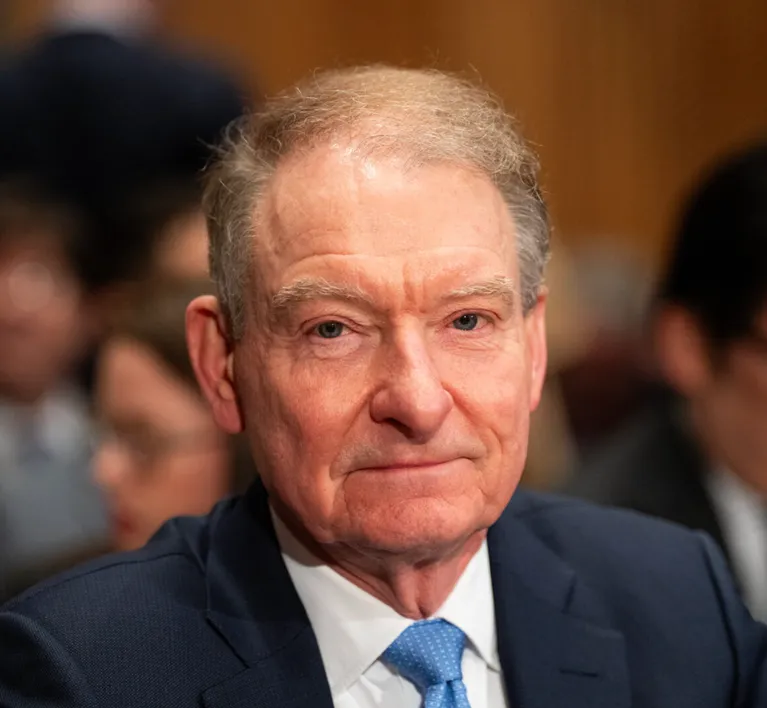
Paul Atkins, a former SEC Chair, steps into this conversation with a perspective shaped by years at the center of U.S. financial regulation. His comments signal how the regulatory mindset is evolving, what Washington now recognizes about blockchain's benefits, and how quickly the United States may move toward on chain markets.
A Soft Voice With a Loud Message For RWAs
Paul Atkins speaks with the calm, measured tone of someone who has been in Washington long enough to understand the value of restraint, but the message he delivers is anything but quiet. Sitting across from FOX Business, he talks about blockchain, transparency, and tokenization as if these ideas were not once considered fringe, but were simply overdue upgrades to a creaking financial system.
Seeing Real World Assets discussed on one of the most mainstream and conservative business networks in the United States signals how far the conversation has shifted. Legacy media is no longer tiptoeing around crypto. It is engaging with it directly.
Post from @coinbureauView the original post on X↗
Atkins makes it clear that he understands the fundamental benefit blockchain brings to markets. Transparency is not a marketing bullet point for him. It is a structural correction to decades of opacity that has defined clearance, settlement, and delivery within traditional finance. These processes have always been hidden behind institutional walls, and with that secrecy came risk.
“All this modernization of the markets is good.”
Paul Atkins
Atkins does not dismiss this history. He contrasts it openly with what a more visible, auditable ledger could provide for investors, institutions, and regulators. The message is simple. The system can be better, and blockchain is one path that makes it possible.
Tokenization Moves From Theory To Inevitability
When Atkins talks about tokenization, he does not frame it as a speculative experiment. He frames it as an eventual step for banks and financial institutions that want to keep pace with technological progress. He believes they will adopt it because the logic is undeniable.
Tokenization streamlines operations, eliminates the lag between key market processes, and gives all participants a shared source of truth. These are not ideological reasons. They are operational reasons, and for institutions that move billions of dollars every day, operational benefits win arguments that hype never could.
There is also a cultural shift happening within the regulatory sphere. Historically, the SEC has never been a vanguard of innovation. It reacts more often than it leads. Atkins, however, signals something different. He reinforces that the agency is becoming a force that will help modernize the marketplace rather than slow it down. It is a subtle but meaningful shift in tone.
Crypto has spent years battling a regulatory posture that felt defensive and punitive. Hearing a former SEC Chair say that tokenization is not only plausible but necessary suggests that the internal temperature has changed. The agency is leaning in instead of pulling back.
A System Ready For Structural Repair
The most striking part of the interview revolves around infrastructure. The current system separates clearance, settlement, and delivery into distinct layers that often sit in different institutions. Atkins describes this gap as inherently risky, which anyone inside finance knows to be true. Those layers introduce friction and delays, but they also create blind spots. When transfer of ownership is disconnected from settlement, there is always potential for mismatched books, errors, or worse.
Blockchain removes that fragmentation. Transactions, ownership updates, and settlement occur in a single cohesive event. The transparency is not just philosophical. It is functional.
“One block at a time. Real-world value is finally coming on-chain.”
@thirdweb
Markets become safer because the plumbing becomes simpler. Regulators get clearer visibility. Institutions eliminate reconciliation burdens. Investors gain confidence because the path between a trade and its completion is no longer a black box. Atkins does not have to oversell this. He just explains it plainly, and the logic carries itself.
A New Day For The United States
Atkins closes with an acknowledgment that feels almost cathartic. The United States has stifled crypto in the past. The SEC was a major part of that resistance. Yet he insists that it is a new day and that things are changing. Coming from a former Chair, that statement is not casual.
It is a recognition that public pressure, global competition, and institutional adoption have reached a point where the old posture no longer works. The United States cannot afford to remain behind as the rest of the world builds new financial rails.
Post from @DayinthemarketView the original post on X↗
The idea that all U.S. markets could be on chain within two years would have sounded outrageous a few years ago. Today it sounds like a roadmap. Maybe ambitious, maybe optimistic, but no longer unrealistic. Atkins gives the vision legitimacy by speaking with the composure of someone who has spent decades inside the institution that once resisted this very change.
His tone is steady. His message is seismic.
Final Thoughts
This interview marks a cultural shift as much as a regulatory one. When blockchain becomes a topic on FOX Business, and when a former SEC Chair talks about tokenization with this level of certainty, it signals that the narrative has crossed the boundary from speculative technology to inevitable infrastructure.
Crypto has always lived in tension with the old world, but that tension is dissolving. Traditional finance is beginning to treat blockchain not as a rival system, but as the next upgrade to its own machinery.
The question is no longer whether tokenization will happen. The question is how quickly institutions will move and how gracefully the regulatory environment will adapt. Atkins hints that the SEC is finally prepared to participate in the modernization rather than obstruct it.
If that proves true, the United States may finally step into a leadership role in a space it once tried to slow down. The future of markets is being rewritten, and for the first time in years, Washington seems ready to join the drafting table.
Related News: Discover how Kraken’s acquisition of Backed is accelerating the global market for tokenized equities.
Reporting by Lidia Yadlos