
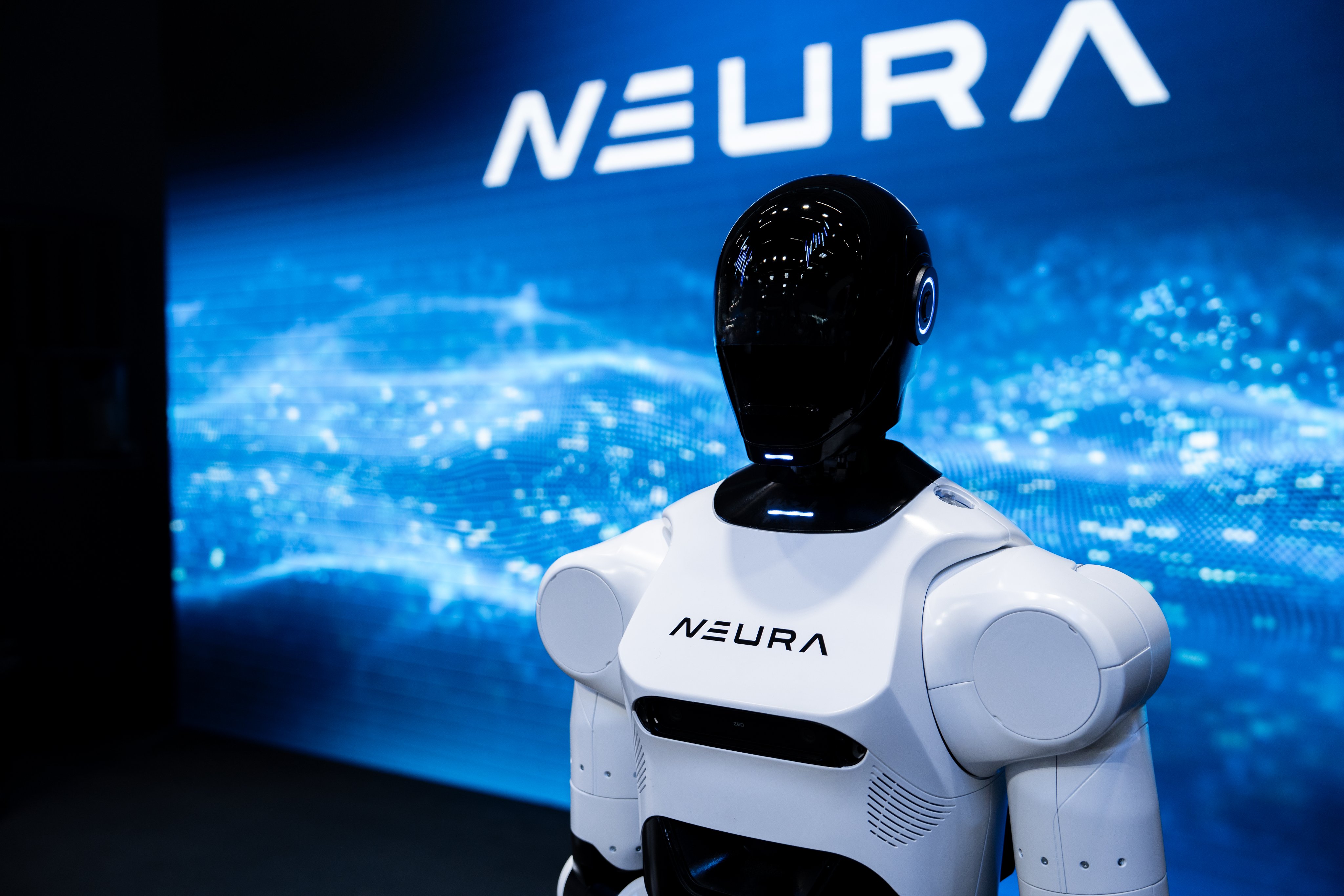
Tether is making one of its biggest bets beyond digital assets, leading a financing round of up to $1.4 billion for German robotics company NEURA Robotics as the stablecoin giant expands deeper into artificial intelligence, autonomous systems, and what it calls the emerging machine economy.
The investment ranks among the largest private funding rounds ever raised in humanoid robotics and physical AI, backing a company building everything from humanoid robots and robotic arms to autonomous mobile systems designed to work alongside humans across industrial, commercial, and service environments.
But the deal is about more than robotics.
Tether plans to integrate key pieces of its technology stack directly into NEURA's ecosystem, providing both the intelligence and financial infrastructure that autonomous machines will need to operate independently.
Post from @tetherView the original post on X↗
Giving Robots a Wallet
One of the most notable aspects of the partnership is NEURA's planned integration of Tether's Wallet Development Kit (WDK), which would allow robots to hold self-custodial wallets and execute transactions without relying on centralized intermediaries.
The vision is straightforward: if autonomous machines are expected to perform tasks, purchase services, share resources, or interact with other systems, they need native access to payments.
Rather than routing every transaction through a human operator, robots could eventually receive compensation for completed tasks, make micropayments, or participate in machine-to-machine economic activity within predefined parameters.
The concept has long been discussed in both robotics and crypto circles, but few major companies have attempted to build the financial rails required to make it practical.
Bringing AI to the Edge
Beyond payments, NEURA will also work with Tether to deploy and test QVAC, the company's edge-first AI runtime.
Unlike traditional AI systems that depend heavily on cloud infrastructure, QVAC is designed to run models locally on devices.
For robots operating in factories, warehouses, hospitals, or public spaces, that distinction matters. Local AI execution can reduce latency, improve reliability, and minimize dependence on centralized cloud providers.
In environments where machines need to react in milliseconds, sending data back and forth to remote servers is often impractical.
Tether argues that truly autonomous systems will require both local intelligence and local financial capabilities, making AI and payments two sides of the same infrastructure challenge.
The Race Toward the Machine Economy
The investment reflects Tether's increasingly aggressive expansion strategy.
Known primarily as the issuer of the world's largest stablecoin, the company has spent the past two years deploying profits into sectors ranging from energy and artificial intelligence to telecommunications, media, and biotechnology.
Robotics now joins that list.
According to Paolo Ardoino, Tether's CEO, the existing infrastructure used for payments, computing, and coordination was built for humans, not autonomous systems.
"As robotics moves beyond scripted automation and into true autonomy, the infrastructure behind it must evolve as well," Ardoino said.
The company believes future robotic systems will require native payment capabilities, localized AI processing, and direct participation in economic networks without relying on layers of centralized approval and coordination.
Post from @NEURARoboticsView the original post on X↗
Why NEURA?
Founded in 2019 and headquartered in Germany, NEURA Robotics has emerged as one of Europe's most ambitious physical AI companies.
The firm develops cognitive robotic systems capable of seeing, hearing, learning, and adapting to real-world environments while also building the software infrastructure required to manage large fleets of intelligent machines.
At the center of that strategy is the Neuraverse, a platform designed to connect robots, AI models, data, simulation environments, components, and services into a unified ecosystem.
The long-term goal is to create a marketplace where robots can continuously learn, share capabilities, and operate across industries using common infrastructure.
Several of NEURA's strategic partners are also participating in the financing round, signaling growing industry confidence in the company's approach.
Beyond Stablecoins
For Tether, the NEURA investment represents another step in its evolution from stablecoin issuer into a broader technology and infrastructure company.
The company already processes hundreds of billions of dollars in global liquidity flows through its stablecoin ecosystem. With robotics, the focus shifts from enabling people to transact digitally toward enabling machines to act, learn, and transact in the physical world.
If autonomous robots become a meaningful part of the global economy, Tether is positioning itself to provide both the financial rails and the intelligence layer that power them.
The company is betting that the next generation of economic participants may not be human at all.
Reporting by Lidia Yadlos