
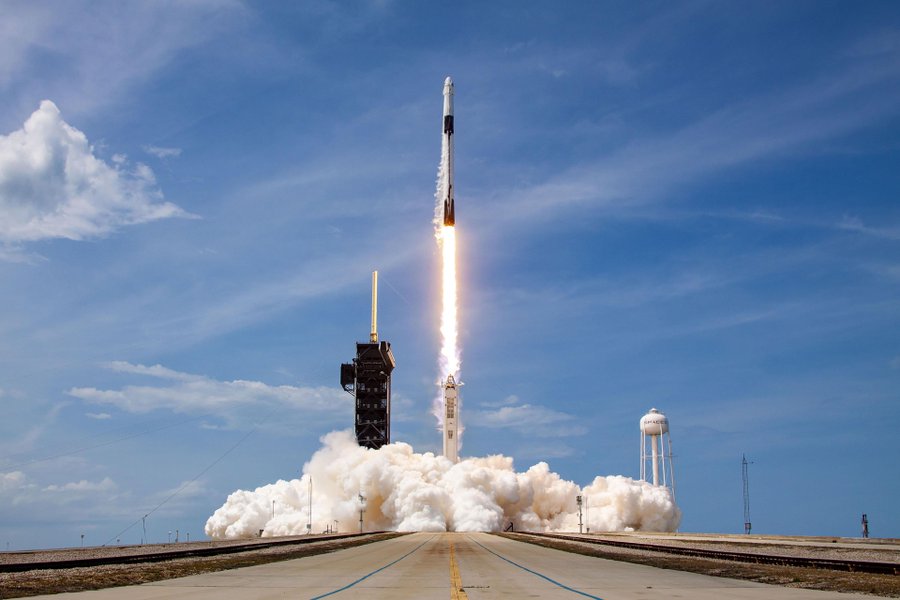
SpaceX has lost more than $400 billion in market value since reaching its post-IPO peak.
Shares of Elon Musk's aerospace giant are currently trading around $155, down roughly 27% from their all-time high of $211.39 reached on June 16. The decline has pushed the company's valuation back to approximately $2.04 trillion after briefly approaching the $3 trillion mark during one of the most explosive public market debuts in history.
For many investors, the correction is simply a healthy pullback after an extraordinary rally. For others, it highlights a much larger debate that could soon dominate financial markets: how should investors value the next generation of AI companies preparing to go public?
With firms such as OpenAI, Anthropic, and Perplexity attracting enormous private-market valuations, SpaceX may offer an important case study in what separates a highly valued company from a truly defensible one.
Post from @MeidasTouchView the original post on X↗
SpaceX Is Expensive — But It Owns Assets Few Companies Can Replicate
Critics have long argued that SpaceX is overvalued. Even after its recent decline, the company remains worth more than most publicly traded corporations on Earth.
Yet investors continue paying a premium because SpaceX owns assets that competitors cannot easily reproduce.
The company dominates the global launch market, operates Starlink, the largest satellite internet constellation in history, holds billions of dollars in government and defense contracts, and continues developing Starship, the most ambitious rocket program currently underway.
Those advantages are not built overnight. Launching rockets requires decades of engineering expertise, regulatory approvals, manufacturing infrastructure, launch facilities, supply chains, and billions of dollars in capital.
The same applies to Starlink.
Starlink May Be More Valuable Than the Rockets
While SpaceX is best known for launching rockets, many investors increasingly believe Starlink could become the company's most valuable asset.
The satellite internet network has grown to more than 6 million subscribers worldwide and continues expanding across consumer broadband, aviation, maritime, enterprise, defense, and government markets.
Unlike many high-growth technology companies that remain heavily dependent on future projections, Starlink already generates recurring revenue from millions of paying customers while building a network that becomes more valuable as coverage and adoption increase.
This combination of infrastructure ownership, recurring revenue, and global reach is why some analysts believe Starlink alone could eventually command a valuation measured in the hundreds of billions of dollars.
Investors aren't simply betting on future possibilities—they're assigning value to a business that already controls critical communications infrastructure, real customers, and multiple long-term growth opportunities.
Post from @MarsUniversityXView the original post on X↗
The AI IPO Boom Faces a Different Challenge
That brings us to the next wave of AI companies expected to enter public markets.
OpenAI, Anthropic, and several other leading AI firms have attracted private-market valuations that would place them among the world's most valuable technology companies. Those valuations are largely built on the belief that today's leaders will maintain their technological edge for years to come.
However, investors are beginning to confront a more complicated reality. Open-source AI models are improving at an extraordinary pace, with projects such as Meta's Llama, DeepSeek, Qwen, and Mistral steadily narrowing the performance gap with proprietary systems.
As capabilities converge, factors such as distribution, enterprise relationships, proprietary data, and infrastructure may become more important than model performance alone.
That raises a critical question for future public investors: if the technology itself becomes increasingly accessible, where does the long-term competitive advantage come from?
Investors May Be Paying Too Much for Models
None of this suggests that OpenAI or Anthropic lack value. Both companies remain at the forefront of the AI revolution and have built products that are transforming how individuals and businesses interact with technology.
The concern is whether public markets will ultimately value AI companies the same way venture capital investors do.
Private investors often pay for growth, market potential, and future possibilities. Public investors tend to focus more heavily on durability, profitability, and competitive moats. History is filled with examples of once-dominant technology companies that appeared untouchable before competition eroded their advantages.
Search engines, social networks, smartphones, and cloud computing all experienced periods where leadership seemed permanent—until it wasn't.
The challenge for AI companies approaching IPOs will be convincing investors that their advantages extend beyond having the most capable model today.
Post from @WSJView the original post on X↗
Why Infrastructure May Be the Better Bet
For that reason, some investors increasingly believe the biggest winners of the AI boom will be infrastructure providers rather than model developers.
Nvidia has become one of the world's most valuable companies because every major AI platform depends on its chips. Cloud providers including Microsoft, Amazon, Google, and Oracle continue investing hundreds of billions of dollars into data centers and compute infrastructure.
Even decentralized AI networks such as Bittensor, Render, and Akash are built around the idea that access to compute will ultimately become more valuable than the models themselves.
SpaceX fits surprisingly well into that framework. Whether through launch services, Starlink, satellite infrastructure, or future communications networks, the company owns physical assets that are extraordinarily difficult to replicate.
As demand for connectivity, compute, and data transmission continues growing, those assets may become even more valuable over time.
The Real Test for Future AI IPOs
Cathie Wood's decision to buy additional SpaceX shares during the selloff suggests some institutional investors continue to view the company as a long-term winner despite recent volatility.
Post from @StockMKTNewzView the original post on X↗
More importantly, it highlights what investors are willing to pay for: businesses with assets, infrastructure, and competitive advantages that competitors cannot easily copy.
That may prove to be the real lesson from SpaceX's $400 billion correction.
The company remains worth more than $2 trillion because investors believe its position is defensible. The next generation of AI IPOs will likely face the same question.
As open-source models continue improving and AI capabilities become increasingly widespread, public markets may place greater value on companies that control infrastructure, distribution, data, and real-world networks than on those whose primary advantage is a model that can eventually be matched.
The distinction could determine which AI companies become the next trillion-dollar giants—and which fail to live up to the valuations being assigned today.
Reporting by Lidia Yadlos