


The Core Theme: The 2026 Debasement Trade
The explosive rally in the first four weeks of 2026 was defined by the "debasement trade"—a systemic flight from the U.S. dollar and paper assets toward "hard" stores of value. This trade was fueled by a unique convergence of fiscal instability and political rupture:
The J.P. Morgan Trigger
On January 22, 2026, President Trump filed a $5 billion lawsuit against J.P. Morgan and CEO Jamie Dimon, alleging political "debanking".[1] This unprecedented attack on the nation's largest lender signaled a complete breakdown in the relationship between Washington and Wall Street, sparking fears that the financial system was becoming a tool for political retribution.[3]
Monetary Erasure
Combined with public criticisms of the Federal Reserve's independence, investors sought insulation in assets that could not be "printed" or frozen. This rotated capital out of overextended AI tech stocks into the metals complex, pushing gold past $5,600, silver past $120 and copper to a record $14,500/ton.

The Perfect Storm: Debasement Meets Physical Scarcity
The debasement trade did not happen in a vacuum; it collided with the most acute physical silver shortage in history, creating a positive feedback loop that propelled the price to an intraday high of $121.75 on January 29.
1. The Inventory Free Fall
In mid-January, a "physical run" on Wall Street saw 33.45 million ounces withdrawn from COMEX registered warehouses in just seven days—a 26% disappearance of deliverable inventory in one week.[5] By January 27, registered stocks fell to a critical 107.7 million ounces.[7]
2. The Paper System Fracture
The "paper game" began to collapse as the coverage ratio fell to 14.2% (Registered inventory vs. 760 million ounces of open interest).[7] With commercial short positions totaling 231 million ounces—over double the available deliverable supply—shorts were trapped in a vertical squeeze.
3. The Eastern Magnet
Shanghai spot premiums exploded to over +$12/oz above London (LBMA) benchmarks, creating an unstoppable one-way flow of physical metal from West to East.[9] This prompted LBMA lease rates to spike to 39%, effectively ending the economic viability of short-selling.[11]

The Pivot: The "Warsh Shock" and the Margin Hammer
On January 30, the "debasement trade" hit an abrupt wall through two coordinated catalysts.
1. The Warsh Nomination
President Trump's nomination of Kevin Warsh to succeed Jerome Powell as Fed Chair removed the expectation of a "politicized Fed". Warsh is perceived as a monetary hawk who prioritizes inflation control and Fed independence.
•Interest Rate Outlook: The market immediately priced in higher rates for longer and a potential reduction in the Fed's balance sheet.[12]
•Currency Rebound: The U.S. Dollar Index (DXY) surged 0.8% above the 97 mark, crushing the "debasement" narrative and raising the opportunity cost of holding non-yielding metals.
2. The CME "Kill Switch"
To contain the "metal mania," the CME Group and LBMA implemented a 36% margin hike, which stimulated vigorous market reactions.[13]
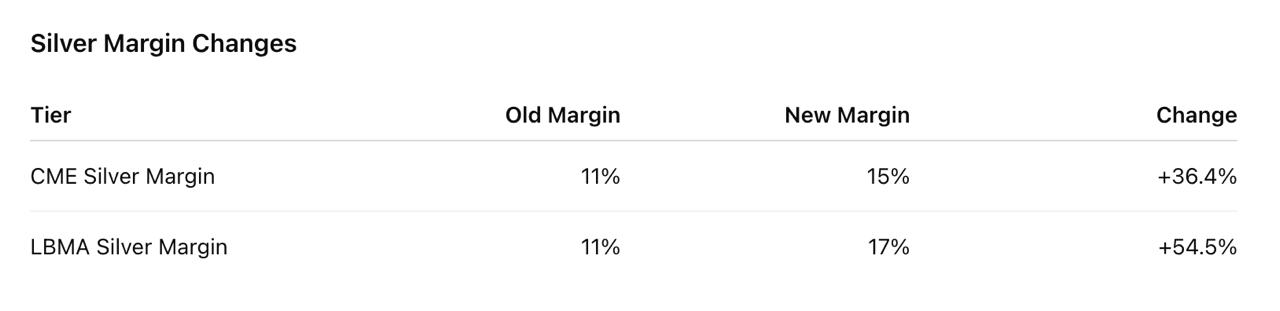
This forced a violent liquidation of levered positions. Silver spot dropped by 36% and silver futures plummeted 31.4% in a single session to settle at $78.53—the worst daily decline since March 1980.

Foundation Check: Is the Silver Bull Dead?
Despite the "liquidity-driven washout," the structural foundation of the silver market remains remarkably bullish.[13]
•Supply Scarcity: China's reclassification of silver as a strategic material (effective Jan 1) and its subsequent export controls remain in place, permanently fragmenting global supply.[16]
•Inelastic Demand: The photovoltaic (PV) industry requires 120–125 million ounces in 2026 to meet 665 GW of capacity. Silver now represents 29% of solar module costs, yet substitution remains years away from scaling.
•Structural Deficit: The market enters its fifth consecutive year of deficit, with mine supply unable to respond to prices due to its status as a by-product of base metal mining.
Consolidation Period
Using Elliott Wave Theory and the Fibonacci sequence from the foundation low price of $28.31 to the Jan peak $121.75, we identify the support floor for the current consolidation phase.[12]
•Golden Ratio Support ($64.02): The 0.618 retracement serves as the critical structural floor for the next three months.
•Psychological Pivot ($75.00): The 50% retracement level where the market is currently attempting to stabilize.
Outlook
The "Warsh Shock" has purged the speculative froth from the debasement trade, but it has not resolved the physical shortage. We expect a "base-building" period between $64 and $75 and wait for the structural deficit to reassert price control again.
Works cited
Silver $100, Gold $5000 as Trump's 'Rupture' Turns on J.P.Morgan - BullionVault, accessed on January 31, 2026
Trump's JPMorgan lawsuit underscores his growing clash with Wall Street - BNN Bloomberg, accessed on January 31, 2026
Trump sues JPMorgan for $5 billion, alleges the bank closed his accounts for political reasons - The Hindu, accessed on January 31, 2026
Trump's lawsuit against JPMorgan highlights rising tensions between Wall Street and Washington, accessed on January 31, 2026
2026 Silver Run: When the Paper Game Collapses and Silver ..., accessed on January 31, 2026
Silver: How Structural Deficits Are Setting Up a Once-in-a-Generation Move | Investing.com, accessed on January 31, 2026
$120! Spot silver and New York silver futures hit new highs together ..., accessed on January 31, 2026
The Silver Short Squeeze: Only 14% of Futures Are Covered - Mitrade, accessed on January 31, 2026
Silver Hits $100 in Shanghai | The $12 Arbitrage Gap That Will DRAIN Every Western Vault, accessed on January 31, 2026
Silver's Holiday Basis: China's Premiums Ignite, Vaults Drain, and Two Curves Tell One Story - InProved, accessed on January 31, 2026
Silver leasing rates surge 39%! Banks refuse to le | MarketWhisper on Gate Square, accessed on January 31, 2026
Kevin Warsh Fed Chair Nomination: Gold and Silver Crash Today ..., accessed on January 31, 2026
CME raises gold, silver margins after steepest single-day plunges in decades, accessed on January 31, 2026
Silver price crash: Why precious metals witnessed one of the worst corrections in decades on Friday, January 30 - Upstox, accessed on January 31, 2026
Gold plunges 12% in biggest single-day selloff. Key levels to watch on Budget Day 2026, accessed on January 31, 2026
Silver Prices Surpass $100: Supply Chain & Fed Policy - Discovery Alert, accessed on January 31, 2026
Silver's Elliott Wave Journey: 2026 Correction Ahead ... - Bullion World, accessed on January 31, 2026
Reporting by Lidia Yadlos