

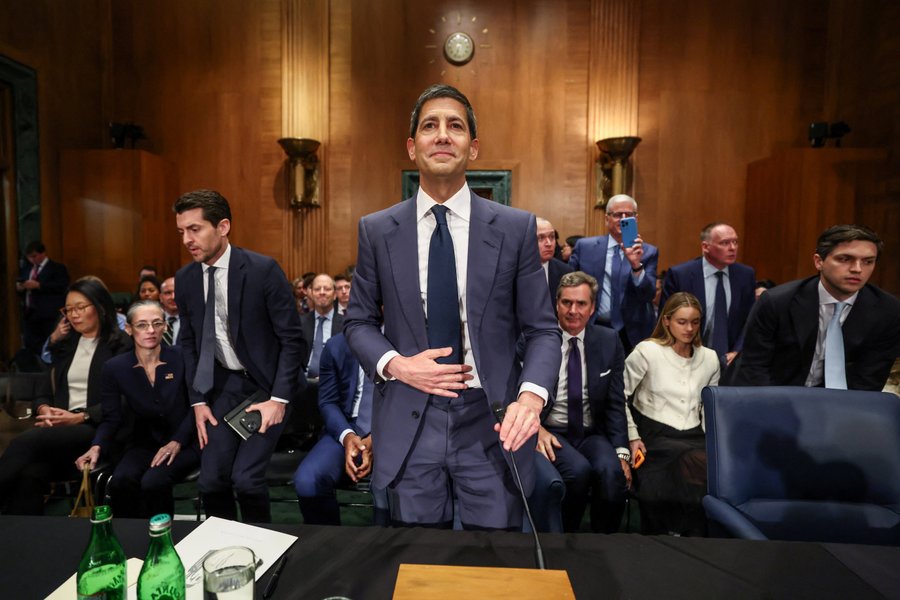
Jerome Powell’s final press conference as Jerome Powell has strengthened the confirmation prospects of Kevin Warsh as his likely successor.
—
The leadership transition at the world’s most influential central bank could mark a meaningful shift in monetary policy direction, with broad implications for financial markets, including crypto.
Post from @PredMTraderView the original post on X↗
Recent market data reinforces that shift. Prediction markets now price Warsh’s confirmation by mid-May at roughly 86%–96% probability, with near certainty (~96%+) for confirmation before June.
The sharpest repricing has occurred in the May 1–May 15 window, signaling traders expect a decisive political catalyst in that period.
Who Is Kevin Warsh?
Kevin Warsh served as a Federal Reserve Governor from 2006 to 2011, navigating the central bank’s response during the global financial crisis. A former Morgan Stanley investment banker and economic adviser, Warsh has been considered a leading candidate to succeed Powell for some time.
He is broadly viewed as more hawkish than Powell on certain policy matters, with markets already adjusting expectations accordingly. Following his confirmation hearings, economists have scaled back expectations for rate cuts in 2026, with many now anticipating no more than one cut this year.
Warsh’s rising confirmation odds come at a pivotal moment. The Fed’s policy trajectory over the next several years will shape interest rate expectations, liquidity conditions, and the broader regulatory environment for both traditional and digital asset markets.
Post from @danielisdizzyView the original post on X↗
What Powell’s Exit Signals
Powell’s tenure at the Federal Reserve was defined by extraordinary monetary interventions — from near-zero interest rates during the pandemic to the aggressive rate-hiking cycle that followed. His final press conference appears to have cleared a major political bottleneck for Warsh’s confirmation.
The biggest catalyst: the U.S. Department of Justice dropping its criminal probe into Powell, which had previously blocked progress in the Senate.
That move triggered immediate political alignment. Senator Thom Tillis — who had been holding up the nomination — reversed course and signaled support, effectively clearing the procedural path forward.
The Senate Banking Committee is now expected to vote on Warsh’s nomination before recess, putting the process on a compressed timeline heading into mid-May.
Market reaction has been equally sharp. Prediction market pricing jumped by as much as 20 percentage points intraday following Tillis’s endorsement, with traders now overwhelmingly aligned around a mid-May confirmation window.
Post from @WatcherGuruView the original post on X↗
At the same time, macro conditions remain complex. The Fed is expected to hold rates steady around 3.5%–3.75%, even as inflation risks persist due to geopolitical pressures like rising energy prices.
Warsh’s rising confirmation odds suggest potential shifts in Fed policy direction, impacting market expectations and economic strategies globally. — Crypto Briefing
A change in Fed leadership historically triggers recalibration across asset classes. Traders and institutional investors closely monitor the transition for signals on rate policy, balance sheet management, and regulatory posture toward emerging financial technologies.
Implications for Crypto Markets
The Fed Chair’s influence extends well beyond traditional finance. Monetary policy decisions directly affect risk appetite, dollar strength, and liquidity — all of which are key drivers of crypto market cycles.
A Warsh-led Fed is increasingly being interpreted as less dovish than markets previously expected, with implications for tighter liquidity conditions and potentially slower risk-asset expansion. That shift is already visible in rate expectations and derivatives positioning.
Post from @ReutersView the original post on X↗
Market participants are also watching whether a new Fed Chair would take a more defined stance on digital assets. Warsh has not been explicitly anti-crypto, but his broader focus on financial stability and inflation control could shape regulatory tone indirectly.
Reporting by Blockster Newsdesk