


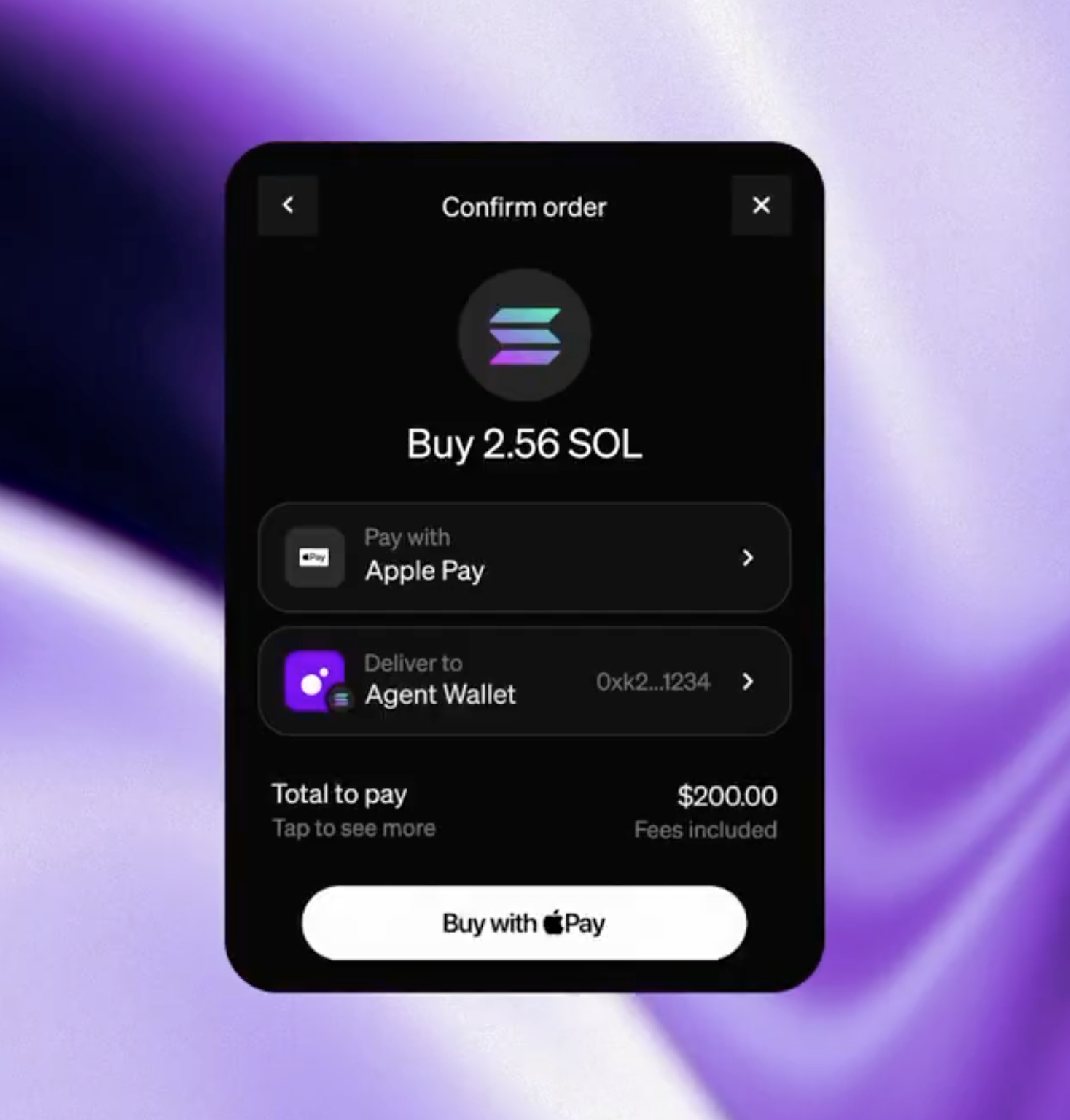
AI agents have crossed a threshold. They no longer just answer questions or generate outputs. They trade. They rebalance portfolios. They execute strategies. They operate continuously.
But until now, they’ve been missing one critical thing: access to money.
—
This morning, MoonPay launched MoonPay Agents, a non-custodial financial layer that allows AI agents to hold wallets, access funds, and execute onchain transactions autonomously.
From Intelligence to Execution
The limitation has never been reasoning — it’s been rails.
AI agents can analyze markets, optimize strategies, and identify opportunities, but without a way to custody value and move capital, they remain observers. MoonPay Agents removes that constraint by unlocking the full financial lifecycle for agents: funding, transacting, and off-ramping back to fiat.
Once a user verifies and funds an agent’s wallet through MoonPay, that agent can independently trade, swap tokens, and move funds without ongoing manual approval — all while remaining non-custodial and permissionless.
The result is a financial layer purpose-built for the emerging agent economy.
Post from @moonpayView the original post on X↗
How MoonPay Agents Works
MoonPay Agents is built on MoonPay CLI, the company’s developer-focused command-line interface. With a single install, developers can spin up non-custodial wallets stored locally on a user’s device, fund them through MoonPay’s global onramps, and programmatically execute onchain transactions.
The system supports:
Fiat-to-crypto funding via global onramps
Wallet generation and management
Swaps, trading, and cross-chain execution
Recurring buys to ensure agents remain funded
Off-ramps back to fiat when strategies complete
MoonPay Agents also supports machine-to-machine payments through x402 compatibility, enabling fully autonomous transactions without human intervention.
AI Needs Capital Infrastructure
According to Ivan Soto-Wright, the launch addresses a structural gap in the AI stack.
AI agents can reason, but they can’t act economically without capital infrastructure. MoonPay positions itself as the bridge between intelligence and money — and crypto as the fastest, most programmable rail for that transition.
This framing matters. MoonPay isn’t pitching agents as a novelty. It’s positioning them as participants in real financial workflows.
Built for an Agent Economy at Scale
MoonPay Agents is designed for thousands — eventually millions — of agents operating across trading, gaming, commerce, treasury management, and beyond.
MoonPay integrates directly into agent workflows via CLI, APIs, and infrastructure layers. If a service requires identity verification, the human completes KYC once — and from there, the agent can transact autonomously on their behalf.
The same MoonPay infrastructure that already powers nearly 500 companies now becomes the default financial rail for AI-native systems.
Post from @KeithGrossmanView the original post on X↗
Why This Matters
As AI systems move from tools to actors, finance becomes unavoidable.
Agents that allocate capital, execute trades, or manage treasuries need direct access to value — not workarounds, approvals, or custodial bottlenecks. MoonPay Agents collapses that friction into a single, programmable layer.
AI agents need capital to act. Developers need infrastructure to scale. MoonPay is betting it can be the onramp for both.
Reporting by Lidia Yadlos