

As crypto heads into a new week, the conversation across 'Crypto X' is converging around a few unmistakable themes: scaling finally working, capital still flowing, real-world assets accelerating, wallets stepping into the physical world — and familiar crash warnings resurfacing. Here’s what matters...
1. Ethereum Hits Record Usage as Gas Fees Collapse
Ethereum just crossed a major inflection point.
Daily transactions have surged to nearly 2.5 million, an all-time high, while average gas fees have fallen to near-zero — often below $0.01. For a network long criticized for congestion and high costs, this combination of record usage + minimal fees marks a structural shift.
More importantly, it helps Ethereum better compete with Solana on execution cost and throughput.
Solana has built its reputation on ultra-cheap transactions, with average fees typically ranging between $0.00025 and ~$0.003, depending on network conditions and measurement methodology. Ethereum narrowing that gap — while maintaining its deep liquidity, developer base, and institutional adoption — reshapes the Layer-1 landscape.
Why it matters: Sustained low fees on Ethereum unlock more native activity — DeFi, NFTs, social apps, RWAs — without forcing everything into L2s. This isn’t just a UX improvement; it’s a competitive reset.
Post from @coinbureauView the original post on X↗
2. Capital Is Still Deploying: Top Fundraises Mid-January 2026
Despite ongoing macro uncertainty, venture capital continues to flow into core crypto infrastructure. According to CoinMarketCap, last week’s top raises included:
LMAX Group — $150M (Centralized Exchange)
Alpaca — $150M (Trading & API Infrastructure)
Project 11 — $20M (Post-Quantum Security)
VelaFi — $20M (Payments)
Konnex — $15M (Robotics Marketplace)
XMAQUINA — $10M (Robotics)
Noise — $7.1M (Prediction Markets)
Meld — $7M (Payments)
Signal: Investors are prioritizing trading infrastructure, payments, security, and automation — not speculative narratives. Capital is clustering where long-term usage is inevitable.
Post from @CoinMarketCapView the original post on X↗
3. RWAs & Macro Signals Are Moving Together
Real-world assets continue to gain relevance as macro signals push investors toward defensiveness and yield.
Trending stats this week, according to Nexo.com:
Gold is trading around $4,600 per ounce, hitting record highs as investors move into safe-haven assets.
Markets see just a 5% chance of a Fed rate cut on January 28, according to CME FedWatch.
Goldman Sachs expects global equities to return about 11% over the next 12 months, including dividends.
VanEck estimates Bitcoin could reach $2.9 million long term if it’s widely adopted for global settlements and reserves. Silver has jumped to around $85 per ounce, outperforming as investors position defensively.
Post from @NexoView the original post on X↗
But beyond price action, RWAs are now showing real adoption and volume.
In 2025, BTCC alone recorded $5.72B in tokenized gold futures volume — about 10.7% of its total futures activity — a clear sign that tokenized commodities are becoming real, high-volume markets.
Yield is now being layered on top. As gold hits record highs, exchanges such as Bybit have introduced products like XAUT Flexible Earn, offering up to ~11% APR on tokenized gold, blending safe-haven exposure with crypto-native liquidity.
On the product side, Solana continues to expand its RWA footprint, with Remora Markets launching tokenized gold, silver, platinum, palladium, and copper — all tradable 24/7 onchain.
Taken together, these developments show RWAs evolving from narrative to infrastructure: liquid, yield-generating, and increasingly integrated into both centralized and decentralized markets.
Post from @RemoraMarketsView the original post on X↗
4. Wallets Are Going IRL — and This Trend Is Just Starting
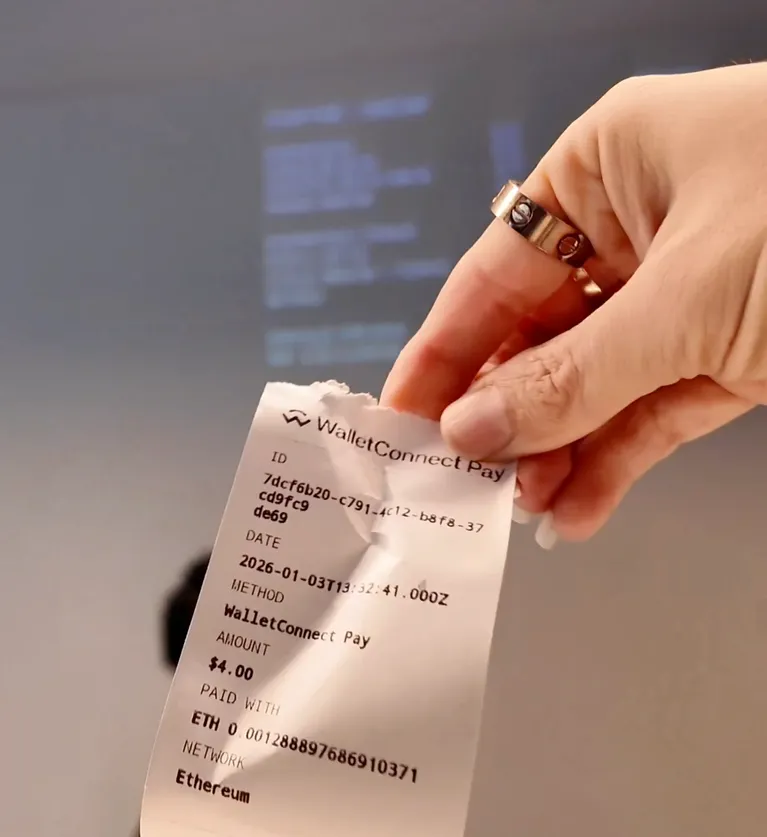
The IRL wallet trend continues this week, with WalletConnect making its first-ever in-person debut.
Wallets are rapidly evolving from background infrastructure into consumer-facing platforms, brands, and real-world access layers. And WalletConnect won’t be the last.
We’re already seeing this shift accelerate:
Walmart accepting crypto payments, pushing blockchain rails closer to everyday commerce
AEON, enabling crypto payments across 50M+ merchants, bridging payments with AI-driven economies
Binance Pay, now powering payments for 20M+ merchants globally
Bybit Pay, expanding exchange-to-merchant payment rails
Phantom, positioning wallets as the most important consumer apps in crypto, according to its leadership
What this signals: Wallets are becoming the front door to crypto — not just for DeFi, but for payments, identity, RWAs, events, and IRL commerce. Expect far more physical activations, partnerships, and consumer integrations in 2026.
Post from @HoulgraveView the original post on X↗
5. “A Crash Is Coming” — Context Matters
Finally, a familiar headline resurfaced.
“The Big Short” investor Michael Burry warned that a major market crash is coming — a message he’s repeated in various forms over recent years.
Editor’s note: This isn’t a reason to panic.
"Markets can stay irrational longer than anyone expects, and timing systemic resets is notoriously difficult. Even former Fed Chair Alan Greenspan famously noted that markets don’t move on prediction — they move on liquidity, confidence, and structural shifts."
Fed Chair Alan Greenspan
More importantly, today’s crypto landscape isn’t what it was in previous cycles.
Well-capitalized, infrastructure-level Web3 companies — exchanges, wallets, payment rails, and RWA platforms — are built to survive volatility, not depend on perpetual risk-on conditions. The industry is maturing, not disappearing.
Post from @cryptoroverView the original post on X↗
Closing Thought
Ethereum scaling, RWAs going live, wallets moving IRL, and capital concentrating around real utility all point in the same direction: crypto is embedding itself into financial and consumer infrastructure — not drifting away from it.
Short-term volatility will come and go. The builders shaping payments, markets, and access layers are playing a much longer game. And that story is still unfolding.
Reporting by Lidia Yadlos