

Most memecoin trading is already gambling. FateSwap just turns that reality into the product. It's a Solana DEX with a gambling mechanism built directly into the trade, and on April 20th its FATE token launches on pump.fun with tokenomics tied directly to the platform's success.
—
Crypto has no shortage of products that try to make degenerate behavior sound respectable. FateSwap is not one of them.
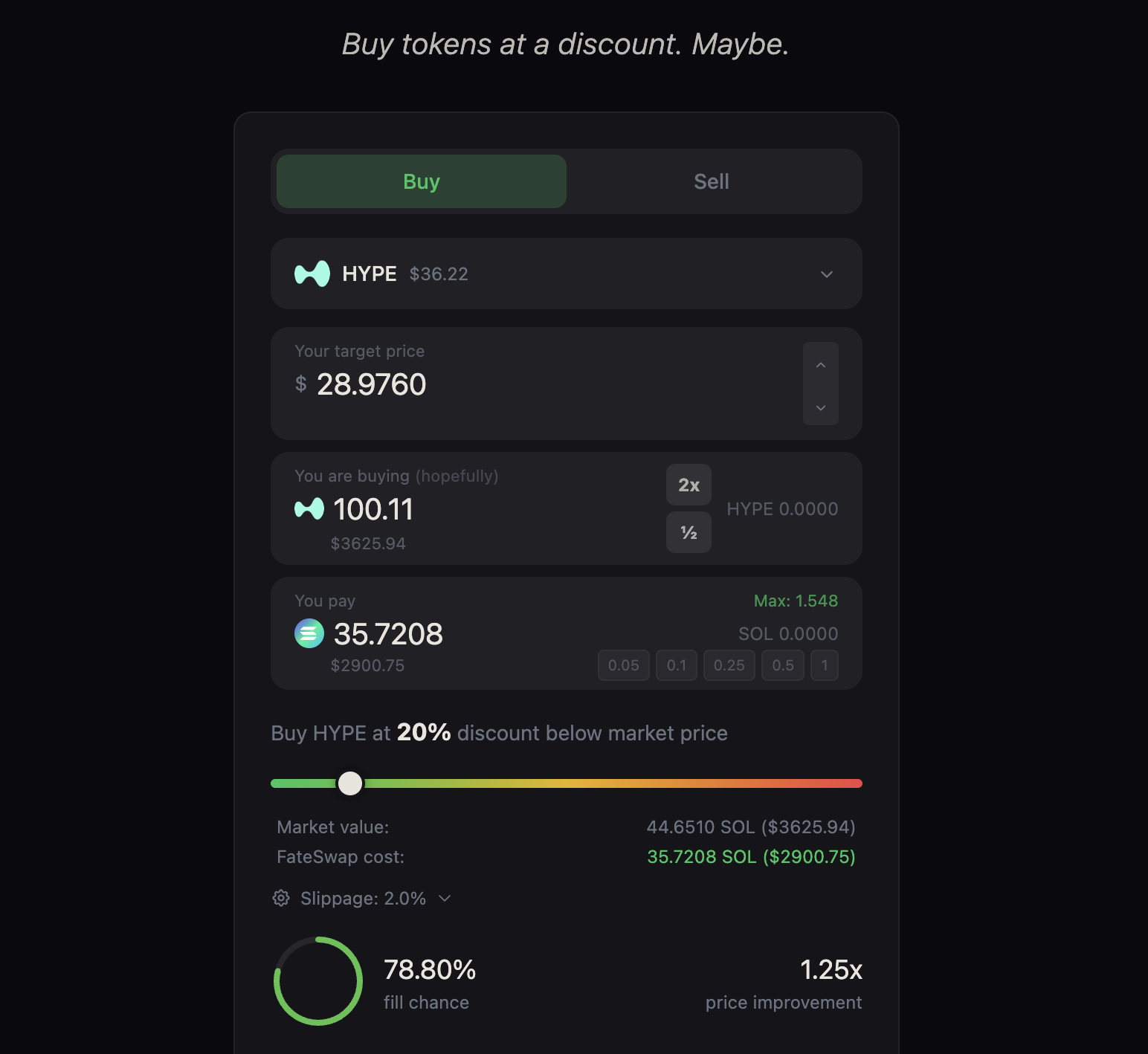
The pitch is refreshingly direct: FateSwap is a Solana DEX with a gambling mechanism built into the trading flow. Instead of simply accepting the market price when you buy or sell a token, you can choose to gamble for a better one.
That single idea is what makes the product click immediately. Anyone who has traded memecoins on Solana already understands the psychology. People are not just buying tokens because they want neat, efficient market access.
They are taking risk in search of outsized outcomes. FateSwap does not try to hide that impulse behind polite DeFi language. It productizes it.
Post from @FateSwapDEXView the original post on X↗
How FateSwap Works
At a base level, FateSwap is a real DEX experience on Solana. Token execution routes through Jupiter, so traders are interacting with real liquidity and real market prices.
Just as importantly, the whole system is built onchain. The gambling mechanics are provably fair rather than hidden behind a black box, which matters in a market where traders have learned to be suspicious of anything they cannot verify.
But FateSwap adds a gambling layer before the trade settles.
When you place a buy, you are not merely submitting an order and taking whatever the market gives you. You are effectively saying: I am willing to take a gamble for the chance to buy at a much better price.
When you place a sell, the same principle applies in reverse: you can risk the proceeds of that sale for the chance to walk away with more SOL than a normal market exit would have given you.
That is the appeal in one sentence: FateSwap lets traders gamble for a potentially amplified price through a DEX interface.
Something for Every Risk Appetite
One of the strongest parts of the product is that FateSwap is not limited to one kind of trader psychology.
If you want to scalp with relatively small risk, you can. If you want to go full degen and swing for a huge multiple, you can do that too.
The platform supports multipliers from 1.01x all the way up to 10x, with 210 different payout options in between. That creates a broad spectrum of possible strategies.
At the lower end, traders can aim for relatively modest improvements in price. That is the scalper mindset: smaller upside, but a much higher hit rate. If you are trying to grind out consistent small advantages, those lower multipliers are where the product starts to feel less like a moonshot machine and more like a disciplined degen tool.
Post from @FateSwapDEXView the original post on X↗
At the higher end, FateSwap becomes exactly what the most aggressive memecoin traders want it to be. You can take a shot at 5x or 10x outcomes, knowing full well that you are going to lose most of the time. But when those bets hit, the payoff is dramatic.
That is what makes the design unusually flexible. It is not a one-speed casino product. It gives traders a full range of risk from near-conservative all the way to absurdly aggressive, depending on what kind of trade they want to take.
In practical terms, FateSwap can serve:
scalpers looking for small but frequent edges
medium-risk traders looking for more meaningful upside
full degens willing to lose often in exchange for the chance at a huge hit
That range is a major part of the appeal. The product is not just "gambling" in a generic sense — it is a tool for expressing different risk appetites through the same trading interface.
Why This Makes Sense on Solana
Solana has become the natural home of fast-moving, highly speculative memecoin trading. It is where traders already live when they are rotating into hype, chasing momentum, or taking absurdly asymmetric bets on small caps.
In that environment, FateSwap feels less like a weird novelty and more like an honest evolution.
Most memecoin trading already contains a gambling mindset:
traders are trying to front-run momentum
they are taking outsized risk for better entries
they are looking for ways to multiply outcomes, not just execute efficiently
Traditional DEXs handle the execution side of that behavior. FateSwap leans into the psychology behind it.
That makes it memorable. It also makes it marketable, because the concept can be explained in plain English:
Normal DEX: execute the trade at market price. FateSwap: gamble for a better price.
The Other Side of the Trade: The Bankroll
One of the cleverer parts of the model is that FateSwap is not only for traders who want to gamble.
The bankroll side of the platform is user-funded. Users deposit SOL into the bankroll and receive fSOL LP tokens, which represent their proportional share of that bankroll. As the bankroll grows over time, those fSOL LP tokens increase in value along with it.
That bankroll position is also self-custodial in design, which is another important distinction. Users are not handing capital over to some opaque off-chain manager and hoping for the best. They are interacting with an onchain system where the position and mechanics are transparent.
Post from @FateSwapDEXView the original post on X↗
That means FateSwap creates two very different but complementary user experiences:
one side appeals to degens who want amplified upside by gambling through the trading flow
the other side appeals to users who want exposure to the house edge through a bankroll position that behaves more like a yield-bearing DeFi product
This is an important distinction. The bankroll side is not just "the other side of the bet" in a meme sense. It can also be understood in the language of traditional DeFi: users are putting capital to work in return for yield from protocol activity. The difference is that here the source of that yield is the embedded house edge of a gambling-based trading product.
For users who prefer something steadier than taking directional punts on memecoins, that makes the bankroll side of FateSwap feel closer to a more traditional and comparatively safer DeFi yield strategy than the trader side of the platform.
So FateSwap is not just a meme-y front end for reckless clicking. It is a more complete ecosystem where speculation and yield both have a place.
Why FateSwap Is Taking Off
FateSwap has a few advantages that a lot of token launches do not.
1. The concept is instantly understandable
A lot of crypto products need three diagrams and a whitepaper before anyone can explain them to a friend.
FateSwap does not.
"It's a DEX where you can gamble for a better price" is enough to make the lightbulb go on.
2. It is built for the audience that already exists
This is not a product trying to convince conservative investors to become gamblers. It is a product built for people who are already acting like gamblers in memecoin markets and want a better tool for doing it.
3. It has native virality
Products that combine risk, screenshots, stories, wins, losses, and degenerate behavior tend to generate conversation on their own. People share trades. They talk about improbable hits. They argue about risk. They invite friends. That kind of social energy matters.
4. The token is connected to actual platform usage
This is where FATE becomes more than just another ticker.
The FATE Token: Why Platform Success Matters
FATE launches on April 20th on pump.fun.
The most important part of the token design is that its value is tied directly to the success of the platform itself.
Here is the core mechanism:
10% of all platform fees are used to buy FATE on the open market and burn it.
That means the relationship is straightforward:
more trading activity on FateSwap
more fees generated
more FATE bought back
more FATE burned
less circulating supply over time
In other words, if the platform gets used, the token benefits mechanically.
That is far more compelling than the usual token story where "value accrual" is promised later and somehow never arrives.
With FateSwap, the link between product usage and token pressure is built into the design.
Post from @FateSwapDEXView the original post on X↗
Not a Fake "No Insider Allocation" Story
One point deserves to be stated clearly: this is not a story where the team pretends to have no stake at all.
The supply structure is more honest than that.
Of the total 1 billion FATE supply:
75% enters circulation via the pump.fun launch
1% is allocated to the referral competition
24% is reserved for the team
That team allocation is not a hand-wavy promise or a stealth bag hidden in the background. It is vested through Streamflow, and the structure is unusually long-term for this corner of the market.
The team tokens have a:
12 month cliff
followed by a further 2 year vesting schedule
That is practically alien behavior in pump.fun land.
Most pump.fun tokens are built around instant gratification, short time horizons, and creators who behave as though next week barely exists. A project with a full 12-month cliff and then another two years of vesting is signalling something very different.
It says the team is not positioned to immediately dump into the market, and it says they are structuring the token around a longer-term build rather than a quick extraction.
That does not mean blind trust is required. It means the incentives are much more aligned with actually growing the platform over time.
Why pump.fun Still Makes Sense
Launching on pump.fun is not a contradiction.
It is exactly where the audience already is.
If FateSwap is a product for the Solana memecoin crowd — the people who already think in terms of risk, speed, and asymmetric upside — then pump.fun is the native venue for introducing FATE. The difference is that behind the memecoin-friendly launch venue there is an actual product, actual trading activity, and a token model connected to real platform behavior.
That combination is where the upside lies.
The Real Bet
The bull case on FateSwap is not just "people like gambling." Crypto has already settled that question.
The real bet is that:
a blunt, memorable product concept cuts through faster than polished nonsense
Solana's degen trading audience immediately understands the use case
product activity can drive token demand through buybacks and burns
long vesting keeps the team aligned with building rather than flipping
If that thesis plays out, FateSwap has the ingredients to become one of the more talked-about products in the Solana memecoin orbit.
Not because it pretends to be safer than it is. Because it understands exactly what kind of market it is serving.
Key Details
Platform: FateSwap
What it is: A Solana DEX with a gambling mechanism built into the trade
Core appeal: Traders can gamble for a potentially better / amplified price
Token: FATE
Launch date: April 20, 2026
Launch venue: pump.fun
Supply: 1,000,000,000
Value accrual: 10% of platform fees go to open-market buybacks and burns
Team allocation: 24%, vested via Streamflow
Vesting structure: 12 month cliff, then 2 year vesting
Referral competition: 1% of supply / 10M FATE
Token page: fateswap.io/token
Competition page: fateswap.io/token/competition
Reporting by Blockster Newsdesk