

ETHDenver 2025 kicked off with an electrifying sense of unity and optimism, capturing the essence of what blockchain can truly achieve.
—
From the opening remarks by John Paller, the founder of ETHDenver, who called for collaboration over conflict, to Governor Jared Polis’s vision of blockchain and AI empowering individuals, the conference was charged with a sense of purpose.
Post from @EthereumDenverView the original post on X↗
The theme of community-driven innovation echoed throughout the event, as Ethereum’s co-founder Joe Lubin emphasized the importance of evolving together through hard forks, and Ben Jones from Optimism reflected on 2025 as the year to resolve Ethereum’s fragmentation.
Industry leaders, developers, and thought leaders delved into crucial topics, including privacy, interoperability, and AI, showcasing the diverse paths toward a more decentralized future. As the event unfolded, there was a palpable sense of anticipation—this was a conference about building, collaboration, and breaking new ground in both technology and community.
Here's a look at some of the standout moments from Day one.
—
1. John Paller, Founder of ETHDenver, Matt Lockyer, NEAR Protocol & Proximity, and Jared Polis, Governor of Colorado, kicked off ETHDenver with an opening ceremony. John opened with the following words for the Ethereum community:
“When we come together, we don’t have to fight, we’re strong enough to build together. If you don’t like it, you can Spork it”.
John Paller, Founder of ETHDenver
The Governor said, “I’m excited about the opportunity for blockchain technologies in general, putting people in charge of their organizations and associations. AI and intelligent agents will make that work and take it to the next level. Hopefully, something about the fresh mountain air and our pioneering spirit will inform your time here, welcome to Colorado and enjoy ETHDenver.”

Colorado Governor Jared Polis on stage with John Paller, Founder of ETHDenver.
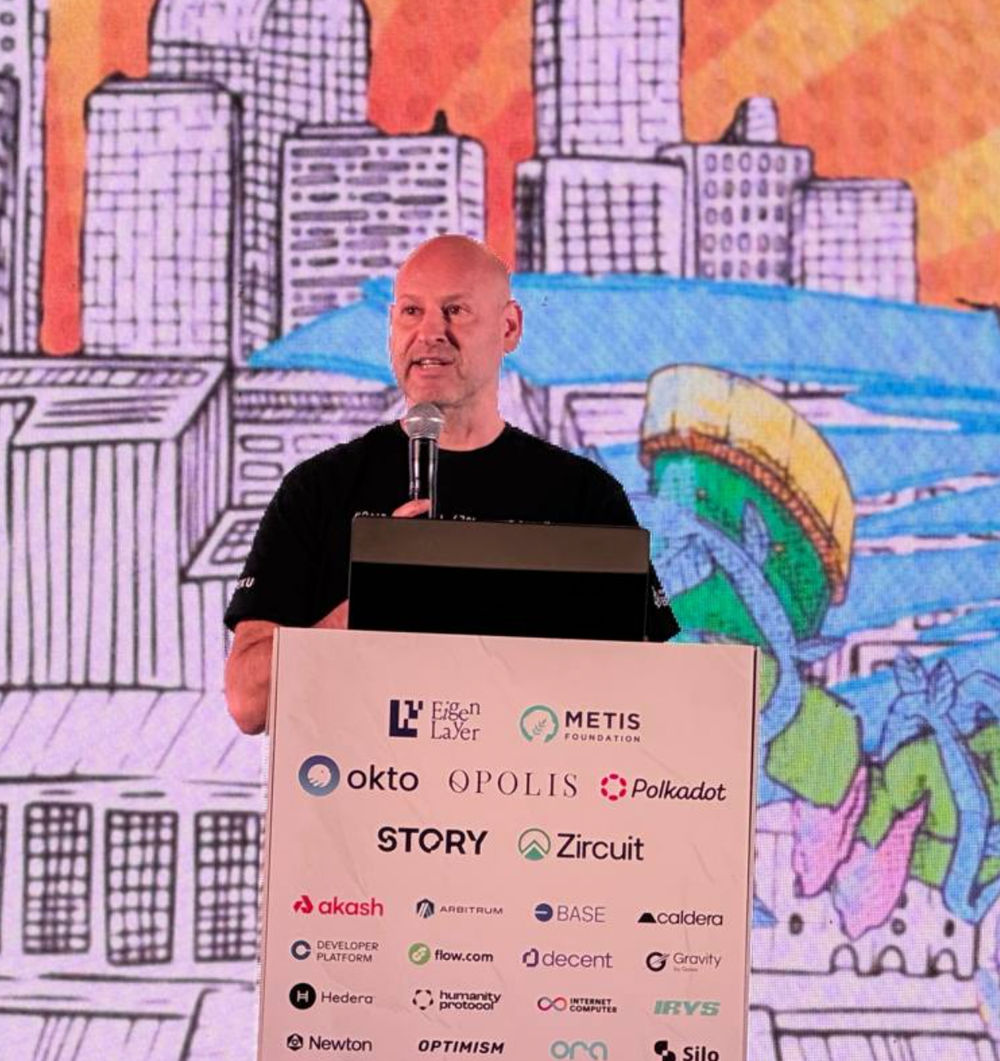
2. Joe Lubin, Co-Founder of the Ethereum Project and CEO of Consensys followed with an overview of the current State of Ethereum:
“Ethereum’s community is full of smart and useful people, and like smart and useful people — we like to argue.” To people who would criticize Ethereum, he said, “There’s no grand design for a universal settlement layer, there's no manual for how to build a universal settlement system for humanity, the only way is to do it together hard fork by hard fork.”

Joe Lubin, CEO of Consensys on the Regeneratooor Main Stage at ETHDenver 2025.
3. Ben Jones from Optimism discussed the history of Ethereum and the state of the ecosystem. “We have to think of where we are as a community — as Ethereum,” he said. “We are going through a crisis of fragmentation, a moment of re-evaluation, of what Ethereum is and what we should be doing. We need to think about the next progression of Ethereum at a deeper level of what it is.
Is Ethereum fragmented? Absolutely. There is serious work we need to do as a community, but I believe that 2025 is the year that we kill Ethereum fragmentation.”

Ben Jones from Optimism.
4. Maria Shen from Electric Capital, Jason Rosenthal from a16z crypto, and André Geest from Safe spoke about why crypto builders must focus on product-market fit. During the panel being moderated by Jenna Pilgrim from CoinFund, Rosenthal added:
“Looking at crypto as a category is too broad, I think there are parts of the industry that work well like Solana and layer 2s, if you look at the DEX ecosystem in Solana and Ethereum it's thriving, however, what we’re not seeing is full consumer adoption.”

Jenna Pilgrim of CoinFund, André Geest of Safe, Jason Rosenthal of a16z crypto, and Maria Shen from Electric Capital.
5. Howard Wu from Aleo, and Rich Widmann from Google, discussed how payments unlock privacy with compliance. Widmann said, “Every user wants a level of control over their privacy, that’s what I am excited about.” Wu added:
“Zero-knowledge allows us to unblock capabilities of what is available and possible for crypto today. For me, it’s unlocking new capabilities and fixing the issues.”

Howard Wu, from Aleo, and Rich Widmann, from Google.
6. Jess Houlgrave from Reown, Ben Jones from Optimism, Steven Goldfeder from Offchain Labs, and James Fry from Risk Labs (UMA & Across) discussed why we need to make blockchain technology more interoperable to reduce the fragmentation issues we’re seeing today, with the panel being moderated by Margaux Nijkerk from CoinDesk.
Goldfeder stated: “When I think about building interoperability, I don’t think about how to best connect users onto the Arbitrum chain, I’m thinking about how to bridge users onto other chains.”

Talk: The Role of Data in Shaping Crypto Market Trends (CoinMarketCap).
7. Alice Liu from CoinMarketCap discussed how data is shaping crypto market trends. She said, “Traditionally the U.S. has always been the number one market for crypto with 20-25% market share for the U.S. market. It has been on a downtrend for the past three months, which is contrary to what people think because everyone anticipates the Trump administration means a boost to the crypto industry and more users onboarded, but it doesn't seem so yet.
So, for the past month, we have seen the memecoin trend transform global user behavior. India became the second largest nation on our crypto world map and that is now counting close to 8,000% percent of all the users in crypto coming from India. Brazil got a boost as well and the U.S. and Europe have been on a decline.“

Alice Liu, CoinMarketCap.
8. During the panel “Barrier to Entry: Overcoming Web3 Onboarding” with Austin Griffith, Founder of BuidlGuidl, Francesco Andreoli Head of Developer Relations at Consensys, and Nader Dabit Director of Developer Relations for Eigen Labs, Griffith shared the following success story of onboarding developers into the industry:
“I saw someone the other day who said you got me into the industry, you bought me an ENS name! And he’s still here. We still do that, you come in, we give you $30, and say go buy an ENS name! It’s about soft-catching people and giving them the tools to thrive.”

Moderator Bianca Buzea, Lead DevRel at Chronicle Labs, Nader Dabit Director of DevRel for Eigen Labs, Francesco Andreoli Head of DevRel at Consensys, and Austin Griffith, Founder of BuidlGuidl.
9. Mahsa Moosavi from Offchain Labs discussed how Arbitrum Stylus simplifies smart contract deployment in Rust. She noted, “Arbitrum Stylus enables multi-language smart contracts on a single chain.” Emphasizing its interoperability with Ethereum, she added:
“Stylus runs inside the Arbitrum Nitro stack, and because Arbitrum is fully interoperable with Ethereum, Stylus enables developers to interact with any Ethereum application.” She also highlighted Stylus’s efficiency, saying it has 99% lower gas costs when compared to Solidity.

Mahsa Moosavi, Offchain Labs.
10. Samantha Yap, CEO & Founder of YAP Global spoke on Founder Mode Comms: Leading From the Front. She urged all founders to embrace being the face of their projects.
“My call today is for founders to lead their vision from the front. I have 3 key points that your founder should take note of when it comes to comms — inform, inspire, and influence.” She reminded listeners: “Trends fade away. You want to be sustainable— and not just chase the hype”.

Samantha Yap, CEO & Founder of YAP Global.
11. Shikhai Wei from Agentstarter, Carra Wu from Andreessen Horowitz (a16z), and Eskender Abebe from Eliza Labs discussed the state of AI agents with the panel being moderated by Jeff Wilser from AI-Curious. Abebe believes AI agents are currently most active in entertainment, especially for streaming, and coding agents. Shikhai added, “We’ve had the first spread of the wildfire, but that first wave of AI agents is fading now. Now we’re waiting for the real utility to come around.”
They also explored what success might look like for AI agents in the next 10 years. Abebe noted, “Trying to retrofit AI agents that can interact with crypto still needs modification to enable that to happen. Agents are going to need their own decentralized identity, bank account, and wallet if they want AI agents to make purchases on behalf of other human beings. Most require a degree of personhood.”

Jeff Wilser of AI-Curious, Carra Wu from Andreessen Horowitz (a16z), Shikhai Wei of Agentstarter, and Eskender Abebe of Eliza Labs.
12. Erica Kang from KryptoPlanet, explored organizing a successful event. She said, “Quality over quantity. I know that a lot of times we assess the success of an event based on the number of attendees. And I think it’s a good metric but should not be the only metric. I would highly recommend we focus on the quality, vibes, and holistic experience when planning an event.”

Erica Kang from KryptoPlanet.
13. Illia Polosukhin, CEO and Founder of NEAR Protocol and NEAR AI stated in his talk, Why 2025 Is the Year of Agents: “We are already transitioning with agents interacting on your behalf by making transactions and booking flights. Closed-source AI presents many challenges. We need a different model, user-owned AI, instead of profit for a company, or freely shared in the future hoping for an economic model, user-owned AI, is AI that optimizes for users' well being.”
“We need a way to access global liquidity, we want agents to be on your side, we want a whole ecosystem of agents. AI is the final state of chain abstraction. This is not a single company or ecosystem effort, we need a whole group of people coming together. I’m excited to announce an Open Agents Alliance, where partners are collaborating. Everyone is building different parts of the ecosystem to bring users.”

Illia Polosukhin, CEO and Founder of NEAR Protocol and NEAR AI is pictured to the right of the podium in the pink long sleeve shirt.
14. Asad Ahmed from Okto and Apriori Apriori from Anoma explored the future of blockchain intents and their growing role in improving user experience. Apriori explained that “Intents help users express what they want, and this is a mindset shift for a bunch of legacy crypto users.” Looking ahead, Apriori stated, “We are going to start to see a race for wallets to include one-click intents.”

Asad Ahmed from Okto and Apriori Apriori from Anoma.
15. Day One of the conference closed with the panel “What to Expect in the New Era of Crypto Regulation” moderated by Gerald Gallagher General Counsel for Sei Labs, and featuring TuongVy Le General Counsel and Corporate Secretary at Anchorage Digital, Chris Grieco General Counsel for Rain, Jay Stolkin Deputy General Counsel at Multicoin Capital, and Lizandro (Laz) Pieper Research Director at DeFi Education Fund.
When asked about how the U.S. can get the ball rolling on legislation, the panel fell silent for a moment until Grieco finally spoke up. “I don’t think we’re going to get real clarity. We might have something come out from the executive branch agencies but that's not as enduring legislation,” he said. The only more optimistic take from the panel came from Jay Stolkin of Multicoin who believes we could possibly get stablecoin legislation in the near term.

Gerald Gallagher, TuongVy Le, Chris Grieco, Jay Stolkin, Lizandro (Laz) Pieper.
16. Rob Green from Runic Labs, Inc. explores how to navigate the challenges of AI-driven Web3 development, emphasizing how large language models (LLMs) can accelerate progress while highlighting the critical need for security—because faster doesn’t always mean safer. He added: “LLMs do not understand the great architecture required to build safe, efficient, and interoperable contacts.”

Rob Green from Runic Labs, Inc.
17. Charles d'Haussy from dYdX Foundation, Jill Gunter from Espresso Systems, and Rushi Manche from Movement Labs discussed whether ETH is the next ATOM. Gunter said, “The biggest issue with L1s is attracting liquidity, whether we like it or not. The reason why Solana is so successful today is that it moves as one unit.“

Charles d'Haussy from dYdX Foundation, Jill Gunter from Espresso Systems and Rushi Manche from Movement Labs.
18. Sam Green from Cambrian Network discussed reinforcement learning as it relates to DeFi agents. “The idea of reinforcement learning is basically to pick decisions that can lead to rewards. Reinforcement learning can go beyond imitation learning,” he added: “Hedge funds have almost certainly experimented with it, and banks and asset managers have publicly explored reinforcement learning for order execution and risk management.”

Sam Green, of Cambrian Network.
Closing Thoughts
ETHDenver 2025 is off to an electrifying start, already delivering critical insights on the future of decentralized technologies. But this is just the beginning. With more keynotes, panels, and announcements still to come, ETHDenver promises to be a game-changing moment for the blockchain and crypto space in 2025.
Stay tuned—there’s much more to come as the event unfolds.
Reporting by Lidia Yadlos