

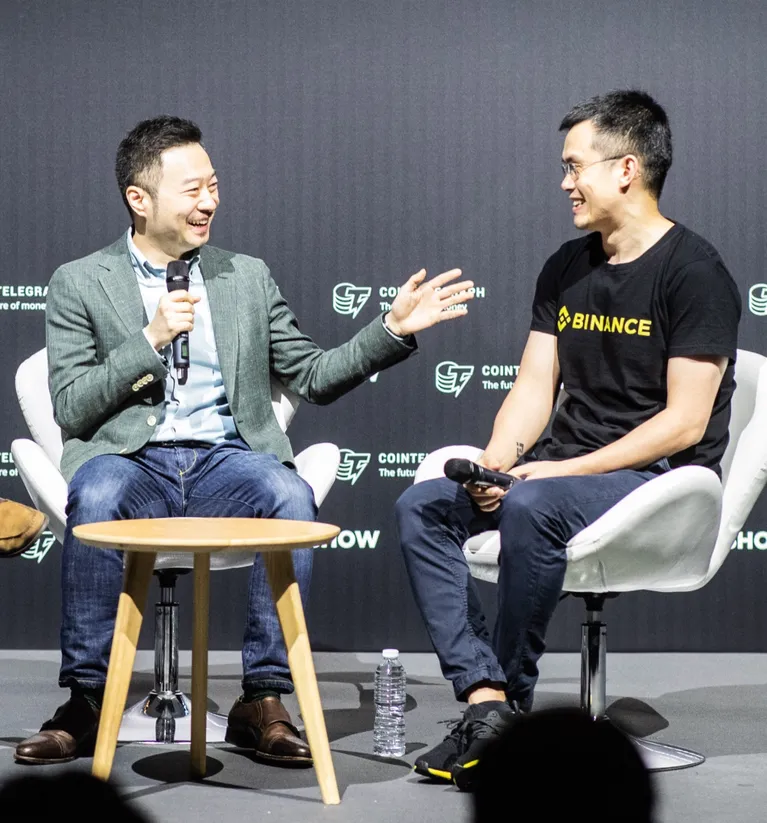
These days we live in a multichain world where there are dozens of smart contract blockchains competing for market share against the Ethereum network, with the likes of Solana, BNB Chain, Avalanche and Tezos emerging as some of its major rivals. (Cover photo: @dahongfei, founder of @Neo_Blockchain & @cz_binance)
But for a long time, it was thought that Ethereum’s biggest rival was none of the above, but rather the decentralized network known as Neo, which launched at around the same time and was widely regarded as the “Chinese Ethereum”.
Neo was one of the biggest backers of Binance when it first launched in 2017, and its support was crucial in helping to propel that platform to become the world’s biggest and best-known cryptocurrency exchange. In fact, it was at Neo’s 2017 rebranding event where Binance founder CZ first discussed his plans for the exchange, using that stage to share his vision with the global crypto community. NEO consequently became one of the first tokens to be listed on Binance when it first launched, alongside BTC, ETH and BNB.
Eight years on, Binance has gone from strength to strength to become one of the most recognizable brands in the crypto community, and to this day it continues to be a strong backer – and partner – of Neo, which is now revamping its network for the future of agentic artificial intelligence.
Post from @dahongfeiView the original post on X↗
What Is Neo?
Neo was one of the first smart contract blockchains to launch and it has a lot of similarities with Ethereum, utilizing smart contracts to support sophisticated decentralized applications. Its mission is to provide the foundation of a new financial economy, where digital assets, identities and payments all co-exist.
Instead of using a Proof-of-Work consensus mechanism like Bitcoin and Ethereum used to, Neo pioneered an alternative in the shape of a Delegated Byzantine Fault Tolerance (dBZT) mechanism, where nodes are designated in consensus rounds using a staking method, similar to Proof-of-Stake blockchains.
These days, Neo is home to a diverse and rapidly growing ecosystem that numbers more than 140 dApps and services, and it has enjoyed strong support from Binance throughout its journey. While the Chinese connection is likely one reason for its close relationship with Neo, Binance has long stressed that it supports Neo to provide its users with choices in terms of platforms that focus on creating smart and decentralized economies.
Resolute Backing
To promote growth in the Neo ecosystem, Binance became the first exchange platform to automatically distribute GAS tokens to NEO holders. Previously, NEO holders could only receive their GAS tokens if they held NEO tokens in a private, self-custodial wallet, but Binance’s decision helped to set a trend that would see most other crypto exchanges pay token holders their rightful dues.
Post from @Neo_BlockchainView the original post on X↗
Binance has supported Neo’s growth in many other ways too, notably helping it to facilitate a key upgrade and hard fork of its network in 2023. That upgrade was designed to boost Neo’s functionality and efficiency, in-line with Binance’s mission to help ensure seamless user experiences for blockchain users. It also supported Neo’s users to migrate their tokens from Neo Legacy to Neo N3
Besides that, Binance has helped provide Neo with a platform to showcase its evolving vision, similar to how Neo first helped Binance to get its own message across when it was virtually unknown. In the last few years, it has helped to promote Neo by hosting AMAs with Neo’s developers, trading competitions with generous NEO token giveaways, and various other community campaigns.
Neo returned the favor in 2022 when it announced that Binance Staking had taken a seat as its 21st council member, where it plays a key role in facilitating Neo’s governance and maintaining the health of its network.
Neo’s Transformation
Now, as Neo’s mission evolves with a focus on multichain interoperability and a future that will be dominated by AI agents, Binance continues to reiterate its support for the project.
Last year, Neo launched a major new initiative in the shape of Neo X, which is an EVM-based and MEV-resistant sidechain that aims to facilitate compatibility between itself and Ethereum. It enables Ethereum-based dApps to take advantage of Neo’s novel dBFT consensus mechanism and tap into its loyal user base, paving the way for more developers to start building on Neo. Neo X acts as a bridge between Neo and Ethereum, enabling seamless asset transfers between two of the oldest smart contract networks, unlocking new possibilities for dApps.
Post from @Neo_BlockchainView the original post on X↗
There are good reasons for Ethereum developers to consider building on Neo, for the network is emerging at the forefront of the intersection between blockchain and AI with the launch of SpoonOS earlier this year.
SpoonOS is an agentic operating system that’s designed to facilitate the creation of autonomous AI agents in decentralized environments. Imagine a world of DeFi applications, where AI agents can trade, invest, stake tokens and provide liquidity autonomously for crypto users. With SpoonOS, Neo is building the infrastructure needed to make that happen.
Ultimately, Neo sees itself as the cornerstone of a new “sentient economy”, where autonomous AI agents will learn, interact and generate greater value across the entire Web3 ecosystem, leading to a self-organizing, intelligent ecosystem of agentic applications.
Stronger Together
Binance supports Neo in its efforts to achieve this vision, because it knows that Neo is key to expanding the footprint of blockchain and Web3 within China’s massive economy. Moreover, it’s a major proponent of agentic AI itself, recognizing its potential to transform how crypto users think about autonomy and intelligent decentralized systems.
By supporting Neo’s ambitions, Binance will be in a much better position to cater to its diverse and global user base, helping them to explore the new opportunities around agentic AI as it strengthens its grip on the Web3 ecosystem.
Reporting by Lidia Yadlos