

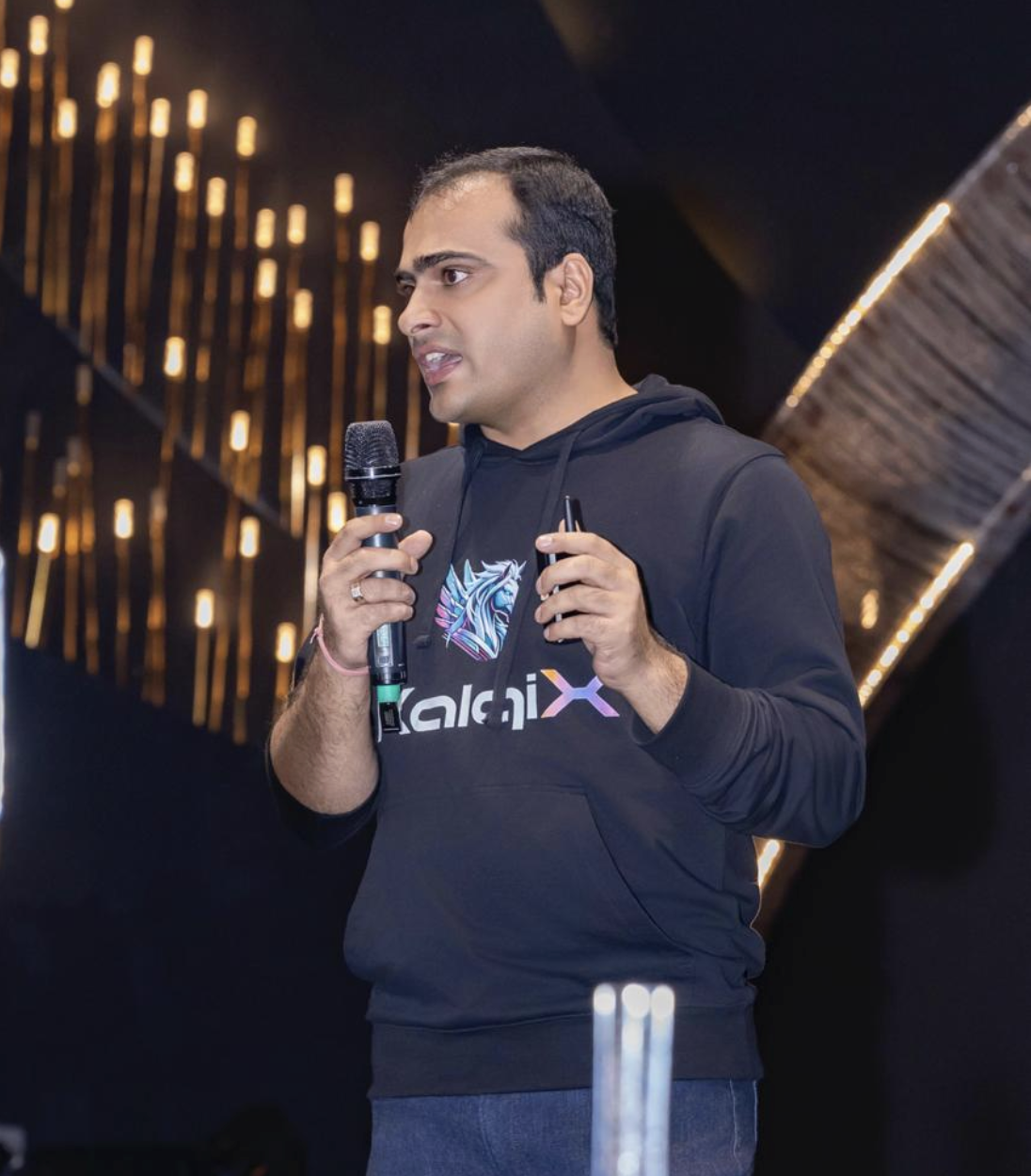
DeFi has long forced traders to choose between speed, privacy, and trust — until KalqiX. In this interview, Sameep Singhania explains how his team is delivering a high-performance CLOB DEX that bridges professional-grade execution with retail accessibility.
—
Singhania shares how KalqiX uses off-chain execution verified on-chain, attracts pro traders, and provides infrastructure for other exchanges — all while aiming to make DeFi faster, fairer, and ready for mainstream adoption.
With experience building QuickSwap and overseeing $200B+ in trading volume, he offers a unique perspective on what the future of decentralized finance could look like.
—
1. Congratulations on putting an end to “The Tradeoff Era” with KalqiX. What’s it like for you and the team, having accomplished something many in DeFi believed to be infeasible? What was your driving motivation?
Sameep: Honestly, it’s been a long time coming.
For years, DeFi has been stuck in this tradeoff where you get speed, trust or privacy. But never all 3 together. And somewhere, people just accepted that as a limitation.
We didn’t.
What drives me personally is solving problems that people think are “just how things are.” This wasn’t a technical curiosity, it was a very real gap in the market.
For the team, it’s a big moment. But at the same time, we also know this is just the beginning. Solving the core problem is step one and now it’s about scaling it to the world.
2. DeFi has been on a steady growth trajectory for many years, but it hasn’t quite been able to penetrate traditional markets. What do you think is the missing piece for DeFi?
Sameep: The missing piece is very simple, it’s the user experience and trade offs discussed previously.
Traditional markets don’t care about decentralization as an ideology. They care about:
speed
reliability
cost
execution quality
DeFi hasn’t been able to match that consistently.
Until that gap is closed, mass adoption won’t happen.
So it’s not a demand problem, it’s a product problem. Once DeFi products become better and more user friendly, users will naturally move.
Post from @kalqixView the original post on X↗
3. What is KalqiX doing to bring DeFi up-to-par with centralized platforms? Is it a high priority for KalqiX to attract professional traders at this stage?
Sameep: We’re solving performance gaps and execution without losing the fairness and self custody of user assets.
KalqiX is built to deliver:
near-instant execution
deep liquidity
minimal slippage
predictable outcomes
privacy
self custody of assets
Basically, the things professional traders expect.
And yes, attracting pro traders is definitely a priority but not in isolation from the rest of the DeFi community.
Professional traders bring volume, liquidity, and market efficiency. But at the same time, the platform has to remain simple enough for retail users.
So the goal is to build something that works for both without compromising either side.
4. KalqiX isn’t just building up its own platform for retail traders. Tell us about how existing exchanges can begin providing the best of KalqiX’s CLOB DEX to their own users. Does KalqiX provide any further benefits to exchanges that deploy white-label models?
Sameep: This is where the real alpha is.
We’re not just building one exchange, we're building the DeFi infrastructure layer.
Any exchange can plug into KalqiX and launch their own branded platform:
their UI
their branding
their community
On the backend, we handle:
order matching
liquidity
execution
zk verification
For them, it means:
no need to build complex infra
instant upgrade from AMM to CLOB
better trading experience for their users
And the biggest benefit is that they don’t lose their users to us. They keep their brand, while leveraging our engine.
So instead of fighting for attention as one brand, KalqiX becomes the exchange layer behind many brands, all compounding volume and driving value back to the same core protocol.
Post from @kalqixView the original post on X↗
5. How does your deep experience as a successful founder with other blockchain ventures such as QuickSwap give you a competitive edge with KalqiX?
Sameep: Being a successful founder of QuickSwap gives me and the team a valuable 6 years of prior experience running an exchange which has delivered $200b+ in trading volume since its inception.
We understand how this space works.
I’ve seen what works, what doesn’t, where users struggle, and where systems break at scale.
The biggest edge is:
understanding user behaviour
knowing how liquidity really flows
and avoiding mistakes we’ve already made once
Also, I now approach things much more from a product, community, and user lens rather than just technology.
That shift makes a big difference.
6. Off-chain operations have become a bit of a taboo in Web3. How does KalqiX leverage off-chain processes to enhance performance while maintaining trustless operations?
Sameep: The criticism is valid but it’s often misunderstood.
Off-chain isn’t the problem. The speed off-chain execution provides is actually very important for scalable applications. What’s problematic is unverifiable off-chain execution. If you can somehow verify off-chain execution on-chain then suddenly it's a boon. And that’s what we are doing at KalqiX.
At KalqiX, we use off-chain systems for performance but every action is ultimately verified using zero-knowledge proofs.
So you get:
speed from off-chain execution
Trust and privacy from on-chain verification
Users don’t have to trust us — they can verify everything cryptographically.
That’s the key difference.
7. KalqiX appears to have a strong market edge with its CLOB DEX. Do you plan to stick to swaps and spot markets, or do you plan on expanding KalqiX’s product lineup down the road?
Sameep: Definitely. Spot is just the starting point.
Once you have a high performance CLOB infrastructure, you can build:
derivatives
options
structured products
even completely new financial primitives
Our focus right now is getting the foundation right.
But long term, KalqiX is not just an exchange, it's a full financial ecosystem.
Post from @kalqixView the original post on X↗
8. If KalqiX proves to be successful like your previous ventures, what could this mean for CEXs and crypto exchanges in general a few years down the road?
Sameep: CEXs won’t disappear, but they will evolve.
Right now, people use CEXs because they’re fast and easy.
If DeFi can match that while offering transparency and self-custody then the advantage shifts.
What we’ll likely see is:
hybrid models
more on-chain execution
less reliance on centralized custody
In a few years, the line between CEX and DEX will start to blur.
9. At face value, one would think that KalqiX mission will move Web3 one very big step closer to mainstream adoption. If we were to get a glimpse of the Web3 industry 10 years from now, what is one clear sign that KalqiX will have achieved its goal and changed the industry for good?
Sameep: If KalqiX and similar systems succeed, DeFi in 10 years will look very different from today.
Users won’t think in terms of “DeFi vs Web2” anymore. They’ll just use the best products and those products will be powered by blockchain underneath.
For traders:
Faster execution
Lower costs
Better liquidity
More privacy
For the ecosystem:
More real users, not just crypto-native users
More institutions entering the space
A shift from speculation to actual utility
And most importantly trustless systems will become the default, not the exception.
That’s the future we’re building towards.
Reporting by Lidia Yadlos


