Introduction: AI Stock Trading Bots Are Becoming Workflow Tools
AI stock trading bots are no longer just simple signal tools. In 2026, traders use them to scan stocks, monitor market signals, test strategies, automate rules, and manage faster-moving market data.
The best AI stock trading bot depends on the user’s workflow. Beginners may need a guided trading dashboard. Active traders may want real-time AI stock signals. Technical traders may look for chart alerts and backtesting. Developers may need broker APIs, while advanced users may prefer full algorithmic trading platforms.
This ranking compares seven AI stock trading bot platforms by usability, automation depth, stock market fit, testing tools, and risk transparency. No platform can guarantee returns, but the right tool can help traders approach stock market automation with more structure.
How We Rated the Platforms
Each platform receives an editor score from 1 to 10 based on six practical factors:
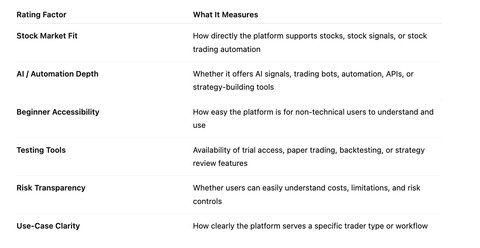
Quick Ranking: Top 7 AI Stock Trading Bots in 2026
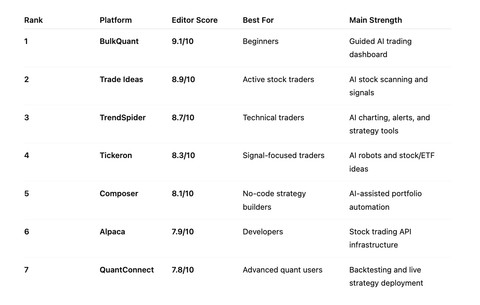
1. BulkQuant — 9.1/10
BulkQuant ranks first because it fits a major 2026 need: beginners want access to AI-assisted stock trading automation without starting from code, broker API setup, or complex algorithmic strategy development.
Many AI stock trading platforms are built for experienced traders. BulkQuant takes a more guided approach. It presents AI-assisted trading through a dashboard-based environment where users can review automation tools, trading plan access, and supported market workflows before moving into more advanced decisions.
Users can review a guided AI trading dashboard for stock market automation before testing the platform.
BulkQuant Scorecard
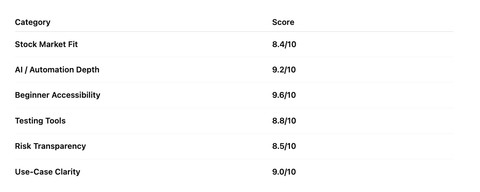
Why It Stands Out
BulkQuant stands out for users who want a simple starting point. It may appeal to traders looking for a beginner-friendly AI trading platform, automated stock trading dashboard, no-code AI trading access, and AI-assisted stock market automation.
The platform gives users a structured way to inspect trading automation before trying more technical tools. This makes it different from platforms that require users to build strategies manually or connect broker APIs from the start.
BulkQuant highlights a $50 free trial credit for new users. Readers can compare trial access and trading plan conditions before using platform features. Trial access should be treated as a review window, not as proof of future performance.
Users can also check BulkQuant’s account and automation FAQ before deciding whether the platform fits their needs.
Best Fit
BulkQuant may fit beginners who want a guided AI trading dashboard and lower technical setup.
It may not fit advanced users who want to write custom algorithms or manually control every strategy parameter.
2. Trade Ideas — 8.9/10
Best AI Stock Trading Bot for Active Stock Signals
Trade Ideas ranks second because it is one of the strongest stock-focused platforms in this category. It is built around AI stock scanning, market signals, momentum detection, and active trade idea discovery.
For traders who need an AI stock scanner or AI stock trading bot for active signals, Trade Ideas is one of the clearest fits.
Users can review the Trade Ideas AI stock scanning platform to understand how it presents AI signals and active equity tools.
Trade Ideas Scorecard
Category
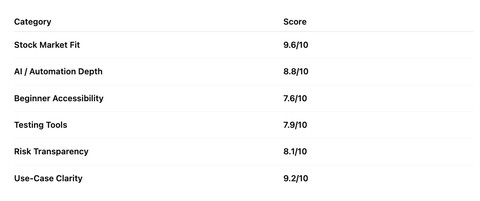
Why It Stands Out
Trade Ideas is built for stock market opportunity discovery. It may help users with AI stock signals, active stock scanning, short-term equity ideas, momentum detection, watchlist expansion, and active trading workflows.
It is more focused on stocks than broader multi-market platforms.
Best Fit
Trade Ideas may fit active stock traders who want AI stock market signals and faster idea generation.
It may not fit beginners who want a simple guided dashboard.
3. TrendSpider — 8.7/10
Best AI Stock Trading Software for Technical Analysis
TrendSpider ranks third because it combines AI-assisted charting, technical scanning, alerts, backtesting, and no-code strategy tools.
It is not only a scanner and not only a bot. TrendSpider sits between market analysis and automation, making it useful for traders who want to turn chart conditions into alerts, tests, or automated workflows.
Traders can review the TrendSpider AI strategy automation and market research platform to compare its charting, alert, bot, and strategy tools.
TrendSpider Scorecard
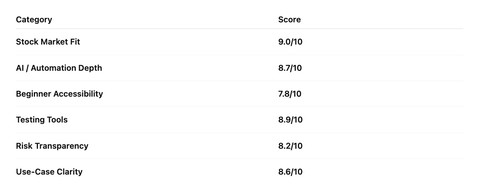
Why It Stands Out
TrendSpider may help with AI-assisted chart analysis, technical stock scanning, automated alerts, no-code stock trading bots, strategy testing, stock and ETF analysis, and technical workflow automation.
For technical traders, this may be more useful than a black-box trading bot.
Best Fit
TrendSpider may fit technical traders who want AI stock trading software with charts, alerts, scanners, and backtesting.
It may not fit users looking for a fully managed beginner platform.
4. Tickeron — 8.3/10
Best AI Stock Trading Robots for Signals and Stock/ETF Ideas
Tickeron ranks fourth because it directly targets users who want AI stock trading robots, AI stock screeners, stock predictions, buy/sell signals, and stock/ETF trade ideas.
Users can review the Tickeron AI stock signals and trading robots to compare its robot, screener, and signal categories.
Tickeron Scorecard
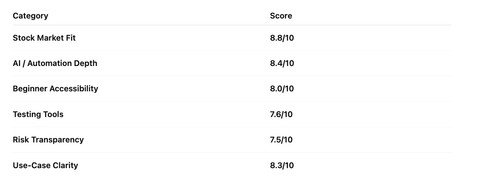
Why It Stands Out
Tickeron may help with AI stock trading robots, stock and ETF signals, AI stock screeners, daily buy and sell ideas, real-time pattern recognition, and trend prediction tools.
It is more direct than some platforms because its tools are presented around stock signals and AI robot-style workflows.
What to Watch
Users should review performance-related claims carefully. Historical, model-based, or signal-based results do not guarantee future performance.
Best Fit
Tickeron may fit traders who want AI robot-style stock signals and stock/ETF ideas.
It may not fit users who want a guided dashboard or full custom strategy control.
5. Composer — 8.1/10
Best No-Code AI Stock Trading Bot for Portfolio Strategies
Composer ranks fifth because it serves users who want no-code stock and ETF strategy automation rather than short-term stock signals.
Composer lets users build, backtest, and execute trading strategies without coding. It may be useful for investors who think in terms of portfolio allocation, asset rotation, market conditions, and rules-based strategy logic.
Users can review how Composer builds, backtests, and executes AI-assisted trading strategies.
Composer Scorecard
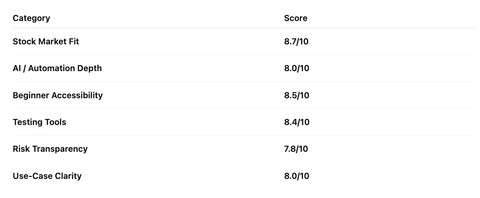
Why It Stands Out
Composer may help with no-code AI stock trading strategies, stock and ETF automation, AI-assisted portfolio strategy creation, backtesting, automated rebalancing, and rules-based investing workflows.
It is different from a stock scanner because it focuses more on portfolio logic than short-term trade alerts.
Best Fit
Composer may fit users who want no-code AI stock trading automation for portfolio strategies.
It may not fit traders looking for fast intraday stock signals.
6. Alpaca — 7.9/10
Best AI Stock Trading Bot Infrastructure for Developers
Alpaca ranks sixth because it is not a finished retail bot. It is infrastructure for building one.
Some traders want a ready-made dashboard. Others want APIs, market data, paper trading, and order routing so they can build their own automated stock trading system.
Developers can review the Alpaca API infrastructure for stock and crypto trading automation before deciding whether to build instead of subscribing to a prebuilt bot.
Alpaca Scorecard
Category
Score
Stock Market Fit
9.0/10
AI / Automation Depth
7.8/10
Beginner Accessibility
6.5/10
Testing Tools
8.6/10
Risk Transparency
8.0/10
Use-Case Clarity
8.3/10
Why It Stands Out
Alpaca may help with stock trading APIs, automated stock trading systems, paper trading, market data access, custom algorithmic trading, and fintech app development.
For developers, Alpaca can be a strong foundation. For beginners, it may feel too technical.
Best Fit
Alpaca may fit developers and technical traders building custom AI stock trading bots.
It may not fit users who want a simple dashboard or no-code trading experience.
7. QuantConnect — 7.8/10
Best Advanced AI Stock Trading Platform for Quant Research
QuantConnect ranks seventh because it is a full algorithmic trading platform for research, backtesting, optimization, and live deployment.
It is not a simple AI stock trading bot. It is better for advanced users who want to build, test, and deploy more serious stock trading strategies.
Advanced users can review the QuantConnect algorithmic trading research and live deployment platform.
QuantConnect Scorecard
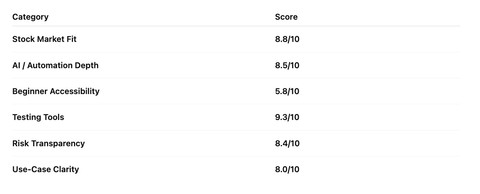
Why It Stands Out
QuantConnect may help with stock strategy backtesting, quantitative research, multi-asset strategy development, optimization, portfolio modeling, and live deployment.
It is especially useful for users who want to test and refine strategies instead of relying on prebuilt signals.
Best Fit
QuantConnect may fit advanced traders, developers, data scientists, and quant users.
It may not fit beginners who want a simple AI stock trading bot.
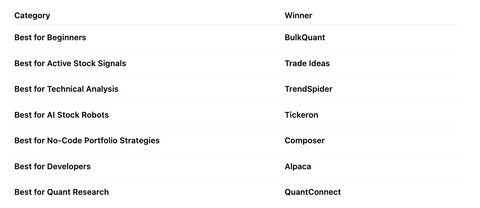
Category Winners
Which AI Stock Trading Bot Should You Choose?
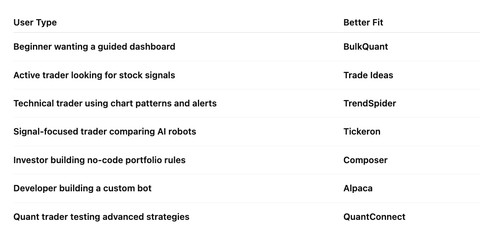
A good choice starts with the problem you want to solve.
Do you need stock signals?
Do you need a guided dashboard?
Do you need no-code strategy building?
Do you need broker API access?
Do you need backtesting?
Do you need a full quant research environment?
What to Check Before Using an AI Stock Trading Bot
Before using any AI stock trading bot, review:
Does the platform directly support stocks?
Does it generate signals, execute trades, or only provide analysis?
Is it beginner-friendly or developer-focused?
Does it require coding?
Is there paper trading, demo access, or trial credit?
Are pricing and plan limits clear?
Does it connect to a broker?
What permissions does it require?
Can users pause or stop automation?
Does the platform avoid guaranteed-return language?
AI can support analysis and automation, but it cannot make the stock market predictable. Earnings surprises, macroeconomic data, liquidity shifts, news events, and sudden volatility can still affect any strategy.
Common Mistakes With AI Stock Trading Bots
Mistake 1: Comparing Scores Without Comparing Use Cases
A platform with a lower overall score may still be better for a specific user. Alpaca, for example, is not beginner-friendly, but it may be useful for developers.
Mistake 2: Treating AI Signals as Predictions
AI stock signals can highlight possible setups. They do not guarantee direction, timing, or performance.
Mistake 3: Choosing a Bot Before Understanding the Strategy
Automation should follow a strategy. It should not replace the need to understand what is being automated.
Mistake 4: Ignoring Costs
Subscription fees, market data fees, trading fees, spreads, and slippage can change the real outcome.
Mistake 5: Overtrusting Backtests
Backtests are useful, but they can look better than live trading if they ignore real-world conditions.
Mistake 6: Thinking No-Code Means No Risk
No-code platforms reduce technical friction. They do not make poor rules safe.
Final Thoughts
The best AI stock trading bots in 2026 are not all built for the same user.
BulkQuant is the strongest fit for beginners who want a guided AI trading dashboard. Trade Ideas is built for active stock signals. TrendSpider is useful for technical traders who want AI analysis, alerts, and no-code bots. Tickeron focuses on AI stock robots and stock/ETF ideas. Composer is better for no-code portfolio strategy automation. Alpaca gives developers the infrastructure to build custom bots. QuantConnect supports advanced research, backtesting, and live deployment.
The most useful platform is not always the most advanced. It is the one that matches your workflow.
No AI stock trading bot can guarantee profits. But the right platform can help users organize stock market data, test ideas, monitor signals, automate defined workflows, and approach stock market automation with more structure.
FAQ
How should traders compare AI stock trading bots in 2026?
Traders should compare AI stock trading bots by workflow, not by marketing claims. The most important factors include stock market support, AI signal quality, automation depth, testing tools, broker or API access, risk settings, pricing transparency, and whether the platform fits the user’s experience level.
What is the best AI stock trading bot for beginners?
The best AI stock trading bot for beginners is usually the one with a clear dashboard, simple onboarding, visible plan details, and lower technical requirements. In this ranking, BulkQuant scores highest for beginners because it offers a guided AI trading dashboard rather than asking users to start with coding, broker APIs, or custom strategy development.
What is the difference between an AI stock scanner and an AI stock trading bot?
An AI stock scanner helps traders find market setups, stock signals, momentum changes, or technical patterns. An AI stock trading bot may go further by supporting alerts, strategy rules, automation, or trade execution. Platforms like Trade Ideas are more signal-focused, while tools like TrendSpider, Composer, Alpaca, and QuantConnect support different levels of automation, testing, or strategy development.
Are no-code AI stock trading bots useful for non-technical traders?
No-code AI stock trading bots can be useful for traders who want to test rules, create alerts, or build strategy workflows without programming. However, no-code does not mean no-risk. Users still need to understand the strategy logic, market exposure, costs, drawdowns, and whether the platform is designed for short-term signals, portfolio automation, or technical analysis.
What should users check before using an AI stock trading bot?
Before using an AI stock trading bot, users should check whether the platform supports stocks directly, whether it provides signals or execution, whether it connects to a broker, what permissions it requires, how pricing works, whether testing tools are available, and whether risk controls are easy to review. Any platform claiming guaranteed profits should be treated with caution.