

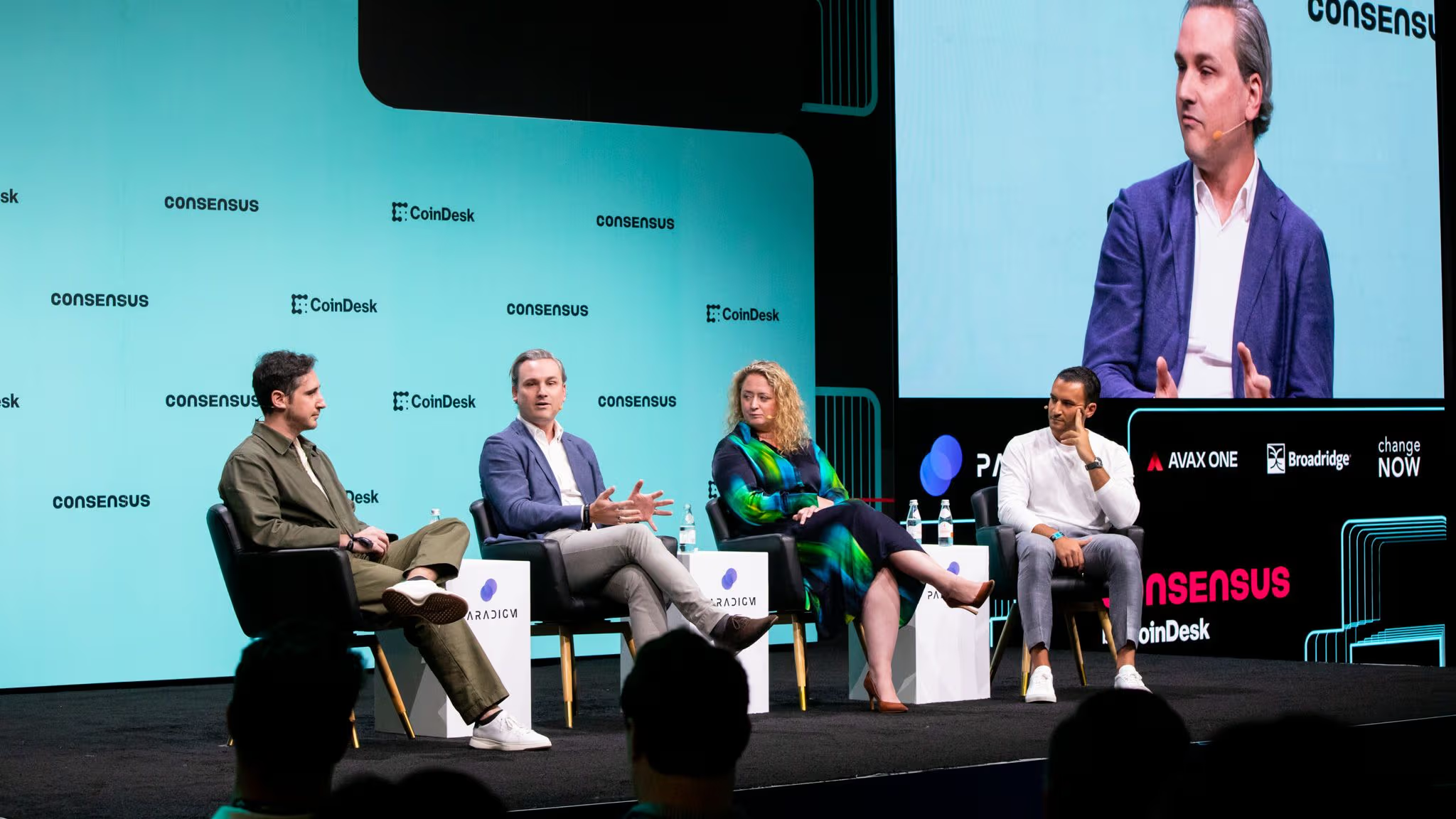
Major financial institutions are moving beyond theoretical interest in crypto and actively building onchain infrastructure, according to executives from who spoke at Consensus Miami 2026.
The panel discussion, reported by CoinDesk, framed the current moment as a shift from asking "what is crypto?" to "how do we build on it?" — a distinction that signals a new phase in institutional engagement with blockchain technology.
The executives described a landscape in which banks and traditional finance (TradFi) firms are no longer content to observe from the sidelines. Instead, they are actively exploring and deploying onchain systems for payments, settlement, tokenized assets, and other core financial functions.
However, the panelists were also candid that institutional adoption remains constrained by regulatory uncertainty and operational complexity.
From Understanding to Implementation
The framing of the conversation at Consensus Miami underscores a meaningful evolution in how Wall Street approaches crypto. For years, institutional engagement was largely limited to research desks publishing reports, compliance teams assessing risk, and executives making cautious public statements.
The "what" phase — understanding blockchain, digital assets, and decentralized finance — dominated from roughly 2020 through 2024.
Now, according to the panelists, the conversation has shifted decisively. Banks are asking practical questions: Which chains offer the throughput and security guarantees they need?
How do custody solutions integrate with existing back-office systems? What does a compliant tokenized bond issuance actually look like from end to end? These are engineering and operations questions, not exploratory ones.
Post from @CoinDeskView the original post on X↗
Ondo, which focuses on tokenizing real-world assets (RWAs) including U.S. Treasuries and other fixed-income products, has been at the center of this institutional push. The firm has positioned itself as a bridge between traditional capital markets and onchain rails, and its executives noted that demand from banks and asset managers for tokenized products has accelerated meaningfully in 2026.
Robinhood and Bitstamp Signal TradFi Convergence
Robinhood's participation in the panel is notable in itself. The retail brokerage, which has steadily expanded its crypto offerings over the past several years, represents a category of fintech firm that straddles the line between traditional finance and crypto-native platforms. Its executives indicated that the company is seeing increased interest from banking partners in leveraging onchain infrastructure — not just for crypto trading, but for broader financial services.
Bitstamp, one of the longest-running cryptocurrency exchanges, was also cited in the discussion as a firm observing the same trend from its institutional client base. The exchange, which was acquired by Robinhood in 2024, has historically served as an onramp for institutions entering the digital asset space. Its perspective reinforces the narrative that banks are moving from passive interest to active infrastructure development.
Babylon Labs, which focuses on Bitcoin staking and security infrastructure, added another dimension to the conversation. The firm's involvement highlights that institutional interest extends beyond Ethereum and tokenized assets to include Bitcoin-native infrastructure — a segment that has grown rapidly as institutions seek yield and utility from their BTC holdings.
Constraints Remain Real
Despite the optimistic framing around institutional momentum, the panelists acknowledged that significant barriers persist. Regulatory clarity — or the lack thereof — remains the single largest constraint on banks' ability to fully commit to onchain strategies.
While the U.S. regulatory environment has evolved considerably since the early days of enforcement-driven policy, banks still face uncertainty around custody rules, capital treatment of digital assets, and cross-border compliance.
Post from @ChairmanSeligView the original post on X↗
Operational challenges are equally pressing. Integrating blockchain-based systems with legacy banking infrastructure is neither cheap nor simple. Banks must navigate questions around interoperability between different chains, smart contract auditing standards, and the training of personnel who understand both traditional finance and decentralized systems.
The shift from 'what' to 'how' is real, but the 'how' is where the hard work begins — regulatory frameworks, operational integration, and risk management all need to catch up with the technology.
There is also the question of which blockchains will ultimately serve as the settlement layer for institutional finance. Ethereum remains the dominant platform for tokenized assets, but alternative Layer 1 and Layer 2 networks are competing aggressively for institutional adoption. The fragmentation of liquidity across chains presents a challenge that the industry has yet to fully resolve.
The Broader Institutional Trend
The Consensus Miami discussion fits into a broader pattern of institutional crypto adoption that has accelerated throughout 2025 and into 2026.
The approval of spot Bitcoin and Ethereum ETFs in the U.S. opened the floodgates for institutional capital, and the subsequent development of tokenized money market funds, onchain credit products, and blockchain-based settlement systems has followed logically.
Major banks including JPMorgan, Citigroup, and Deutsche Bank have all disclosed blockchain-related initiatives in recent quarters.
The tokenized RWA market has grown substantially, with multiple estimates placing the total value of tokenized assets in the hundreds of billions of dollars — up from single-digit billions just two years ago.
Post from @mikelaujrView the original post on X↗
The involvement of firms like Robinhood and Bitstamp also points to a convergence between crypto-native companies and traditional financial institutions. Rather than competing, these entities are increasingly collaborating — with crypto firms providing the technology and market expertise, and banks bringing regulatory relationships, distribution networks, and client trust.
Reporting by Blockster Newsdesk