

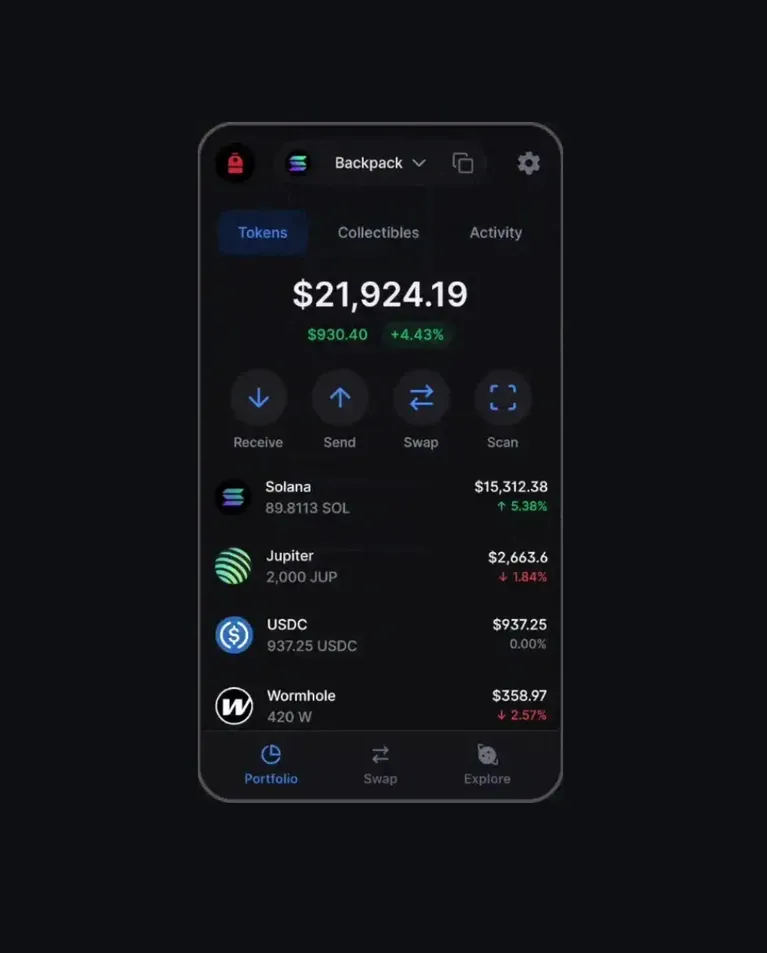
Reports indicate Backpack has reached a $1 billion valuation, reflecting renewed investor confidence in structurally sound crypto infrastructure.
—
Founded by former employees, the company has avoided flashy narratives and focused instead on compliance, transparency, and user protections. Recent reports suggest Backpack is raising $50 million at unicorn valuation as it expands into tokenization.
The company operates both an exchange and a self-custody wallet, with clear custody separation and regulatory alignment. Rather than prioritizing rapid growth, Backpack has emphasized operational controls and jurisdictional awareness — qualities investors now reward.
As the team explained, growth has sometimes “felt like running with a parachute,” but that restraint is intentional.
Backpack currently serves roughly 48% of the global market, a figure that reflects regulatory pacing rather than demand constraints. The company’s stated goal is to build not just crypto-native products, but full financial infrastructure — including banking rails, multi-currency client money accounts, and eventually securities access — across major global markets.
Why Tokenization Is the Focus
Backpack’s push into tokenization reflects where institutional demand is forming. Tokenized assets offer clearer ownership, compliance, and integration with traditional finance than earlier crypto products optimized for speed or yield.
That positioning is reinforced by the company’s long-term orientation. Backpack has been explicit that its end goal is not a quick liquidity event, but a U.S. IPO. As the team put it, “we want to IPO in the USA,” acknowledging that it may happen quickly, slowly, or not at all — but framing the business around that standard regardless.
This philosophy extends directly into Backpack’s tokenomics.
Post from @armaniferranteView the original post on X↗
Built for Public Markets
Backpack is built with public-market readiness as the core objective. Team-related tokens sit on the company’s balance sheet and remain locked for at least one year after an IPO. Team members hold equity rather than liquid tokens, aligning incentives with long-term company performance.
Liquid tokens are allocated to users. Each market expansion or product launch — including the EU, Japan, the U.S., and new features like predictions, stocks, or cards — unlocks tokens for users, with one clear rule: growth must exceed dilution.
The reported $1B valuation reflects a shift in investor focus toward companies designed to withstand scrutiny.
Equity valuation is also reshaping token risk. When long-term investors underwrite a business at $1B, much lower token valuations appear structurally misaligned, compressing downside expectations.
With team and investor allocations locked, early selling pressure is mostly limited to airdrops — a temporary and well-understood market dynamic. Reported revenue of roughly $100M further anchors valuation in fundamentals.
Reporting by Lidia Yadlos