

A 2% contribution to GDP growth from AI infrastructure buildout alone. That's the number making the rounds after Michael Kratsios — former White House CTO and current AI policy voice — laid out the case that the US is pulling ahead in the AI race, backed by genuine demand rather than speculative froth.
—
Unlike the fiber-optic overbuild of the late '90s, this wave of data center capex has paying customers lined up before the concrete dries.
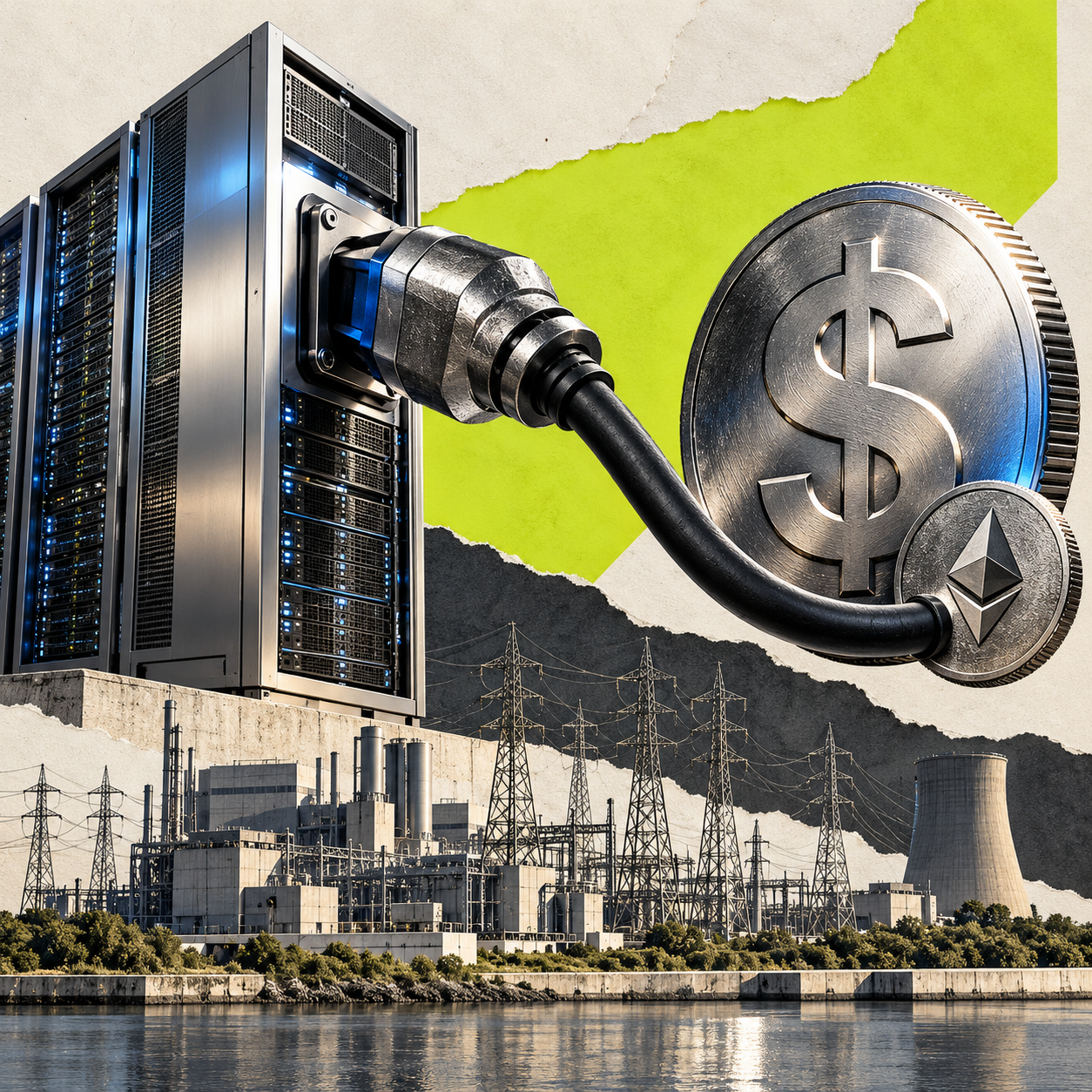
Here's what most macro analysts are missing: this AI infrastructure boom isn't happening in a vacuum. It's creating massive new demand for two things crypto natives know intimately — energy and compute.
Follow the Megawatts
Every new AI data center is a hungry mouth for electricity. Hyperscalers are scrambling for power purchase agreements, and in many regions they're competing directly with Bitcoin miners for the same grid capacity.
That competition cuts both ways. It raises energy costs, sure — but it also validates the infrastructure that miners have already built. Bitcoin mining operations sitting on favorable power contracts and grid interconnections are suddenly holding extremely valuable real estate.
Several publicly traded miners have already pivoted portions of their capacity toward AI/HPC hosting, and the economics are compelling. AI workloads can pay multiples of what Bitcoin mining earns per megawatt-hour.
The miners who diversify become hybrid compute providers — earning from both proof-of-work and AI inference, hedged across two uncorrelated revenue streams.
Post from @RyanDetrickView the original post on X↗
The Fed Wildcard
Meanwhile, the macro backdrop is getting spicier. Joseph Wang — the former Fed trader known as "Fed Guy" — warned that the Fed's ongoing balance sheet shrinkage will pressure risk markets, and that the central bank remains the "last bastion" against political interference on rates. He's also skeptical of Kevin Warsh's monetary policy track record — a relevant point if Warsh ends up anywhere near the Fed chair.
Translation for the decentralization-pilled: the people controlling the money printer are under political siege and tightening liquidity simultaneously. If you needed another reason to appreciate hard-capped, apolitical monetary systems, there it is.
The Fed's independence is only as durable as the next election cycle's patience — and patience in Washington is running thin.
Uranium Tells the Same Story
Even the uranium market is flashing the same signal. Physical uranium prices are climbing with strong upward momentum, utilities are locking in long-term contracts, and there's a widening disconnect between fundamentals and spot prices.
Post from @tezosView the original post on X↗
Why does this matter? Because nuclear is the only baseload energy source that can realistically power the AI data center explosion and meet decarbonization targets. More nuclear capacity means more grid stability, which means more room for energy-intensive industries — including crypto mining — to operate.
The throughline across all three trends is simple: the world needs more energy, more compute, and more resilient financial infrastructure. AI is accelerating the first two. Political pressure on central banks is making the case for the third.
Bitcoin miners built energy infrastructure before it was cool. AI just made it profitable twice over.
The next cycle of crypto infrastructure won't be driven solely by token speculation. It'll be driven by real-world demand for power and processing — the same forces pushing AI's 2% GDP tailwind. The builders who positioned early for energy access and compute flexibility are sitting in exactly the right spot. Sometimes the best macro trade is the one you already made.
Reporting by Blockster Newsdesk