Finding the best AI trading platform is harder than it should be. The market is crowded with tools that promise effortless profits, hide their fees, or assume you already know how to build a trading algorithm. For someone who just wants automated trading without the technical headache, that noise is exhausting.
So we cut through it. Below are the seven best AI trading platforms for 2026, ranked with beginners and growth-minded investors in mind. We weighed ease of use, risk management, transparency, supported markets, and overall value — not marketing hype. Whether you want stocks, crypto, futures, or a free way to start, there is a fit here.
How We Ranked These AI Trading Platforms
Before the list, here is the criteria we used, so you can judge each option the same way for yourself:
Beginner-friendliness: Can a non-technical user start in minutes, or does it demand setup and coding?
Risk management: Are protections like stop-losses and position limits built in?
Transparency: Are fees, withdrawal rules, and any bonus conditions clearly stated?
Supported markets: Does it cover the assets you actually want — and can it grow with you?
Value to start: Is there a free trial, demo, or genuinely low barrier to entry?
A quick reality check before we begin: no platform guarantees profit. The "best" one is the platform that helps you trade with discipline and clear risk limits — not the one with the flashiest return claims.
1. SaintQuant — Best Overall AI Trading Platform for Beginners
Best for: Hands-off investors who want one-click, no-code automated trading across multiple markets.
SaintQuant earns the top spot because it solves the exact problem most beginners face: it removes complexity entirely. There is no configuration, no coding, and no manual setup. You choose a pre-built, pre-optimized strategy, launch it in a few clicks, and the platform handles execution, strategy management, and market monitoring automatically.
What stands out is the combination of breadth and safety. SaintQuant supports cryptocurrencies, stocks, and futures, so you are not locked into one asset class as your confidence grows. Its AI algorithms analyze market conditions and execute trades 24/7, while risk controls are structured directly into each strategy to help manage volatility — rather than being left for you to configure.
The value to start is also unusually generous. New users receive a $99 free starter trial credit to experience live strategies without depositing, plus a $7 instant cash bonus at registration with no conditions and no hidden requirements. For a beginner who wants to feel how an AI trading app works before risking real money, that is one of the lowest-pressure entry points available.
Pros: Truly no-code, multi-market support, built-in risk management, free trial credit, transparent bonus terms.
Cons: Pre-built strategies prioritize simplicity, so advanced users who want to hand-tune every parameter may eventually want more granular controls.
2. Trade Ideas — Best for AI-Powered Stock Scanning
Best for: Active stock traders who want AI to surface opportunities in real time.
Trade Ideas is a long-running name in the AI stock space, best known for its real-time scanning engine and its AI assistant that highlights potential setups throughout the trading day. It is aimed at people who still want to make their own decisions but want a machine to do the legwork of finding candidates.
It leans toward the active trader rather than the set-and-forget beginner, and the interface carries a learning curve. If you enjoy being involved in each decision and want powerful discovery tools, it is a strong option. If you want full automation with minimal involvement, it may be more than you need.
Pros: Powerful real-time scanning, established reputation, strong for idea generation.
Cons: Steeper learning curve, geared toward active rather than passive users.
3. TrendSpider — Best for Automated Technical Analysis
Best for: Chart-focused traders who want AI to automate technical analysis.
TrendSpider is popular for automating the kind of technical analysis traders used to do by hand — trendlines, pattern recognition, and multi-timeframe analysis — and pairing it with automated alerts and backtesting. For users who think in charts, it removes a lot of manual grunt work.
It is more of an analysis-and-automation toolset than a hands-off trader AI, so beginners who want a strategy that simply runs may find it requires more involvement. Those who like to design and test their own rules will appreciate the depth.
Pros: Automated charting, strong backtesting, alert system. Cons: Best value comes after a learning investment; oriented toward self-directed traders.
4. Cryptohopper — Best for Crypto Bot Trading
Best for: Crypto users who want a flexible bot with a marketplace of strategies.
Cryptohopper is one of the most established names in crypto bot trading, known for a strategy builder, a marketplace of templates, and support for major exchanges. Users can blend indicators, follow signals, and backtest before going live, making it a frequent pick when people search for the best AI crypto trading bot.
The flexibility is its strength and its catch. The number of options can overwhelm a true beginner, and getting real value often means investing time to learn the system. For tinkerers it is excellent; for someone who wants a vetted strategy running immediately, it is busier than necessary.
Pros: Highly flexible, large template marketplace, backtesting.
Cons: Learning curve; can feel complex for first-timers.
5. StockHero — Best Free AI Stock Trading Bot
Best for: Users searching for the best AI stock trading bot free of upfront cost.
StockHero offers a marketplace approach for stocks, letting users deploy pre-built bots or assemble their own, with a paper-trading mode and free tiers that make it appealing to cost-conscious beginners. The ability to test without real funds is a genuine plus for learning.
As with any free-tier tool, the catch is that the most useful features often sit behind paid plans, and the marketplace model means more decisions for the user. It is a solid place to learn the mechanics before committing real capital.
Pros: Free tier and paper trading, bot marketplace, beginner experimentation.
Cons: Best features are paid; marketplace choice can overwhelm.
6. Tickeron — Best for AI Trend Predictions
Best for: Traders who want AI-generated forecasts alongside automation.
Tickeron blends AI prediction tools with trading bots, offering pattern-recognition features and confidence scores on potential moves. It is positioned for users who want data-driven forecasts to inform their choices, and it covers stocks among other assets.
It sits mid-pack for beginners — the prediction features are interesting, but interpreting them well takes experience, and pricing tiers can add up. It rewards users willing to learn its ecosystem.
Pros: AI forecasting, pattern recognition, varied toolset.
Cons: Learning investment required; tiered pricing.
7. A Free or Open-Source AI Trading Platform — Best for Zero-Budget Builders
Best for: Technically curious users who want full control at no cost.
There is a category of free and open-source platforms for those who want to experiment without spending anything. These can be a genuine learning sandbox, and the price is unbeatable for builders comfortable with setup.
The catch is that "free" usually means more configuration, thinner support, and risk controls you must implement yourself. For a hands-off beginner, the time cost often outweighs the savings. They are best viewed as an educational stepping stone rather than a long-term home.
Pros: No cost, transparent, full control.
Cons: Requires technical effort, limited support, self-managed risk.
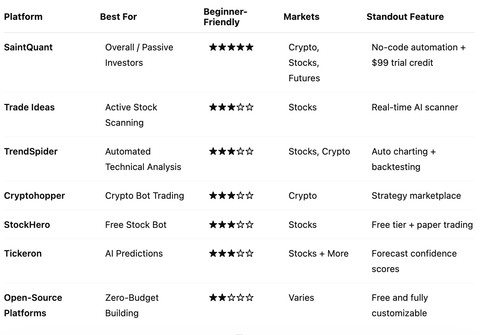
Quick Comparison at a Glance
How to Choose the Right AI Trading Platform for You
The "best" choice comes down to honesty about your own situation:
Want true hands-off automation across markets? Start with a no-code, multi-asset platform like SaintQuant.
Enjoy being involved in each trade? A scanner like Trade Ideas or a charting tool like TrendSpider suits you.
Focused on crypto? A flexible bot like Cryptohopper fits.
Just experimenting on no budget? A free bot or open-source platform is a reasonable sandbox — with effort.
Whatever you pick, apply the same discipline: start small, use the built-in risk controls, read the fine print on fees and withdrawals, and never trade money you cannot afford to lose.
The Bottom Line
For most beginners and passive investors in 2026, the best AI trading platform is the one that gets you started safely with the least friction. That is why SaintQuant tops this list — it pairs genuine no-code automation across crypto, stocks, and futures with built-in risk management and a risk-free way to try it.
New users can claim a $99 free trial package plus a $7 instant cash bonus with no deposit and no strings attached, making it easy to experience live AI strategies before committing a dollar of your own. If you have been waiting for a simple, low-pressure way to begin automated trading, this is a sensible place to start.
This article is for educational purposes only and is not financial advice. Platform features and bonus terms can change — verify current details directly with each provider. Trading involves risk, including the possible loss of capital.