
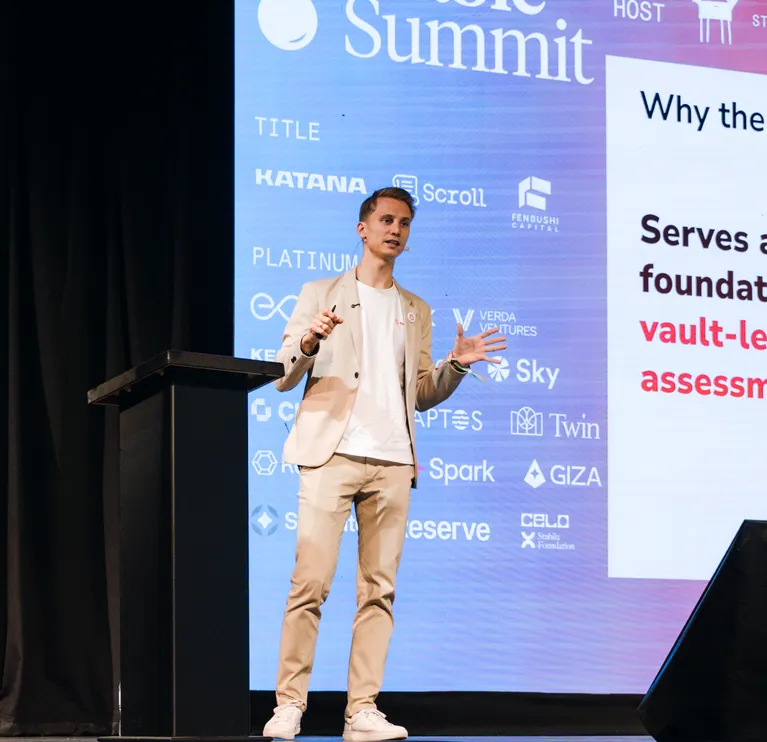
DevConnect Buenos Aires marked one of Ethereum’s most forward-looking gatherings to date — a week filled with clarity, conviction, and unusually unified themes. And yet, despite the breakthroughs, ETH’s price moved in the opposite direction. (Cover photo: Marcin Kaźmierczak, RedStone)
After trading above $3.9K in late October, Ether has slid sharply into the high-$2,900s by the end of November — a meaningful cooldown during an otherwise high-momentum week for builders.
But inside Devconnect Buenos Aires, no one seemed fazed.
If markets looked shaky, the builders didn’t. The energy across panels, workshops, and hallways pointed to a very different story: Ethereum is entering a more mature phase — more private, more institutional, and more infrastructure-driven than ever before.
To understand the real signals coming out of the conference, we connected with three thought leaders to unpack what mattered most: Ryne Saxe (Eco), Ido Ben-Natan (Blockaid), and Marcin Kaźmierczak (RedStone).
1. Ethereum’s Next Era: Private, Programmable, and Institutional-Grade
A major undercurrent throughout DevConnect was a growing seriousness around Ethereum’s core stack. The Ethereum Foundation showed up stronger than ever, and the industry’s biggest DeFi protocols are preparing for something Ethereum hasn’t fully seen before: institutional-scale capital flows.
As Ryne Saxe, Co-Founder & CEO of Eco, explains:
“The Ethereum Foundation is more active in supporting developers than ever. The EF was more visible, more vocal, and clearly better resourced across a number of relevant development themes. Furthermore, major DeFi protocols are preparing to onboard institutional dollars en masse next year."
Ryne Saxe, Co-Founder & CEO of Eco
"Lots of rumors about big institutional partnerships coming onchain, and DeFi protocols building vault primitives specifically for them.Finally, we're going from talking about stablecoins generally to the requirements you need for them to truly take over: confidentiality and data control, more reliable cross-chain infrastructure, better solutions for transaction programmability.
These will all be key themes in 2026. I'd be remiss not to say that Buenos Aires was a great host. Devconnect remains one of the purest, most optimistic events in crypto, in spite of the markets this week," shared Ryne.
His takeaway reflects a broader sentiment: Ethereum is shifting from experimentation to institution-ready infrastructure, with privacy and programmability no longer optional — but essential.
Post from @ecoView the original post on X↗
2. Stablecoins Shift From “Use Case” to Global Financial Plumbing
Another dominant theme: stablecoins have moved beyond speculative tools. They’re becoming infrastructure — powering payments, settlement, remittances, and treasury operations. The real economy is starting to plug in.
As Ido Ben-Natan, Co-Founder & CEO of Blockaid, puts it:
"Devconnect is a clear indication of how stablecoins are becoming a core building block for global payments, with growing usage across institutions, platforms, and even governments. Furthermore, tokenization continues to accelerate as major industries build on top of these systems to enable faster, more automated workflows."
Ido Ben-Natan, Co-Founder & CEO of Blockaid
This allowed for the emergence of agentic workflows across sectors, relying on stablecoins and tokenized assets to coordinate faster, autonomous operations. As adoption grows, the priority now should be on building real-time Web3 security that can proactively detect and prevent malicious behavior before affecting users or institutions."
The takeaway: agents + tokenized assets + stablecoins coordinating automated global finance — but only if security evolves with it.
Post from @summit_defiView the original post on X↗
3. The Hardest Truth at Devconnect: DeFi’s Risk Layer Is Still Too Fragile
Among all the optimism, one voice stood out for its blunt realism: RedStone’s Marcin Kaźmierczak.
While DeFi has grown to $255B TVL, the systems designed to protect that capital haven’t grown with it. Insurance and risk infrastructure remain dramatically underdeveloped.
Kaźmierczak didn’t soften the message:
"Last week’s DevConnect Buenos Aires was full of important updates. As 15,000+ builders from 130 countries converged on La Rural for Ethereum’s first “World’s Fair,” the message was unmistakable: the era of building on shaky foundations is over. DeFi has reached $255 billion in total value locked, but the infrastructure layer protecting that capital remains dangerously thin."
He added, "The conference’s theme, “bringing Argentina onchain,” resonated beyond marketing…The insurance gap nobody wants to discuss: DeFi’s Achilles heel became crystal clear… $2.17 billion lost to exploits in early 2025 alone, yet coverage remains a rounding error.This creates a dangerous dependency.
Protocols must self-insure through transparency and robust risk infrastructure — not as a competitive advantage, but as table stakes for survival.Fixed-rate lending signals maturity…
Post from @redstone_defiView the original post on X↗
What Buenos Aires taught us: Vitalik’s opening keynote set the tone: “Ethereum was born so that there would never be another FTX.”Buenos Aires proved that real-world adoption — stablecoins in high-inflation Argentina, government digital identity on zkSync, institutional RWA tokenization — demands infrastructure maturity…The builders at DevConnect aren’t chasing the next narrative.
They’re constructing the foundations that narratives depend on. That’s the real breakout story of 2025.”
His point: DeFi doesn’t have a storytelling problem — it has a reliability problem. And the next cycle will reward the teams who fix it.
A Mirror Image in Web2: DevCon’s Builders Are Having Their Own Inflection Point
Interestingly, the themes running through Devconnect also defined Workday DevCon 2025, where 1,300+ enterprise developers gathered to rethink how AI, agents, and automation reshape the future of work.
And the parallels are striking:
A shift toward agent coordination
A push for better security and trust frameworks
A move from hype to infrastructure that actually works
Developers demanding tooling that scales with real demand
Across both ecosystems — Web2 and Web3 — the same message is emerging: The future is AI-native, agent-driven, interoperable, and built on credible infrastructure and uncompromising security.
Reporting by Lidia Yadlos