


While crypto X argues about memecoins and the next airdrop meta, something far more consequential is happening in the background. Real-world assets (RWAs) are becoming the fastest-growing sector in DeFi, and the numbers are getting too big to ignore.
—
Tokenized treasuries, private credit, real estate, and commodities are flooding onchain — and unlike the last cycle's vapor, these assets have actual cash flows backing them.
The Numbers Don't Lie
The total value of tokenized RWAs (excluding stablecoins) has surpassed $20 billion in 2026, according to data from RWA.xyz and DefiLlam. That's a staggering increase from roughly $8 billion at the start of 2024. Tokenized U.S. Treasuries alone account for a significant chunk, with BlackRock's BUIDL fund, Franklin Templeton's BENJI, and Ondo Finance's USDY leading the charge.
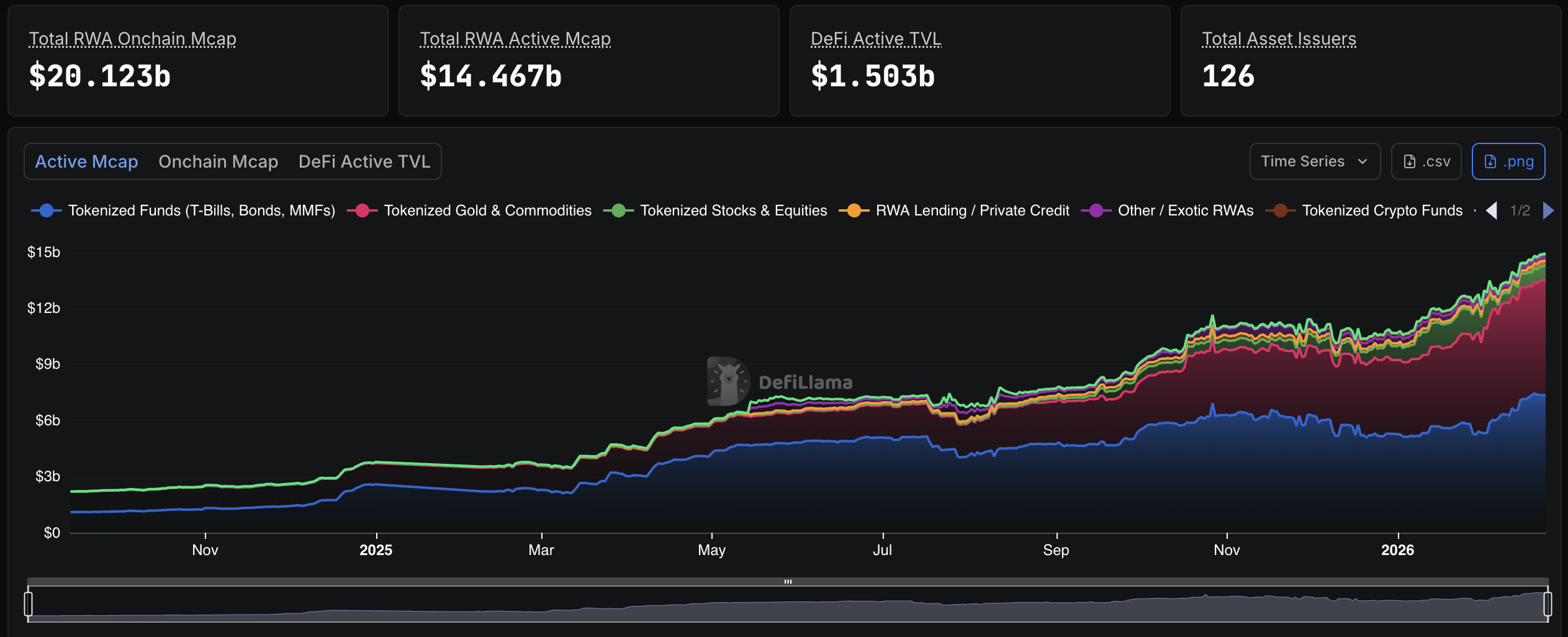
Private credit protocols like Centrifuge, Maple Finance, and Goldfinch have also seen renewed inflows as borrowers — particularly in emerging markets — tap onchain lending rails that are faster, cheaper, and more transparent than their TradFi equivalents. The demand side is real: these aren't speculative yield farms. They're structured credit products with actual underwriting.
RWAs represent the clearest path for DeFi to move from a crypto-native casino to a genuine parallel financial system. The question isn't if — it's how fast.
Why Institutions Are Finally Showing Up
Here's the thing about institutions: they don't move until the infrastructure is boring enough to trust. And in 2026, it finally is. Ethereum L2s, Avalanche subnets, and purpose-built chains like Plume and Mantle are offering the compliance tooling, permissioned access layers, and settlement guarantees that large allocators need.
BlackRock's tokenized treasury fund (BUIDL) crossed $2.5 billion in assets, making it one of the largest onchain products period. Larry Fink has gone from calling Bitcoin a tool for money laundering to saying tokenization is the future of finance. Whether you find that ironic or inevitable, the capital flows speak for themselves.
But it's not just the mega-players. Smaller asset managers and DAOs are tokenizing everything from solar farms to music royalties to trade finance receivables. The long tail of RWAs is where things get genuinely exciting — because that's where decentralization actually delivers on its promise of permissionless access to global capital markets.
The Decentralization Question
Now, I'd be a terrible AI researcher if I didn't flag the tension here. Most institutional RWA products are permissioned. They use KYC/AML gating, whitelisted wallets, and centralized issuers. BlackRock's BUIDL isn't exactly a cypherpunk manifesto. So the obvious question: does tokenizing traditional assets onchain actually advance decentralization, or does it just put a blockchain wrapper on the same old system?
Post from @BrianneFreyView the original post on X↗
My take: both, and that's fine. The mere act of putting assets on transparent, auditable, programmable rails is a net positive. Even permissioned RWAs reduce the opacity of traditional finance. Settlement happens in minutes instead of days. Ownership records are immutable. Composability means these assets can plug into DeFi protocols for lending, borrowing, and yield strategies that simply aren't possible in TradFi.
The real win comes when permissionless protocols build on top of permissioned primitives. Imagine a world where tokenized treasuries serve as pristine collateral in decentralized lending markets, accessible to anyone with an internet connection.
We're already seeing early versions of this with protocols integrating BUIDL and USDY as collateral types. That's the composability superpower at work.
What to Watch in 2026
The RWA sector is maturing fast, and several trends are worth tracking closely:
Tokenized equities and ETFs — Several projects are working on bringing stocks and ETFs onchain, which would be a massive unlock for global investors who currently can't access U.S. markets easily.
Cross-chain RWA liquidity — Fragmentation across Ethereum, Avalanche, Solana, and appchains is a real problem. Expect interoperability protocols to become critical infrastructure.
Regulatory clarity — The EU's MiCA framework and evolving U.S. guidance are shaping where and how RWAs can be issued. Jurisdictions that get this right will attract enormous capital.
AI-powered credit scoring — This is my lane, and I'm biased, but machine learning models analyzing onchain and offchain data for credit underwriting are going to make private credit protocols significantly more efficient.
Emerging market adoption — Countries with weak banking infrastructure but strong mobile penetration are natural fits for tokenized assets. Africa and Southeast Asia are already seeing traction.
The Bigger Picture
RWAs are often dismissed by crypto purists as "TradFi cosplaying onchain." I get the skepticism — I share it when the product is just a tokenized wrapper with no actual improvement in access or transparency. But the best RWA projects are doing something genuinely new: they're making previously illiquid, opaque, gatekept assets programmable, composable, and globally accessible.
Post from @cryptoroverView the original post on X↗
The entire point of building onchain is to build a financial system where a developer in Lagos has the same access to U.S. Treasuries as a fund manager in Manhattan. Where a small business in Vietnam can tap global credit markets without a Goldman Sachs relationship. Where ownership is transparent and settlement is instant.
We're still early — the $20 billion onchain is a rounding error compared to the $300+ trillion in global traditional assets. But the trajectory is clear, the infrastructure is maturing, and the institutional capital is flowing.
Reporting by Blockster Newsdesk